|
|
 |
|
|
Posts Tagged ‘common eider’
Sunday, September 26th, 2010
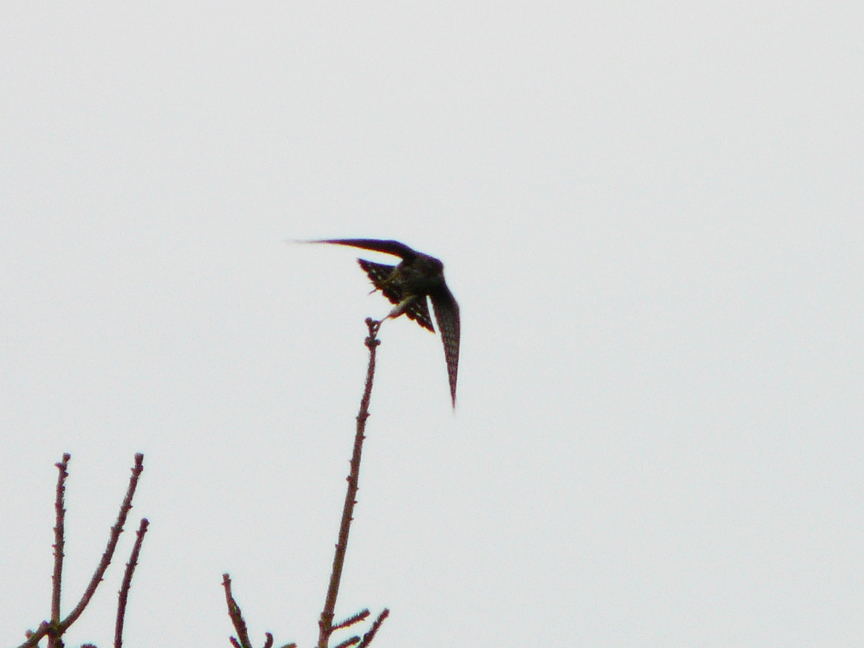 Merlin. The day dawned overcast and much cooler than yesterday. Much cooler. So cool that I was wearing a long-sleeved undershirt, a heavy overshirt, and a hooded sweatshirt as the Elizabeth Ann pulled away from Port Clyde en route to Monhegan.
 Dickcissel. Out in Muscongus Bay, there were herring, black-backed, and laughing gulls, black guillemots, loons, cormorants, and eiders. Also, nearing the island, northern gannets. Saw no seals or whales or harbor porpoises, though. No bald eagles. A low blue cloud hung ominously off to the east.
Once arrived, I was soon walking the trails with my birding friends Kristen and Bill, watching merlin after merlin dart swiftly across the overcast. Above Manana Island, a pair of peregrines dipped and veered, alternately chasing gulls and ravens—and possibly diving after huge flocks of goldfinches. Everywhere we looked, in fact, there seemed to be flocks of goldfinches. Remarkable, for sure.
 Red-eyed vireo. But where else can you go on this earth and see merlins and peregrines and kestrels just about every time you scan the sky? Where else and when else? Oh, there probably are place-time combinations that’ll let you see these three species along with gyrfalcons gathering during fall migration. Still, this is the second time I’ve been here in late-September and seen some species of falcon pretty much any time I wanted to. They’re such expert and entertaining flyers. I can’t imagine tiring of this.
In the brush up beyond the lighthouse we saw sparrows and vireos and a dickcissel. White-throated, song, white-crowned, and clay-colored sparrows; red-eyed and Philadelphia vireos. And all this in only my first afternoon, and in less-than-idea weather.
Happy to be here.
 White-crowned sparrow (juvenile). Monhegan List
(Not in order of sighting.)
1. Wood duck
2. Mallard
3. Blue-winged teal
4. Double-crested cormorant
5. American kestrel
6. Merlin
7. Peregrine falcon
8. Herring gull
9. Greater black-backed gull
10. Mourning dove
11. Belted kingfisher
12. Downy woodpecker
13. Northern flicker
14. Philadelphia vireo
15. Red-eyed vireo
16. Blue jay
17. American crow
18. Common raven
19. Black-capped chickadee
20. Red-breasted nuthatch
21. White-breasted nuthatch
22. Hermit thrush
23. Brown thrasher
24. Cedar waxwing
25. Yellow-rumped warbler
26. Clay-colored sparrow
27. Song sparrow
28. White-throated sparrow
29. White-crowned sparrow
30. Dark-eyed junco
31. Dickcissel
32. American goldfinch
Elsewhere
33. Common eider
34. Common loon
35. Northern gannet
36. Great blue heron
37. Laughing gull
38. Black guillemot
39. American robin
 Belted kingfisher.
Tags: American crow, American goldfinch, American kestrel, American robin, belted kingfisher, black guillemot, black-capped chickadee, blue jay, blue-winged teal, brown thrasher, Cedar waxwing, clay-colored sparrow, common eider, common loon, common raven, dark-eyed junco, dickcissel, double-crested cormorant, downy woodpecker, great blue heron, greater black-backed gull, hermit thrush, herring gull, laughing gull, mallard, merling peregrine falcon, mourning dove, northern gannet, Philadelphia vireo, red-breasted nuthatch, red-eyed vireo, song sparrow, white-breasted nuthatch, white-crowned sparrow, white-throated sparrow, wood duck, yellow-rumped warbler
Posted in Lists, Observations | No Comments »
Monday, May 31st, 2010
 Dead cedar waxwing. Earlier this month, the Alaotra grebe—a small species from Madagascar—was declared extinct. On Monhegan this morning, I got a look at the preserved remains of a lovely cedar waxwing that’d run into a window and died. (Note: an estimated 100 million or more birds die in the U.S. each year from running into windows.) Then on a hike through Cathedral Woods this afternoon, my friends Kristen and Paul and I came upon a whimsical memorial to a dead wood-warbler.
 Ovenbird memorial. This particular trail in the woods is known for its tiny “fairy houses” made of bark and twigs and lichen and spruce cones. And this particular house had a makeshift cross, a snail shell, and a sort of lean-to holding the corpse of a lovely ovenbird. I can hardly express how touching this was to stumble upon on Memorial Day.
A number of house cats—including an exotic breed or two—stalk the yards of Monhegan, and no doubt a few kill birds. In fall, the island gets by peregrine falcons and other raptors, efficient machines for murder. And, sure, every living thing dies. But it sticks with you when you view the dead bodies of more than one recently living bird in one twenty-four-hour period. It sticks with me, at least.
 White-eyed vireo. So it’s with somewhat deeper appreciation that I counted forty-five living species this warm, summer-like spring day on Monhegan—including plenty of living waxwings (about a hundred). Also including a white-eyed vireo (a lifer for me), a bird Kristen and I tracked down in a thicket off the Burnt Head trail; obligingly, it hopped up onto a dead branch just as I raised my camera. Three individual birds were most discussed this weekend: Saturday’s western kingbird, the white-eyed vireo, and an olive-sided flycatcher reportedly seen in the same area as the vireo. We tried for what one birder called the “all-excited flycatcher” but saw and heard only a bunch of alders. Oh, well.
One interesting aspect of this trip were two thirteen-year-old Maine birders—long-time friends—who really knew their stuff. One of the boys got nice photos of the white-eyed, and the other ended the day with a sighting of a black-billed cuckoo. I believe they both photographed the wayward western kingbird. And this afternoon, on the boat back inshore, they both stood with me in the bow snapping photos of northern gannets.
The northern gannets, by the way, were very much alive.
 Northern oriole. Monhegan List
(Numbered for full trip; not in order of listing.)
55. White-eyed vireo**
56. Northern flicker (voice)
57. Spotted sandpiper*
58. White-throated sparrow (voice)
American robin
Cedar waxwing
Red-breasted nuthatch
House wren
Winter wren (voice)
Carolina wren
Magnolia warbler
Alder flycatcher
Golden-crowned kinglet (voice)
Double-crested cormorant
Herring gull
Great black-backed gull
Laughing gull
Common eider
Black guillemot
Mallard
American goldfinch
White-winged crossbill
Ring-necked pheasant (voice)
American crow
Common grackle
Red-winged blackbird
European starling
Purple finch (voice)
Common yellowthroat
Yellow warbler
American redstart
Black-throated green warbler (voice)
Blackpoll warbler (voice)
Gray catbird
Mourning dove
Black-capped chickadee
Northern oriole
Brown thrasher
Northern cardinal (voice)
Eastern kingbird
Alder flycatcher
Eastern wood-pewee (voice)
Song sparrow
Blue jay (voice)
Osprey (voice)
Elsewhere
Northern gannet
Bald eagle
Tufted titmouse (voice)
*First-of-year bird.
**Life bird.
 Northern gannet, living and breathing.
Tags: alder flycatcher, American crow, American goldfinch, American redstart, American robin, black-capped chickadee, black-throated green warbler, blackpoll warbler, blue jay, brown thrasher, Carolina wren, Cedar waxwing, common eider, common grackle, common yellowthroat, double-crested cormorant, European starling, golden-crowned kinglet, gray catbird, great black-backed gull, herring gull, house wren, laughing gull, magnolia warbler, mallard, mourning dove, northern cardinal, northern flicker, northern oriole, osprey, purple finch, red-breasted nuthatch, red-winged blackbird, ring-necked pheasant, song sparrow, spotted sandpiper, white-eyed vireo, white-throated sparrow, white-winged crossbill, winter wren, yellow warbler
Posted in Lists, Observations | No Comments »
Sunday, May 30th, 2010
 Carolina wren. It’s hard to put into words the shift in reality you feel when staying on an island a several miles offshore. A smallish island, with another hundred souls or so, and some leashless dogs, and pickups without license plates driving slowly along windy one-lane gravel roads. Especially at this time of year, when the air smells of the ocean and lilacs and cut grass and roses. And there’s a bird in every tree.
 Cedar waxwing—not an uncommon bird on Monhegan. Another fruitful day on Monhegan. Up at first light (about 5 a.m.). Two hours birding before breakfast. Hazy in the morning, then a spattering of rain. Then clearing into full sun and summer-like warmth. The calendar seems much earlier than the season.
Birders’ excitement yesterday—there’s always some crazy vagrant—was the western kingbird we saw hanging out with the eastern kingbirds at the watery wetland they call The Meadow. We also heard tell of a white-eyed vireo and, today, an olive-sided warbler, but we neither saw nor heard either. However, I personally listed a dozen new island species, including four first-of-year birds (red-breasted nuthatch, winter wren, golden-crowned kinglet, and willet). That’s a good fifty-four species on the trip so far—certainly no record, but not bad for a migration mostly gone by.
 Yellow warbler. I got a couple decent photos but thought I’d lost them all as my camera battery died while downloading. Thankfully, I didn’t—but if I had, it wouldn’t’ve been nearly as upsetting as if I’d been inshore. The Carolina wren was fairly nice. Also a couple of waxwing shots. (I saw a pair of waxwings, by the way, feeding each other berries—a behavior I’ve witnessed in the past but involving apple blossoms.) But no photo overshadowed the dramatic Heimlich Maneuver rescue of a guest at dinner. Lucky for him he sat near a doctor who, though she acknowledged it was her first Heimlich, expelled the food expertly. (Others of us who had taken CPR classes stood by just in case.) In the end, he finished his meal and had chocolate cake for dessert.
This evening, I watched the sunset over the ocean with Kristen and Paul. Gulls were riding the wind lazily in the gathering darkness, headed somewhere to roost. And on my walk back to my room at the Trailing Yew, I saw the silhouette of a great blue heron in flight.
Such is Monhegan. Such is life.
 Willet. Monhegan List
(Numbered for full trip; not in order of listing.)
43. Brown thrasher
44. Common raven (voice)
45. Chipping sparrow (voice)
46. Northern parula (voice)
47. Red-breasted nuthatch*
48. Magnolia warbler
49. Alder flycatcher
50. Willet*
51. Ruby-throated hummingbird
52. Winter wren* (voice)
53. Golden-crowned kinglet* (voice)
54. Great blue heron
Laughing gull
Common eider
European starling
Ring-necked pheasant
Mourning dove (voice)
Blue jay (voice)
American goldfinch
Common yellowthroat
Northern gannet
Black-throated green warbler (voice)
Blackpoll warbler (voice)
Barn swallow
House wren
Cedar waxwing
American redstart
Carolina wren
Black-capped chickadee
Gray catbird
Eastern kingbird
Double-crested cormorant
Northern oriole
Red-winged blackbird
Common grackle
Song sparrow
Yellow warbler
Herring gull
Mallard
American crow
American robin
Gray catbird
Osprey
Black guillemot
Great black-backed gull
*First-of-year bird.
 White Head, Monhegan, 30 May 2010.
Tags: alder flycatcher, American crow, American goldfinch, American redstart, American robin, barn swallow, black guillemot, black-capped chickadee, black-throated green warbler, blackpoll warbler, blue jay, brown thrasher, Carolina wren, Cedar waxwing, chipping sparrow, common eider, common grackle, common raven, common yellowthroat, double-crested cormorant, eastern kingbird, European starling, golden-crowned kinglet, gray catbird, great black-backed gull, great blue heron, herring gull, house wren, laughing gull, magnolia warbler, mallard, mourning dove, northern gannet, northern oriole, northern parula, osprey, red-breasted nuthatch, red-winged blackbird, ring-necked pheasant, ruby-throated hummingbird, song sparrow, willet, winter wren, yellow warbler
Posted in Lists, Observations | No Comments »
|
|
| |
| Bird Report is a (sometimes intermittent) record of the birds I encounter while hiking, see while driving, or spy outside my window. —Brian Willson |
|
|


