|
|
 |
|
|
Posts Tagged ‘black guillemot’
Saturday, October 2nd, 2010
 American redstart. Up at dawn. Windy still but cold, with a painfully blue sky. Took a solo walk through town. Didn’t see much—rusty blackbirds, nuthatches in the spruces, a couple merlins flying over. I was watching sleeping ducks at the ice pond when firecracker explosions from the harbor announced the beginning of lobstering season and woke up the ducks in a hurry. Then I climbed the lighthouse hill and with the sunrise behind me looked down at Manana for a little while.
 Palm warbler. After breakfast I spent a while photographing a redstart in an apple tree, which at one point also got a visit from a ruby-crowned kinglet. Then we all headed to town to see our friends Amy and Charlie off into the whitecaps on the early boat. On our return, Kristen, Bill, and I ran into a birding-tour group whose binoculars were trained on an “empid” (empidonax flycatcher). It turned out to be a least flycatcher. Afterward we sashayed over behind the school, where chippies were hanging out with a dickcissel, and up again to the ice pond, where waded a solitary sandpiper, we saw a blue grosbeak, and Kristen got her elusive (albeit common) black-throated green warbler. It seemed strange to be walking under such an empty sky.
But that sky would be great for flyovers, Bill predicted. And he was right. Falcons and sharpies, a northern harrier, a Canada goose. We also saw ravens—and the others spotted a small, flapping flock of great blue herons.
 Ruby-crowned kinglet. I’d booked passage on the 12:30 boat, but as boarding time neared we heard that island birding patriarch Tom Martin had a dead peregrine up on his porch. Right away we all knew what bird that’d be: yesterday’s young, sick male. Tom called us over, and we took a quick side-trip to see the bird. He held the dead thing up by its wings. A lovely young bird. And, sure enough, it had the band. The bird’s plumage was beautiful close up. Somebody found it on a porch nearby and brought it over to Tom (who is 89 himself). I don’t think it’d been dead long.
 Least flycatcher. There’s also been juvenile great black-backed gull with a broken wing on the island. It hangs around near the road, and people have been feeding it donuts. I don’t expect it’ll last much longer. There’s the mourning dove here with the missing tail. Once or twice on every trip here I see a collection of feathers where a hawk has dined. We saw the carcass of a black-back on the rocks below the wharf this morning.
Every living thing dies. Birds’ lives are short. Still, I felt saddened about the falcon.
The trip back had some bounce in it but was nice and swift. I lugged my stuff to the pickup and headed for home. The inshore world seems so cosmopolitan after a week on a Maine island—all the cars and trucks and motorcycles driving so fast. Still, I couldn’t help but look forward to seeing Jack, my dog, again.
Then coming through Rockland, nearing home, I found myself suddenly behind an old pickup which, I couldn’t help but notice, had a dead moose in its bed.
 Tom Martin holds a dead peregrine. Monhegan List
(Not in order of sighting.)
1. Canada goose
2. American black duck
3. Mallard
4. Blue-winged teal
5. Common eider
6. Ring-necked pheasant
7. Northern gannet
8. Double-crested cormorant
9. Osprey
10. Northern harrier
11. Sharp-shinned hawk
12. Merlin
13. Peregrine falcon
14. Solitary sandpiper
15. Herring gull
16. Great black-backed gull
17. Black guillemot
18. Mourning dove
19. Yellow-bellied sapsucker
20. Downy woodpecker
21. Northern flicker
22. Least flycatcher
23. Eastern phoebe
24. Blue jay
25. American crow
26. Common raven
27. Black-capped chickadee
28. Red-breasted nuthatch
29. Brown creeper
30. Carolina wren
31. Golden-crowned kinglet
32. Ruby-crowned kinglet
33. Gray catbird
34. Northern mockingbird
35. Cedar waxwing
36. Yellow-rumped warbler
37. Palm warbler
38. Blackpoll warbler
39. American redstart
40. Common yellowthroat
41. Chipping sparrow
42. Song sparrow
43. White-throated sparrow
44. White-crowned sparrow
45. Dark-eyed junco
46. Blue grosbeak
47. Dickcissel
48. Rusty blackbird
49. Purple finch
50. American goldfinch
Elsewhere
51. Common loon
 Blue grosbeak.
Tags: American black duck, American crow, American goldfinch, American redstart, black guillemot, black-capped chickadee, blackpoll warbler, blue grosbeak, blue jay, blue-winged teal, brown creeper, Canada goose, Carolina wren, Cedar waxwing, chipping sparrow, common eider, common loon, common raven, common yellowthroat, dark-eyed junco, dickcissel, double-crested cormorant, downy woodpecker, eastern phoebe, golden-crowned kinglet, gray catbird, great black-backed gull, herring gull, mallard, merlin, mourning dove, northern flicker, northern gannet, northern harrier, northern mockingbird, osprey, palm warbler, peregrine falcon, purple finch, red-breasted nuthatch, ring-necked pheasant, ruby-crowned kinglet, rusty blackbird, sharp-shinned hawk, solitary sandpiper, song sparrow, white-crowned sparrow, white-throated sparrow, yellow-bellied sapsucker, yellow-rumped warbler
Posted in Lists, Observations | 1 Comment »
Friday, October 1st, 2010
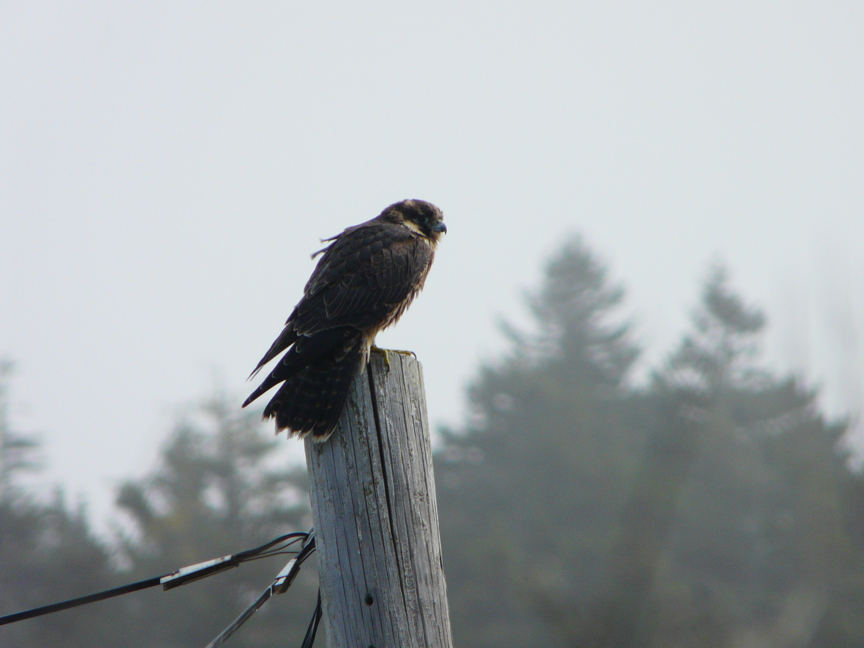 Peregrine falcon (young male). This was supposed to be a stormy day. Trap Day—when the Monhegan lobster crews head out with their traps amid great, traditional fanfare—was postponed until tomorrow. The forecast called for a 100 percent chance of rain. And sure enough, first thing, I looked out to see the island trees bucking and swaying in a strong wind. Fog cloaked everything beyond a few hundred yards out such that the island appeared to float on its own cloud. No rain yet, but my decision to postpone my return until tomorrow seemed sound.
 Clay-colored sparrow and dickcissel. Outside, warm air rushed by and rustled the spruce branches. The sound of surf rose from all around. We first strolled down toward town but didn’t see much in the way of birds: a couple rusty blackbirds, a swamp sparrow, the ubiquitous yellow-rumps. Down at the wharf, below high stacks of lobster traps, a female eider paddled fearlessly about. Gulls hung motionless above, all facing in the same direction.
Up behind the schoolhouse, an indigo bunting made an appearance, looking especially plain in its brown fall attire. Dickcissel and clay-colored sparrow posed agreeably on the same swaying twig. And on its open perch, a blue jay showed off its wind-blown crest.
After a while, the wind blew away the clouds and the sun emerged, causing us to strip off overshirts and tie them around our waist’s. Before long, the clouds would return, and we’d don the shirts again.
 Blue jay. During a break in the clouds while returning through town, we spotted a peregrine on a utility pole near the meadow. A small young male bird. I took photos marveling at being so near a peregrine falcon. One of us noticed it’d been banded. Soon after, we learned that it was one of a couple of birds banded by some researchers on Manana, and that they were alarmed at its weight—that it weighed only about as much as a kestrel. The young bird apparently failed hunting class and was likely starving as a result. This put a damper on what I’d imagined might be inspiring photographs.
This afternoon before dinner I took a walk alone out toward Burnt Head, took a side path, ended up on a remote rocky shore. There was a huge bare rock there—which I’ve since learned is called Gull Rock—overlooking the ocean. I climbed it carefully, maybe three or four stories, and sat facing out to sea for a long time working out how to photograph diving gannets in a gale. I got a couple nice photos of gannets, but only one of a gannet diving. It began to rain on my return via Lobter Cove.
The wind tonight is high, the rain wet, the surf pounding.
 Northern gannet diving. Monhegan List
(Not in order of sighting.)
1. Mallard
2. American black duck
3. Common eider
4. Ring-necked pheasant
5. Northern gannet
6. Double-crested cormorant
7. Sharp-shinned hawk
8. Merlin
9. Peregrine falcon
10. Herring gull
11. Great black-backed gull
12. Black guillemot
13. Mourning dove
14. Downy woodpecker
15. Northern flicker
16. Blue jay
17. American crow
18. Common raven
19. Black-capped chickadee
20. Red-breasted nuthatch
21. Carolina wren
22. Golden-crowned kinglet
23. Gray catbird
24. Cedar waxwing
25. Nashville warbler
26. Yellow-rumped warbler
27. Palm warbler
28. Clay-colored sparrow
29. Song sparrow
30. Swamp sparrow
31. White-throated sparrow
32. Dark-eyed junco
33. Northern cardinal
34. Dickcissel
35. Rusty blackbird
36. Purple finch
37. American goldfinch
 Monhegan cliffs.
Tags: American black duck, American crow, American goldfinch, black guillemot, black-capped chickadee, blue jay, Carolina wren, Cedar waxwing, clay-colored sparrow, common eider, common raven, dark-eyed junco, dickcissel, double-crested cormorant, downy woodpecker, golden-crowned kinglet, gray catbird, great black-backed gull, herring gull, mallard, merlin, mourning dove, Nashville warbler, northern cardinal, northern flicker, northern gannet, palm warbler, peregrine falcon, purple finch, red-breasted nuthatch, ring-necked pheasant, rusty blackbird, sharp-shinned hawk, song sparrow, swamp sparrow, white-throated sparrow, yellow-rumped warbler
Posted in Lists, Observations | No Comments »
Tuesday, September 28th, 2010
 Yellow-throated warbler. Ever since I caught sight of my first yellow-throated warbler, I’d had a nagging wish to see it again but nearer and for a longer period—i.e., posing for a photo.
 Yellow-throated vireo. But first thing this morning, Kristen and I set off through rain toward Lobster Cove in hopes of spotting the yell0w-breasted chat everyone’s been talking about. After about five minutes, the sun emerged from behind a ceiling of clouds, and we grew hopeful. No chat, though. Nor any of the common warblers we hadn’t yet seen—black-throated green, black-and-white, black-throated blue. We did, however, see a nice aerial dogfight between a merlin and a peregrine.
Then a few of us trekked to the ballfield and around behind the school house and over to the Ice Pond on our mission for new warblers. Instead, we saw a dickcissel and an exotic sparrow or two.
No black-throated green, no black-throated blue. But we did hear from other birders that the yellow-throated warbler was still hanging around. Not until we were headed back for lunch and ran into Bryan Pfeiffer (of Vermont Bird Tours), did we think to take a little side trip along the harbor road to where we saw the yellow-throated yesterday. Sure enough, a couple noted birding experts had their binoculars trained up into some spruces, and before long we were staring ourselves up into a spruce above the road itself at the lovely little bird as it pecked around in the boughs. It lingered. It gave us some great looks. It didn’t seem to mind the little cluster of humans all observing it from just a few feet below. And I got some photos.
That made my day.
But the day wasn’t done: soon after, a couple hundred yards away, we were gazing up into an apple tree that contained a yell0w-throated vireo—another life bird for me. (Not one, but two yell0w-throated songbirds!) And then we saw a Tennessee warbler.
The weather was fickle, breeze and warm, overcast then sunny, a spattering of rain. Tonight the stars have emerged, and I hear the sound of the ocean out my window. Crazily, I ended up with the same number of species as yesterday.
I love this island.
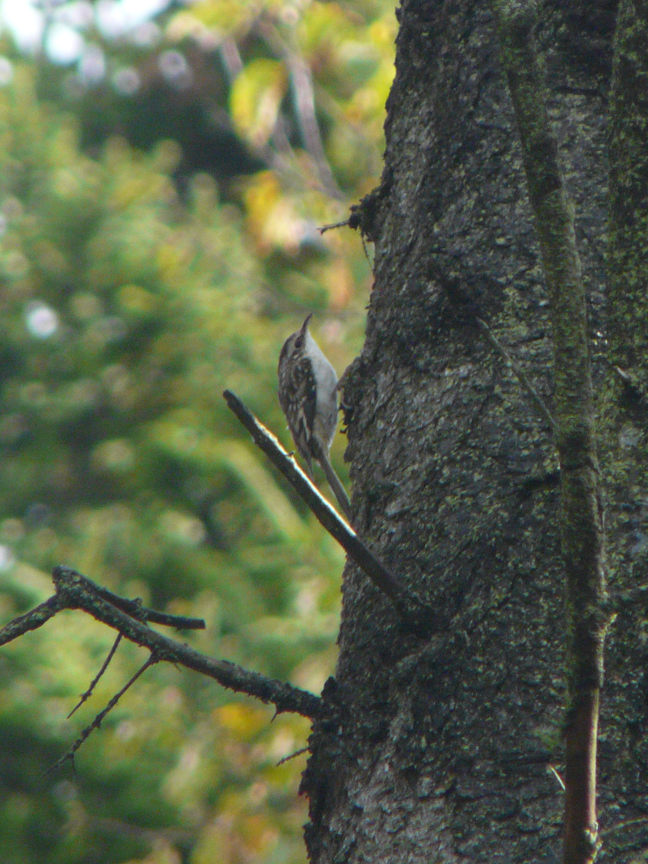 Brown creeper. Monhegan List
(Not in order of sighting.)
1. Mallard
2. Blue-winged teal
3. Common eider
4. Ring-necked pheasant
5. Northern gannet
6. Double-crested cormorant
7. Great blue heron
8. Osprey
9. Sharp-shinned hawk
10. Merlin
11. Peregrine falcon
12. Herring gull
13. Great black-backed gull
14. Black guillemot
15. Mourning dove
16. Belted kingfisher
17. Yellow-bellied sapsucker
18. Downy woodpecker
19. Northern flicker
20. Eastern phoebe
21. Yellow-throated vireo
22. Red-eyed vireo
23. Blue jay
24. American crow
25. Common raven
26. Black-capped chickadee
27. Red-breasted nuthatch
28. White-breasted nuthatch
29. Brown creeper
30. Carolina wren
31. House wren
32. Golden-crowned kinglet
33. American robin
34. Gray catbird
35. Brown thrasher
36. Cedar waxwing
37. Tennessee warbler
38. Yellow-rumped warbler
39. Yellow-throated warbler
40. Palm warbler
41. Blackpoll warbler
42. Common yellowthroat
43. Chipping sparrow
44. Clay-colored sparrow
45. Savannah sparrow
46. Song sparrow
47. Swamp sparrow
48. White-throated sparrow
49. Dickcissel
50. Rusty blackbird
51. Baltimore oriole
52. Purple finch
53. American goldfinch
 Tennessee warbler.
Tags: American crow, American goldfinch, American robin, Baltimore oriole, belted kingfisher, black guillemot, black-capped chickadee, blackpoll warbler, blue jay, blue-winged teal, brown creeper, brown thrasher, Carolina wren, Cedar waxwing, chipping sparrow, clay-colored sparrow, common eider, common raven, common yellowthroat, dickcissel, double-crested cormorant, downy woodpecker, eastern phoebe, golden-crowned kinglet, gray catbird, great black-backed gull, great blue heron, herring gull, mallard, merlin, mourning dove, northern flicker, northern gannet, osprey, palm warbler, peregrine falcon, purple finch, red-breasted nuthatch, red-eyed vireo, ring-necked pheasant, rusty blackbird, savannah sparrow, sharp-shinned hawk, song sparrow, swamp sparrow, Tennessee warbler, white-breasted nuthatch, white-throated sparrow, yellow-bellied sapsucker, yellow-rumped warbler, yellow-throated vireo, yellow-throated warbler
Posted in Lists, Observations | No Comments »
|
|
| |
| Bird Report is a (sometimes intermittent) record of the birds I encounter while hiking, see while driving, or spy outside my window. —Brian Willson |
|
|


