|
|
 |
|
|
Posts Tagged ‘winter wren’
Monday, April 14th, 2014
 Cattle Egrets. I thought about another early hike today, but it was pretty foggy, so I figured there wouldn’t be as much to see, so Jack and I went to work early instead. Then, about midday, after the sun had emerged, I got word that there were a couple of Cattle Egrets over near the middle school in Rockland.
 Dark-eyed Junco. Cattle Egrets don’t often show up in Maine—in fact, I’m not sure I’ve ever seen one here—and the fact that a local news site was looking for photos was all I needed to go on a little twitch. When I pulled up, the two little guys were just yards from the road, and they didn’t seem too concerned with the barking dogs (in the yard of the nearest house) that greeted me as I stepped out of the pickup. Jack didn’t seem concerned with the dogs, either, but then he had to wait in the truck.
Photographing the birds was easy. For me. Come to find out somebody earlier in the day actually trespassed onto school property and prompted someone to call the police to report such suspicious behavior. (Don’t trespass, fellow bird nerds!) Afterward, we swung by Weskeag Marsh, where I saw my first cormorants of the year.
Mid-afternoon is when dog and I finally did make it up to Beech Hill. Hazy sun, warmth (60-ish (F)), and a high wind. Kind of a crazy combination. But I managed to spot a few Hermit Thrushes and a flicker coming up through the woods. Up above the open fields I saw another Kestrel and a vulture. Juncos down by the road. Then, returning through the woods, I heard—above the rush of the warm wind—a long jumble of notes and spotted two or three thrushes flutter by, along with a tiny brown bird that seemed to zip into the end of a hollow log. Or was that just an old dead leaf blowing by?
 Winter Wren. No, it was a bird: a Winter Wren, bobbing up and down and back and forth, it’s tiny tail stuck straight up in the air. I’ve heard Winter Wrens up there before, but I believe this was the first one I’ve ever seen.
In the wee hours tonight is the “blood moon”—a total lunar eclipse. Alas, I think the skies will be too cloudy.
Beech Hill List
Beginning at 2:45 p.m., I hiked all trails.
1. Black-capped Chickadee**
2. Hermit Thrush
3. American Crow*
4. Northern Flicker
5. Song Sparrow** (v)
6. Northern Cardinal**
7. Eastern Phoebe**
8. Dark-eyed Junco
9. American Robin*
10. American Goldfinch (v)
11. House Finch (v)
12. Pileated Woodpecker (v)
13. Turkey Vulture*
14. American Kestrel
15. Winter Wren†
16. Tufted Titmouse
Elsewhere
17. House Sparrow (v)
18. Herring Gull
19. Osprey (v)
20. Mallard
21. Rock Pigeon
22. Cattle Egret†
23. Double-crested Cormorant†
24. Red-tailed Hawk
25. Mourning Dove
v = Voice only
*Also elsewhere
**Voice only elsewhere
†First-of-year bird
Tags: American crow, American goldfinch, American kestrel, American robin, black-capped chickadee, cattle egret, dark-eyed junco, double-crested cormorant, eastern phoebe, hermit thrush, herring gull, house finch, house sparrow, mallard, mourning dove, northern cardinal, northern flicker, osprey, pileated woodpecker, red-tailed hawk, rock pigeon, song sparrow, tufted titmouse, turkey vulture, winter wren
Posted in Lists, Observations | No Comments »
Tuesday, June 15th, 2010
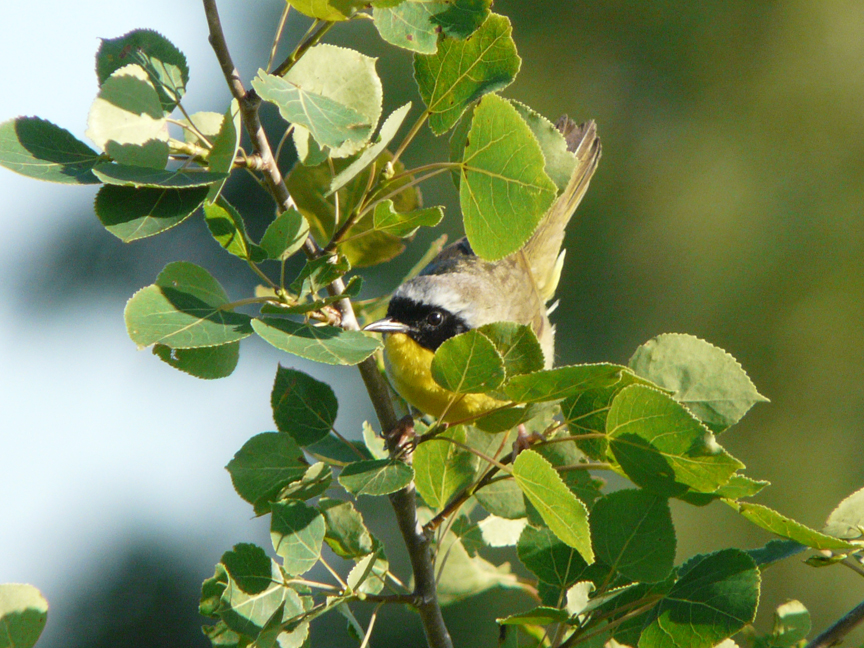 Common yellowthroat. Dawn came early to a sun-soaked world. Nearing summer solstice. Noticed a little breeze in the greenery and so didn’t bother with the digital recorder—there would’ve been too much rush and rustle—so dog and I took only camera and binoculars and leash this day.
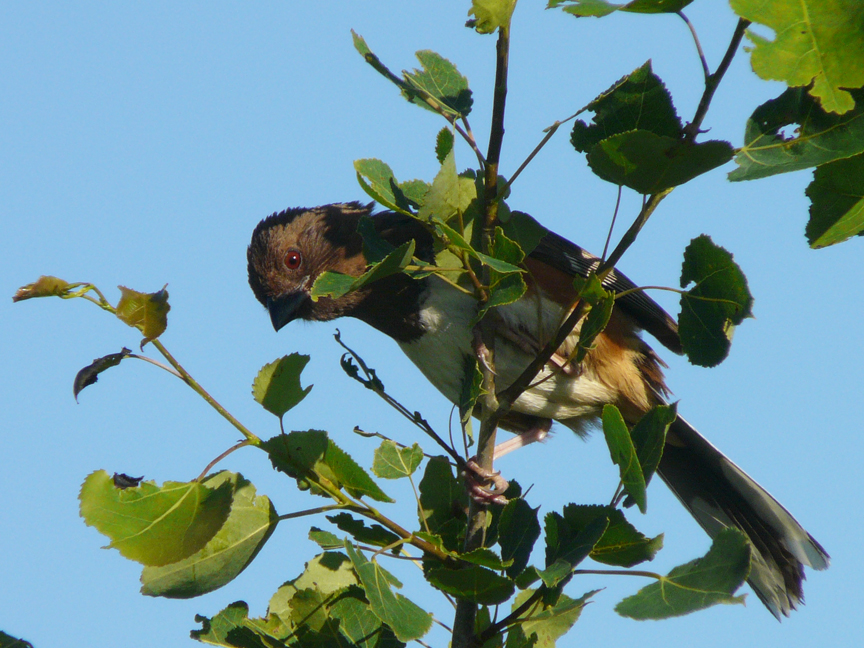 Eastern towhee (female). Interesting contrast with yesterday’s burgeoning overcast, and its birds galore. Today I counted noticeably fewer species. But among them were a couple mentionables: 1) as we reached the far parking lot at Beech Hill Road, I heard the rambling, chippity burbles of a winter wren coming from a shady patch of woods across the road; 2) as we arrived back to the Rockville Street parking lot, having walked the whole hill, I heard the high, thin whistles of a broad-winged hawk. The former was a first-sighted bird on the hill; the latter could’ve been a blue jay’s impersonation. But the jays I’ve heard lately have all delivered their standard, species-specific calls—and I didn’t even hear one today. I’m guessing it was for sure a hawk I heard.
(Mainly, I’m psyched to have heard a winter wren.)
Otherwise, our hike revealed the usual frantic yellowthroat parents, the protective towhee parents, the exhausted chickadee parents, the secretive chestnut-sided parents. Catbird parents snuck around in the undergrowth. Robin parents gave out the alarm.
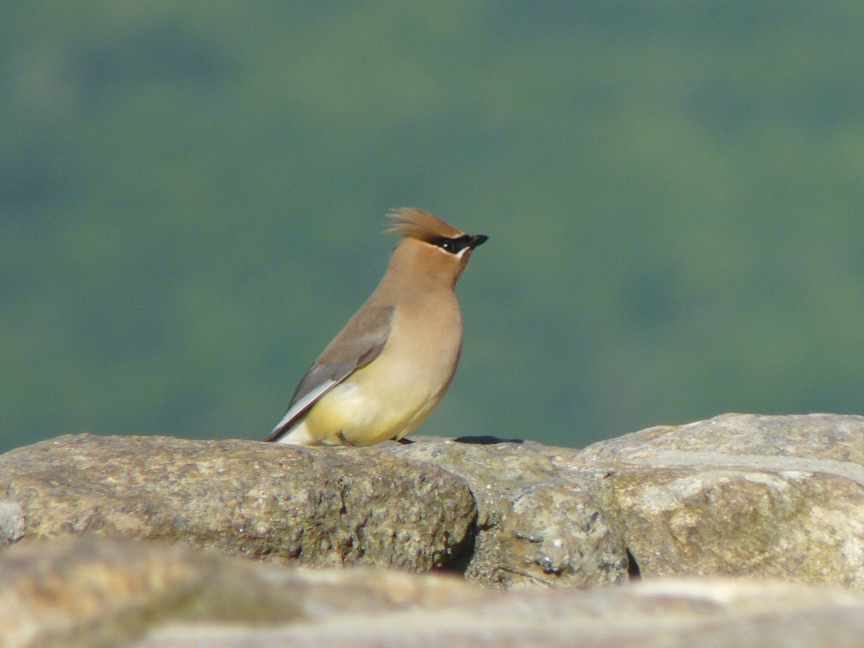 Cedar waxwing at Beech Nut. Meantime, Jack has a nose for rodents, I’ve observed. He invariably—well, other than one time involving a gray squirrel—notices any squirrel or chipmunk or mouse or vole before I do. Today we both watched a mouse (or vole) hurry across the trail just in front of us. Distantly, I spotted a solitary herring gull soaring over toward Chickawaukee Lake.
Also interesting to me is how some birds seem to sleep later than others. Rose-breasted grosbeaks, for instance, don’t seem to begin to call nearly as early as vireos, ovenbirds, robins. And today, I’d nearly climbed the whole of the hill before I heard a redstart—whereas they were everywhere on the way back down.
But perhaps the most thrilling part of the day occurred on our return down the lower wooded trail when an ovenbird flitted up fairly near us and began walking slowly along a limb, headed away. I’ve seen this behavior each the past few years: it means we’ve gotten too near their chicks. Today the bird didn’t get close enough for a great photo, but I still have hope of one this year. The ovenbird is one of my favorite species.
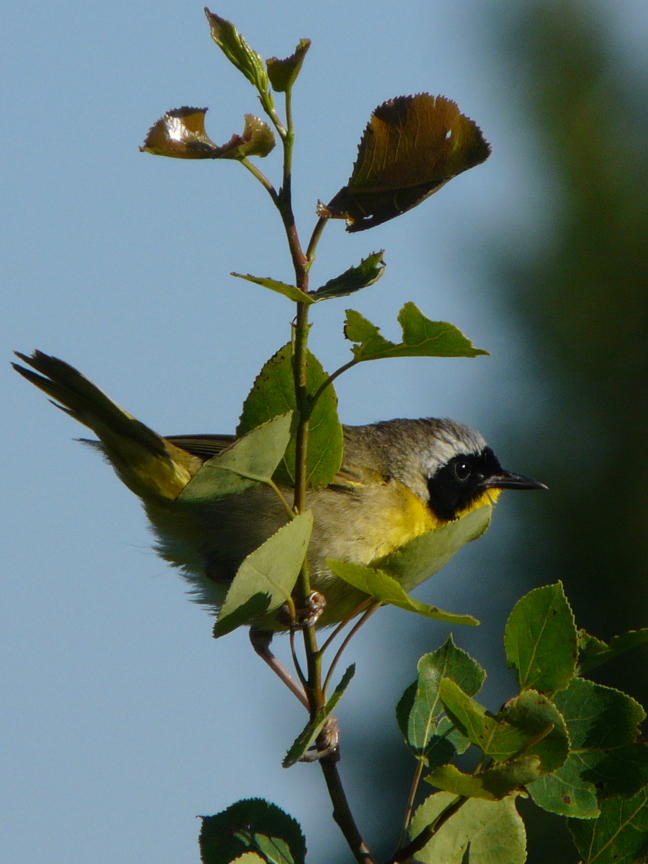 Common yellowthroat. Beech Hill List
Beginning at 6:30 a.m., I walked all trails.
1. Ovenbird
2. Red-eyed vireo
3. Chestnut-sided warbler
4. American robin
5. Common yellowthroat
6. Eastern towhee
7. Veery
8. Black-capped chickadee
9. American goldfinch
10. American crow
11. Gray catbird
12. Mourning dove
13. Cedar waxwing
14. Alder flycatcher
15. American redstart
16. Herring gull
17. Field sparrow
18. Eastern phoebe
19. Savannah sparrow
20. Tree swallow
21. Yellow warbler
22. White-throated sparrow
23. Chipping sparrow
24. Winter wren
25. Song sparrow
26. Northern parula
27. Hermit thrush
28. Broad-winged hawk
Elsewhere
29. Northern cardinal
30. House finch
31. Herring gull
 Beech Nut.
Tags: alder flycatcher, American crow, American goldfinch, American redstart, American robin, black-capped chickadee, broad-winged hawk, Cedar waxwing, chestnut-sided warbler, chipping sparrow, common yellowthroat, eastern phoebe, eastern towhee, field sparrow, gray catbird, hermit thrush, herring gull, house finch, mourning dove, northern cardinal, northern parula, ovenbird, red-eyed vireo, savannah sparrow, song sparrow, tree swallow, veery, white-throated sparrow, winter wren, yellow warbler
Posted in Lists, Observations | No Comments »
Monday, May 31st, 2010
 Dead cedar waxwing. Earlier this month, the Alaotra grebe—a small species from Madagascar—was declared extinct. On Monhegan this morning, I got a look at the preserved remains of a lovely cedar waxwing that’d run into a window and died. (Note: an estimated 100 million or more birds die in the U.S. each year from running into windows.) Then on a hike through Cathedral Woods this afternoon, my friends Kristen and Paul and I came upon a whimsical memorial to a dead wood-warbler.
 Ovenbird memorial. This particular trail in the woods is known for its tiny “fairy houses” made of bark and twigs and lichen and spruce cones. And this particular house had a makeshift cross, a snail shell, and a sort of lean-to holding the corpse of a lovely ovenbird. I can hardly express how touching this was to stumble upon on Memorial Day.
A number of house cats—including an exotic breed or two—stalk the yards of Monhegan, and no doubt a few kill birds. In fall, the island gets by peregrine falcons and other raptors, efficient machines for murder. And, sure, every living thing dies. But it sticks with you when you view the dead bodies of more than one recently living bird in one twenty-four-hour period. It sticks with me, at least.
 White-eyed vireo. So it’s with somewhat deeper appreciation that I counted forty-five living species this warm, summer-like spring day on Monhegan—including plenty of living waxwings (about a hundred). Also including a white-eyed vireo (a lifer for me), a bird Kristen and I tracked down in a thicket off the Burnt Head trail; obligingly, it hopped up onto a dead branch just as I raised my camera. Three individual birds were most discussed this weekend: Saturday’s western kingbird, the white-eyed vireo, and an olive-sided flycatcher reportedly seen in the same area as the vireo. We tried for what one birder called the “all-excited flycatcher” but saw and heard only a bunch of alders. Oh, well.
One interesting aspect of this trip were two thirteen-year-old Maine birders—long-time friends—who really knew their stuff. One of the boys got nice photos of the white-eyed, and the other ended the day with a sighting of a black-billed cuckoo. I believe they both photographed the wayward western kingbird. And this afternoon, on the boat back inshore, they both stood with me in the bow snapping photos of northern gannets.
The northern gannets, by the way, were very much alive.
 Northern oriole. Monhegan List
(Numbered for full trip; not in order of listing.)
55. White-eyed vireo**
56. Northern flicker (voice)
57. Spotted sandpiper*
58. White-throated sparrow (voice)
American robin
Cedar waxwing
Red-breasted nuthatch
House wren
Winter wren (voice)
Carolina wren
Magnolia warbler
Alder flycatcher
Golden-crowned kinglet (voice)
Double-crested cormorant
Herring gull
Great black-backed gull
Laughing gull
Common eider
Black guillemot
Mallard
American goldfinch
White-winged crossbill
Ring-necked pheasant (voice)
American crow
Common grackle
Red-winged blackbird
European starling
Purple finch (voice)
Common yellowthroat
Yellow warbler
American redstart
Black-throated green warbler (voice)
Blackpoll warbler (voice)
Gray catbird
Mourning dove
Black-capped chickadee
Northern oriole
Brown thrasher
Northern cardinal (voice)
Eastern kingbird
Alder flycatcher
Eastern wood-pewee (voice)
Song sparrow
Blue jay (voice)
Osprey (voice)
Elsewhere
Northern gannet
Bald eagle
Tufted titmouse (voice)
*First-of-year bird.
**Life bird.
 Northern gannet, living and breathing.
Tags: alder flycatcher, American crow, American goldfinch, American redstart, American robin, black-capped chickadee, black-throated green warbler, blackpoll warbler, blue jay, brown thrasher, Carolina wren, Cedar waxwing, common eider, common grackle, common yellowthroat, double-crested cormorant, European starling, golden-crowned kinglet, gray catbird, great black-backed gull, herring gull, house wren, laughing gull, magnolia warbler, mallard, mourning dove, northern cardinal, northern flicker, northern oriole, osprey, purple finch, red-breasted nuthatch, red-winged blackbird, ring-necked pheasant, song sparrow, spotted sandpiper, white-eyed vireo, white-throated sparrow, white-winged crossbill, winter wren, yellow warbler
Posted in Lists, Observations | No Comments »
|
|
| |
| Bird Report is a (sometimes intermittent) record of the birds I encounter while hiking, see while driving, or spy outside my window. —Brian Willson |
|
|


