|
|
 |
|
|
Posts Tagged ‘purple sandpiper’
Saturday, December 18th, 2010
 American wigeon. The day began early. I rose and dressed in many layers, as I had an 8 a.m. date at the Rockland Breakwater—the nearly-mile-long granite structure that stretches out into Rockland’s wide harbor. In the past few years, it’s seemed that our local Christmas Bird Count happens to fall on one of the coldest, windiest days of the year so far. Today was a happy exception.
 Herring gull (juvenile). Oh, it was chilly. I was happy to have on a few layers. But the air was still, and the temperature soon rose into the upper-20s (F)—as opposed to the low-teens of recent years—and this mostly sunny day delivered an ample supply of birds.
As always, I met my friends Kristen and Paul, along with Joe from Coastal Mountains Land Trust. Notable was the state of the tide: high. I thought first, on seeing this, that we might miss out on purple sandpipers. In my experience, they seem to prefer mid-tide, when they can poke around in the marine plant life clinging low on the granite stones. But the thought soon vanished amid the calls of the large raft of Canada geese floating in the lee of the breakwater (a challenge to count) and the adult bald eagle that sailed overhead within minutes of the beginning of our excursion.
Soon we were counting eiders, guillemots, mergansers, gulls, long-tailed ducks, loons, great cormorants. Across the way, the Owls Head Light stood sentinel against a golden morning sky. And about half-way out—a sandpiper.
 Mallards. All told, we saw at least a half-dozen purple sandpipers. Herring and ring-billed gulls. And around the shore of the Samoset Resort property, goldeneyes, black-ducks, mallards, horned and red-necked grebes. The air warmed genially. Finally, with the fifteenth species, we counted a regular ol’ songbird: an American goldfinch.
In other locations nearby, we saw finches, sparrows, chickadees, woodpeckers, and other common passerines. We even saw a solitary great blue heron flapping away across the harbor. At Clam Cove, a large flock of small gulls swept in: Bonaparte’s. Soon after, we stopped at the entrance to a hillside subdivision, a place marked by alders and cattails, and spotted a small flock of common redpolls.
At the southern shore of Chickawakie Lake (also in our territory), we counted the usual dozens of mallards—but among them Kristen spotted a single American wigeon. A young bird, it seemed, and not very skittish. I managed many photos.
An adult eagle sat on the ice far across the lake. A tight-bunched collection of coots hung together just beyond. And overhead, a red-tailed hawk soared just this side of the sun.
 Purple sandpiper. I ditched the count in early afternoon—and no doubt Kristen and Paul found many more interesting species this afternoon—but that’s OK. I so appreciate this single momentous annual birding day. It seems even more momentous being so near the solstice.
Later, Jack and I walked Beech Hill, as usual. Only a crow and a flicker up there this afternoon—and I could only tell from their voices—but a lovely hillside, a few small groups of friendly humans (and one young dog), and a lovely rising moon. Our routine hike seemed the perfect ribbon with which to tie a bow on the gift that was this lovely, birdy day.
Beech Hill List
Beginning at 2:45 p.m., I hiked the open trail.
1. Northern flicker (voice)
2. American crow (voice)
Elsewhere
3. House sparrow
4. Canada goose
5. Bald eagle
6. Common eider
7. Red-breasted merganser
8. Herring gull
9. Bufflehead
10. Black guillemot
11. Ring-billed gull
12. Long-tailed duck
13. Common loon
14. Great cormorant
15. Purple sandpiper
16. Common goldeneye
17. American goldfinch
18. Black duck
19. Mallard
20. Horned grebe
21. Red-necked grebe
22. Blue jay
23. House finch
24. White-throated sparrow
25. Black-capped chickadee
26. Northern cardinal
27. Downy woodpecker
28. White-breasted nuthatch
29. Hairy woodpecker
30. American robin
31. Great black-backed gull
32. Great blue heron
33. European starling
34. Bonaparte’s gull
35. Tufted titmouse
36. Common redpoll
37. American coot
38. American wigeon
39. Red-tailed hawk
 Owls Head Light.
Tags: American coot, American crow, American goldfinch, American robin, American wigeon, bald eagle, black duck, black guillemot, black-capped chickadee, blue jay, Bonaparte's gull, bufflehead, Canada goose, common eider, common goldeneye, common loon, common redpoll, downy woodpecker, European starling, great black-backed gull, great blue heron, great cormorant, hairy woodpecker, herring gull, horned grebe, house finch, house sparrow, long-tailed duck, mallard, northern cardinal, northern flicker, purple sandpiper, red-breasted merganser, red-necked grebe, red-tailed hawk, ring-billed gull, tufted titmouse, white-breasted nuthatch, white-throated sparrow
Posted in Lists, Observations | No Comments »
Friday, May 14th, 2010
 Two islands. Up early. Overcast. Cool. Slight breeze. Reheated a cup of yesterday’s coffee, poured it into a travel mug, put the leash on the dog, headed for Beech Hill.
 Chestnut-sided warbler. In case you’ve been wondering, I don’t write down the birds I hear and see. I’ve got a system. As soon as I get out of the pickup, I listen for birdsong—and I hear it. This morning, simultaneously, I heard the voices of an ovenbird (ever-present on the hill in spring), a robin, and a black-throated green warbler. Within a few seconds, I heard the passionate fee-bee of a chickadee. Here’s what I do in my head:
“One, ovenbird. Two, robin. Three, black-throated green. Four, chickadee.”
Then if there’s a lull—i.e., no new birds heard or seen for a while—I’ll keep repeating that last little clipped sentence to myself silently: Four, chickadee. I repeat it until I hear bird species number five.
“Five, yellowthroat.”
 Mourning dove on Beech Hill trail. I’ve used this system for a couple-three years, and it seems to work great. On my return home, I’ll sit and jot down the list, in order, as near as I can remember. As far as I know, I’ve never listed a bird I didn’t see or hear; however, I’ll occasionally recall a bird or two I somehow missed counting in situ. This morning, for instance, I came home thinking I’d counted twenty-six species—but when I talled ’em up, the total was twenty-seven.
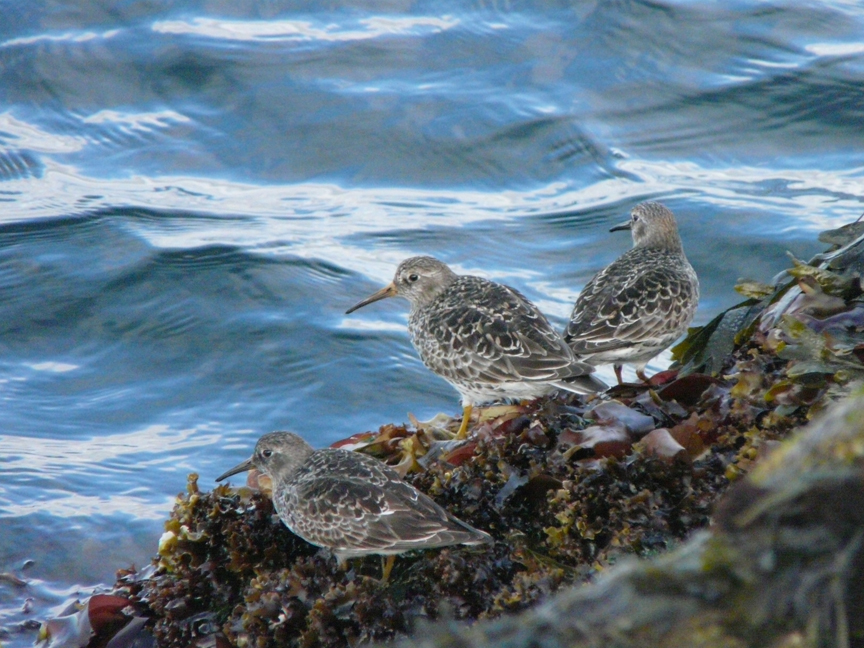 Purple sandpipers. I tend also to remember the count at certain mileposts. A memorable one this morning was: “Seven, blackpoll warbler.” A first-of-year bird, and one I’ve seen only a few times in my life. And I nearly always remember the count when we reach the summit, Jack and I. Today, I’d only reached sixteen when we arrived at Beech Nut—I’ve counted twice as many at that stage—but I heard or saw quite a few birds beyond that point.
Not only did we see and hear birds: coming up the upper wooded trail, emerging from a tree-cloaked section of trail, a sudden boom erupted from the popple to our right—and we stood and watched as two big white-tailed deer dashed off ahead of us through the greening woodland. After they’d disappeared, Jack turned and looked at me with a transparent expression.
“Did you see that?” he asked.
“Deer,” I said.
“So, do we chase ’em?”
“Naw.”
The weather was odd. As we set out, a ripply gray blanket covered the sky overhead and to the west of us, while a cantaloupe-colored field spread across the eastern horizon, above the bay. But by the time we were returning via the lower wooded trail, a bright sun had come out, and I saw few clouds at all up beyond the branches of the hardwoods. The clouds had simply, suddenly burned away. But that, too, was temporary: by early afternoon, the day seemed gray again. Then bright again come late-afternoon. Fickle, the weather this day.
 Common eider. At one point on the hill, a chestnut-sided warbler flitted so near that I had trouble focusing. It was backlit anyway. Not a great photo. Coming down and around the open trail, dog and I noticed a mourning dove walking down the hill in front of us. It continued that way for 40 or 50 yards.
As we headed back across the parking lot to the pickup, I heard the jeers of a blue jay. “Twenty-six, jay,” I said to myself. Turned out it was species number twenty-seven.
This evening, we walked the Rockland breakwater. One notable sighting there: a tree swallow, soaring in the breeze only a few feet above us as we approached the first granite stones. I turned on my camera in hopes of getting a photo of it in flight, but I managed only a shot of it perched oddly on the breakwater itself. Soon after, it veered over to the little beach below and pecked around a bit. I figured it must’ve been gathering nesting materials.
Also saw a laughing gull, a pair of black guillemots in flight, and—lo—purple sandpipers. Seems those little fellas should be back in the Arctic by now.
(Still no hummingbirds today. I’m starting to worry a little.)
 Tree swallow. Beech Hill List
At 6:15 a.m., I walked all trails.
1. Ovenbird
2. American robin
3. Black-throated green warbler
4. Black-capped chickadee
5. Common yellowthroat
6. Tufted titmouse
7. Blackpoll warbler*
8. American crow
9. American goldfinch
10. Chestnut-sided warbler
11. Eastern towhee
12. Mourning dove
13. Nashville warbler
14. American redstart
15. Field sparrow
16. Tree swallow
17. Savannah sparrow
18. Song sparrow
19. Double-crested cormorant
20. American kestrel
22. White-throated sparrow
23. Chipping sparrow
24. Yellow warbler
25. Black-and-white warbler
26. Gray catbird
27. Blue jay
Elsewhere
28. House finch
29. Northern cardinal
30. Herring gull
31. Rock pigeon
32. Great black-backed gull
33. Laughing gull
34. Common eider
35. Purple sandpiper
36. Black guillemot
 Penobscot Bay.
Tags: American crow, American goldfinch, American kestrel, American redstart, American robin, black guillemot, black-capped chickadee, black-throated green warbler, blackpoll warbler, Chesnut-sided warbler, common eider, common yellowthroat, double-crested cormorant, eastern towhee, field sparrow, herring gull, house finch, laughing gull, mourning dove, Nashville warbler, northern cardinal, ovenbird, purple sandpiper, rock pigeon, savannah sparrow, song sparrow, tree swallow, tufted titmouse
Posted in Observations | No Comments »
Sunday, April 25th, 2010
 Yellow-rumped warbler. I was nearly wrong. I declared yesterday that towhees would be singing from now until fall at Beech Hill, thinking the four or five (or more) birds giving forth yesterday would hang around and nest. Well, on today’s morning walk up the hill, I heard no towhee songs at all. In fact, it was a very different hike.
 Eastern phoebe. At the trailhead, I heard only goldfinches and chickadees. The sky was clear and blue. The morning sun bathed the greening landscape. A brisk north wind had kicked up. Not sure if yesterday’s activity came from the dramatic swing in the weather or what—but today’s walk began about as uneventfully as yesterday’s was notable. I did finally hear a crow’s voice from up the hill and a herring gull’s from (no doubt) the little cow farm. Then about half-way up, I heard the subtle chip of a warbler.
I notice things like that. After thirty years of listing birds, my brain is attuned to their voices—whether a cardinal singing its incessant string of sweet, loud notes or an osprey’s scream from 200 yards up or the tiny two-note tee-deet of a nesting female hummingbird. Many (if not most) cultured folk don’t notice their native birds at all; they have other distractions involving family or the office or that strange new sound coming from under the hood of the car. The chip made my ears perk up. I had an idea of what it was.
 Savannah sparrow. I might’ve been wrong about the towhees, but I was right about this: a yellow-rumped warbler, hunting for insects amid new yellow-green poplar leaves. They come through early, the yellow-rumps, but will eventually be outnumbered by chestnut-sideds and yellowthroats—up Beech Hill, at least. A tilted planet turns, the photoperiod lengthens, yellow-green leaves unfurl, insects return. And with them come wood-warblers.
(It’s another thing I notice: the returns of insects. Oh, I’m sure I’m not the only one who notices the return of black flies and mosquitoes, but to me they mean not annoyance and bug spray but the return of insectivorous birds.)
 Common eider. Finally, at the summit, I heard the call note of a towhee coming from somewhere down the eastern slope. I suppose next year I might notice all the singing first arrivals of this species and realize they’re likely simply moving through, stopping off to check out the habitat—certainly wonderful towhee habitat, that’s for sure.
This late-afternoon, dog and I took a brisk walk along the breakwater. The highlight: a female common merganser diving near a low-tide rock on which were perched three double-crested cormorants. And (I noticed from their gentle peeps) more purple sandpipers moving through.
Beech Hill List
At 9:30 a.m., I walked both trails.
American goldfinch
Black-capped chickadee
American crow
Herring gull (voice)
Mourning dove
White-throated sparrow (voice)
Yellow-rumped warbler
Tree swallow
Eastern phoebe
Savannah sparrow
Eastern towhee (voice)
Common raven (voice)
Chipping sparrow (voice)
Tufted titmouse (voice)
 Purple sandpipers at the Rockland Breakwater. Elsewhere
House finch
Song sparrow
Northern cardinal
House sparrow
Common grackle
Double-crested cormorant
Common merganser
Common eider
Common loon
Purple sandpiper
Mallard
 Looking northwest from Beech Hill.
Tags: American crow, American goldfinch, black-capped chickadee, chipping sparrow, common eider, common grackle, common loon, common merganser, common raven, double-crested cormorant, eastern phoebe, eastern towhee, herring gull, house finch, house sparrow, mallard, mourning dove, northern cardinal, purple sandpiper, savannah sparrow, song sparrow, tree swallow, tufted titmouse, white-throated sparrow, yellow-rumped warbler
Posted in Lists, Observations | No Comments »
|
|
| |
| Bird Report is a (sometimes intermittent) record of the birds I encounter while hiking, see while driving, or spy outside my window. —Brian Willson |
|
|


