Another morning with a nice bit of spring migration going on. Jack feelin’ good, what with all the smells, and me feelin’ good, what with all the empids.
Seriously, I didn’t expect any flycatchers (I’ve learned rarely to expect anything), let alone three. First came what I thought might be a Willow Flycatcher or a Western Wood-pewee (neither of which species I’m very familiar with); then came what I thought might be a willow or maybe Hammond’s Flycatcher; finally came what I was pretty sure was another Gray Flycatcher.
The first turned out to be a wood-pewee, the second turned out to be a Dusky Flycatcher—the second I’ve ever encountered. (The first, coincidentally came on 18 May 2020, exactly a year ago.)
Other cool birds, too. Still a little migration excitement left, I’ll bet.
Grandeur Peak Area List Beginning at 7:05 a.m. (8:05 MDT), I hiked a few hundred feet up a mountain.
1. Lazuli Bunting 2. American Robin* 3. Song Sparrow* (v) 4. Black-chinned Hummingbird 5. Woodhouse’s Scrub-jay 6. Spotted Towhee 7. Blue-gray Gnatcatcher 8. Rock Pigeon 9. Pine Siskin 10. Black-billed Magpie* 11. Mourning Dove 12. Western Wood-pewee† 13. Black-capped Chickadee 14. House Finch** 15. Chipping Sparrow 16. Warbling Vireo 17. Dusky Flycatcher† 18. Black-throated Gray Warbler (v) 19. Black-headed Grosbeak 20. Chukar (v) 21. Lesser Goldfinch** 22. Cooper’s Hawk 23. Gray Flycatcher 24. House Sparrow** (v)
Elsewhere
25. Eurasian Collared-dove (v) 26. California Quail
Mammals
Mountain Cottontail Rock Squirrel
(v) Voice only *Also elsewhere **Voice only elsewhere †First-of-year bird
A lovely hike with dog this clear, birdy morning. Before we’d barely left the switchback, in fact, I had more than a dozen species on my list—including a strange, unexpected bird perched in the big Russian olive tree.
A huge-beaked bird it was, but no Black-headed Grosbeak. Every several seconds it emitted a single bright note, a call I didn’t recognize. Had to be another grosbeak, but which could it be? Not until we got back home and I searched the Cornell Lab site for Utah grosbeaks did I realize what I’d seen: an Evening Grosbeak, a female or immature male.
. Every several seconds it emitted a single bright note, a call I didn’t recognize. Had to be another grosbeak, but which could it be? Not until we got back home and I searched the Cornell Lab site for Utah grosbeaks did I realize what I’d seen: an Evening Grosbeak, a female or immature male.
Decades ago, back in Maine, great flocks of Evening Grosbeaks descended during winter irruptions, and I got to know them very well. And then one year they didn’t return, and I hadn’t seen one since. Not in a span of at least 30 years—and never, I think, a solo individual.
Good to see you, great-beaked bird. I hope you find more of your kind.
Grandeur Peak Area List Beginning at 7:05 a.m. (8:05 MDT), I hiked a few hundred feet up a mountain.
Good news and not so bad news this morning: Jack seems fine and was eager to hike this morning; not nearly the excitement of yesterday, bird-wise, but still an enjoyable excursion.
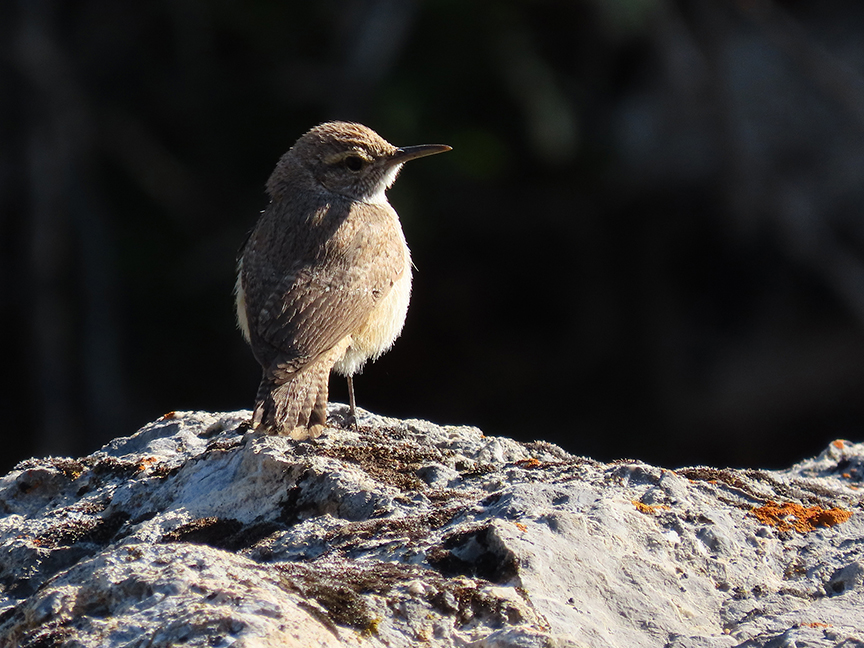
Cooler, breezier, mostly clear. The Rock Wrens are still in the little old quarry, so maybe they’ll nest there this year. Gnatcatchers all over the place, with those antic, highly entertaining songs and calls of theirs. The usual spring warblers, Warbling Vireos, chippies, a Cooper’s Hawk.
Dog really dug our hike, and so did I.
Grandeur Peak Area List Beginning at 7:05 a.m. (8:05 MDT), I hiked a few hundred feet up a mountain.