Birding is a little slower now than it was a couple weeks ago. Oh, there’re plenty of wild birds about—singing, calling, flitting around—but they’re less obvious, more secretive. They’ve got other thoughts on their mind.
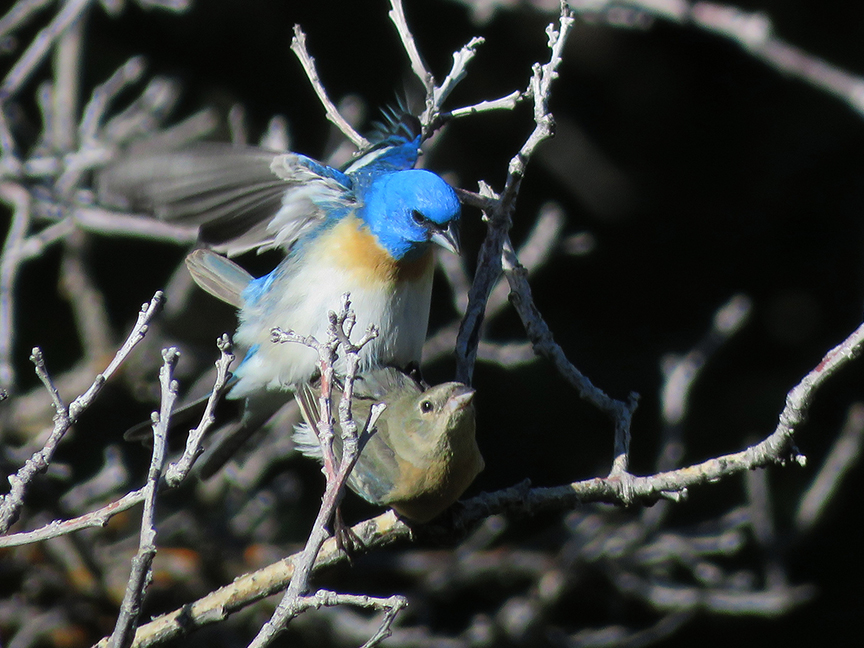
In fact, I’m guessing that most of the resident species either have eggs to incubate, nestings to feed, or fledglings to bring to adulthood. But this morning I happened upon at least one couple of buntings with a nest in need of eggs—right in broad daylight.
Meanwhile, the grosbeak parents are still jamming regurgitated food rather roughly down the throats of their tiny new-hatched nestlings. (Guessing their wide beaks make it something of a challenge.) Gnatcatchers, scrub-jays, and magpies (at least) have fledglings to raise.
Busy times for all.
Grandeur Peak Area List Beginning at 8:45 a.m., I hiked a few hundred feet up a mountain.
I’d never seen a Black-headed Grosbeak until I’d moved to Utah. Saw a single quiet grosbeak in the shady switchback late last summer or in early fall, just for a moment. Impressive-looking bird that I knew nothing about.
Now, in deep spring, I feel like I know them fairly intimately. Not least because of the grosbeak nest I spotted about fifty paces from the trailhead where dog and I begin our daily hikes. From my observations, I’ve learned that both males and females will occupy the nest—and that this particular male often sings while sitting there in the leafy shade.
I’ve learned also that grosbeaks sing a lot—both sexes. (However, I haven’t yet seen any territorial skirmishes of the sort I’ve read about.) I know their song, of course—and their loud, staccato chip-note, which is similar to a Rose-breasted Grosbeak’s, but less squeaky.
Knowledge through observation: the most satisfying part of being a birder.
Grandeur Peak Area List Beginning at 7:45 a.m., I hiked about 1,200 feet up a mountain.
After a few nights of not quite enough sleep (ever since the bakyard mountain lion), I finally had a great one. Thus, the sun had already topped the peaks by the time dog and I hit mountain trail.
Somehow, accidentally (as is usually the case), we ended up doing our favorite high loop: up the shaded valley, around and over the ridge above Millcreek Canyon, down to the Pipeline Outlook, and back.
[Note: I’m still learning the names of places here. Please forgive my past misnomers.]
The weather was cool, breezy, nearly cloudless, lovely. The birds were fairly abundant, interesting, fun to watch, and maddeningly uncooperative photo subjects. Still, I had a blast—in particular, today, observing behavioral peculiarities.
For instance, not 50 feet from the trailhead, a magpie fledgling fluttered over onto a low branch very near Jack and me. This caused the parents to freak out, swoop down, and immediately begin to yell at us things like “Away with you, human devils!” Also, “Begone, murderers!” Jack was a lot less fazed than I.
Not long after, I watched a female Lazuli Bunting flit down onto a dead twig not far from the trail. At once this bird ducked its head down, raised its tail, and opened its wings a bit—then began to quiver a little and (just maybe) begin to emit a faint call that might be described as a nearly inaudible “Squee!” (I actually took a little video of this, half-expecting a male to show up and the two of them to get busy, but it didn’t happen.)
That’s not all, but I won’t bore you. Suffice it to say that these little observations of bird behavior never cease to astound and entertain.
Grandeur Peak Area List Beginning at 8:30 a.m., I hiked some 1,200 feet up a mountain.