|
|
 |
|
|
Posts Tagged ‘magnolia warbler’
Saturday, May 11th, 2013
 Northern parula. OK, maybe not a tsunami, but certainly a series of high waves. Woke up early, noted the grayness and dampness outside. Drove with dog to fog-bound Beech Hill and started up the trail. It was so dark and foggy I didn’t have great hopes, but within seconds, I’d heard my first first-of-year warbler (a northern parula), and within minutes, I’d added a dozen species to my list. Many ovenbirds, many black-and-whites, plenty of black-throated greens. About ten minutes in, I ended up stopping in one place beneath many leafing out hardwoods and watched the warblers flitting through.
 Black-and-white warbler (female). Lots of parulas, turned out. Many more black-and-whites and black-throated greens. Plenty of white-throated sparrows, too, in the undergrowth. from off in the cloudy atmosphere, I heard the yodel of a loon and the quacks of a mallard.
Then I heard a veery (first of the year), saw a hermit thrush, and—coming over the summit—I heard a first-of-year yellow warbler.
At the far side of the hill, I met Kristen coming up. She mentioned two redstarts down at the Beech Hill Road parking lot and walked with me back down, where I spotted the redstarts (foy), along with at least one black-throated blue (foy). On a bad day for photography, I even managed somehow to get a half-way decent parula pic.
At the summit again, Kristen spotted a tail-wagging palm warbler (foy for me). As we started down the wooded trail, it began to rain, so we didn’t do a lot of birding for a while. Drove K around to the other parking lot, where—in a drizzle—we got out and watched another little wave of warblers flit through the trees. Kristen was also the first to see a magnolia warbler (foy for me).
All in all a fruitful birding day. Now, if only tomorrow morning dawns clear…
Beech Hill List
Beginning at 6:30 a.m., I hiked all trails.
1. American crow*
2. Black-throated green warbler**
3. Ovenbird**
4. Eastern towhee
5. American robin*
6. Hairy woodpecker (v)
7. Rose-breasted grosbeak (v)
8. Black-and-white warbler**
9. Northern parula**
10. Black-capped chickadee
11. American goldfinch** (v)
12. Blue-headed vireo (v)
13. Blue jay** (v)
14. Chestnut-sided warbler (v)
15. Common loon (v)
16. Mallard
17. Mourning dove* (v)
18. Herring gull*
19. Common yellowthroat
20. White-throated sparrow
21. Veery (v)
22. Nashville warbler (v)
23. Hermit thrush (v)
24. Yellow-rumped warbler
25. Gray catbird (v)
26. Tufted titmouse**
27. Northern cardinal** (v)
28. Song sparrow**
29. Savannah sparrow
30. Eastern phoebe
31. Yellow warbler**
32. Field sparrow (v)
33. Purple finch (v)
34. American redstart
35. Black-throated blue warbler
36. Northern flicker
37. Chipping sparrow
38. Palm warbler
39. Osprey
40. Magnolia warbler
Elsewhere
41. House finch
42. European starling
43. Red-bellied woodpecker (v)
44. Rock pigeon
45. Common grackle
46. Double-crested cormorant
v = Voice only
*Also elsewhere
**Voice only elsewhere
†First-of-year bird
Tags: American crow, American goldfinch, American redstart, American robin, black-and-white warbler, black-capped chickadee, black-throated blue warbler, black-throated green warbler, blue jay, blue-headed vireo, chestnut-sided warbler, chipping sparrow, common grackle, common loon, common yellowthroat, double-crested cormorant, eastern phoebe, eastern towhee, European starling, field sparrow, gray catbird, hairy woodpecker, hermit thrush, herring gull, house finch, magnolia warbler, mallard, mourning dove, Nashville warbler, northern cardinal, northern flicker, northern parula, osprey, ovenbird, palm warbler, purple finch, red-bellied woodpecker, rock pigeon, rose-breasted grosbeak, savannah sparrow, song sparrow, tufted titmouse, veery, white-throated sparrow, yellow warbler, yellow-rumped warbler
Posted in Lists, Observations | No Comments »
Wednesday, May 16th, 2012
 Common yellowthroat (female). You might be surprised at how many birds you can spot on a foggy morning—at least at this time of year.
 Northern parula. Jack and I rose early today and hit the trail first thing. It had rained overnight and the canopy was drippy and the trail was muddy and fog kept descending and rising and descending again. Lots of warblers singing in the canopy, but would I see any?
You bet. With low visibility comes a certain degree of intimacy. Seems all I had to do was pick a likely spot along the trail—somewhere near an edge, between taller trees and a thicket, between a field and a hedgerow—and the birds would come to me. I stood beside an apple tree, and a northern parula popped into view. I paused along the trail near where I heard chestnut-sided warblers singing, and sure enough one flitted by. I stopped at the edge of the first upper field and got to watch two territorial yellow warblers chase each other around for a while.
Yellow warblers were moving through, apparently. So were redstarts. The two species were everywhere, it seemed. Down near the Beech Hill Road parking lot, I witnessed a dramatic redstart chase—around a little yard, through some small trees, and back around the yard again.
 Black-throated green warbler. On the open trail, a song sparrow hopped around ahead of us, plucking small morsels from the damp gravel. In a bit of scrub, Jack and I waited until a female yellowthroat burst out into the open to see who had arrived.
The morning was dark, though—not exactly conducive to wild bird photography. Still, I somehow managed to get maybe a half dozen clear photos amid at least a hundred that showed only blurry, fuzzy, swirling shapes of color.
Thanks to a bunch of agreeable little flitting, hungry, migratory, urgently territorial birds.
Beech Hill List
Beginning at 6:30 a.m., I hiked all trails.
1. Ovenbird*
2. Common yellowthroat
3. Chestnut-sided warbler
4. Black-throated green warbler
5. Eastern phoebe
6. Red-eyed vireo (v)
7. Black-and-white warbler
8. American crow*
9. American robin*
10. Northern parula
11. Black-capped chickadee*
12. Veery
13. American redstart
14. Rose-breasted grosbeak (v)
15. Herring gull* (v)
16. Blue jay* (v)
17. Great crested flycatcher (v)
18. Mourning dove*
19. Tufted titmouse* (v)
20. Eastern towhee
21. Gray catbird*
22. Mallard*
23. American goldfinch* (v)
24. Song sparrow*
25. Magnolia warbler
26. White-breasted nuthatch
27. Downy woodpecker
28. Yellow warbler*
29. Nashville warbler
30. Ruby-throated hummingbird
31. White-throated sparrow (v)
32. Tree swallow (v)
33. Savannah sparrow
34. Alder flycatcher (v)
35. Chipping sparrow
36. Blackpoll warbler (v)
37. Brown-headed cowbird (v)
38. Northern cardinal*
39. Wild turkey (v)
40. Northern flicker (v)
Elsewhere
41. House finch
42. Laughing gull
43. European starling
44. Rock pigeon
v = Voice only
*Also elsewhere
 Song sparrow.
Tags: alder flycatcher, American crow, American goldfinch, American redstart, American robin, black-and-white warbler, black-capped chickadee, black-throated green warbler, blackpoll warbler, blue jay, brown-headed cowbird, chestnut-sided warbler, chipping sparrow, common yellowthroat, downy woodpecker, eastern phoebe, eastern towhee, European starling, gray catbird, great crested flycatcher, herring gull, house finch, laughing gull, magnolia warbler, mallard, mourning dove, Nashville warbler, northern cardinal, northern flicker, northern parula, ovenbird, red-eyed vireo, rock pigeon, rose-breasted grosbeak, ruby-throated hummingbird, savannah sparrow, song sparrow, tree swallow, tufted titmouse, veery, white-breasted nuthatch, white-throated sparrow, wild turkey, yellow warbler
Posted in Lists, Observations | No Comments »
Monday, May 14th, 2012
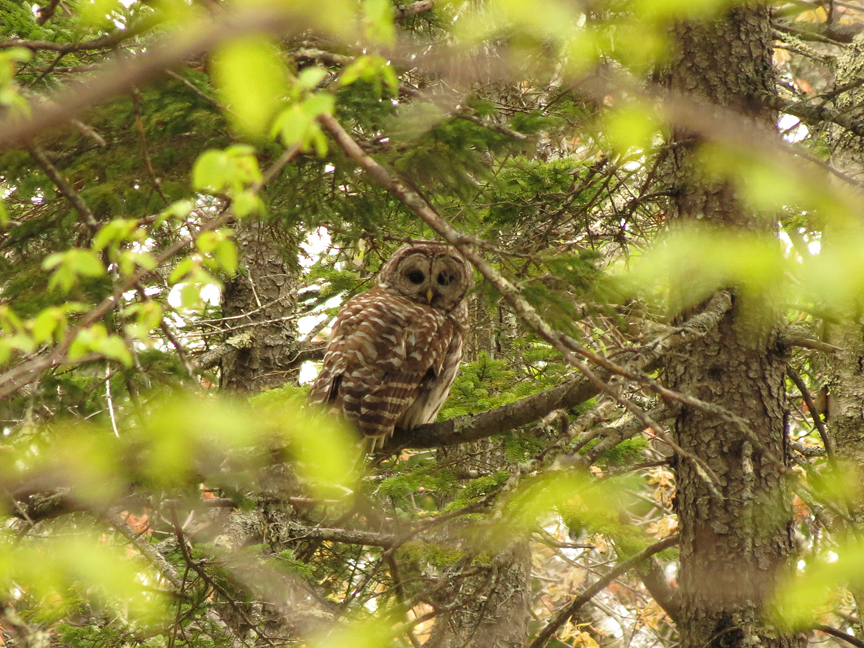 Barred owl. If you’re in the Northern Hemisphere, and you’re thinking you might like to know a little more about the birds around you, the time is now. Floods of migrants are returning, they’re flitting about in the new leaves of the canopy, they’re singing their guts out. All you have to do is listen.
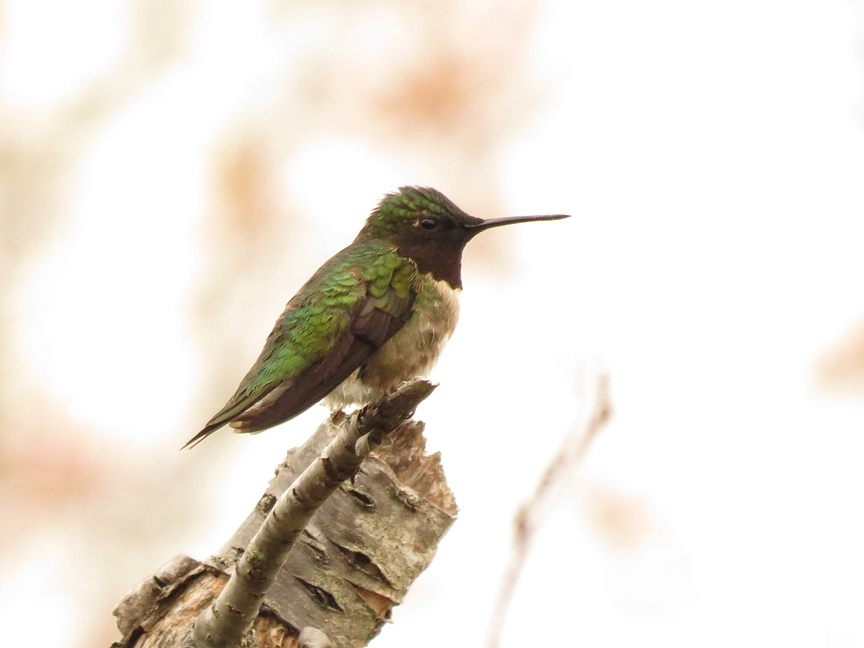 Ruby-throated hummingbird. “Birding” and “birdwatching” are not the same. Most true birders I know have learned to use their ears.
Try this. Get up early. Go out in a mixed woodland. And just stand there. What do you hear? Chances are you hear flutes and chimes and twitters and trills, maybe some buzzy notes, maybe some rattles and squeals. Some near, some far. What are their sources? What tiny, antic winged creatures are making these sounds? You just have to follow them and find out.
That’s how I became a birder—my wonder at the natural music of spring. How well I remember, my first spring in Maine, the sense of awe and confusion I had at the crazy calls of all the returning, singing birds. I’d fixate on a particular call and crash through the trees with a pair of binoculars (you’ll need binoculars) until I’d get a look at the responsible party. And chances were it was a small, moving, colorful bird.
They’re not all colorful, of course, but most of them are. And it’s a good thing, too, because otherwise I wouldn’t have been able to pick them out in my field guide. (You’ll need a field guide.) And as soon as I did—the sweet moment I found the very bird I’d seen making that sound—I claimed that bird forever. I added it to my list. (You don’t absolutely need a list, but nearly all the birders I know keep one. Or several.) And then I’d chase after another bird.
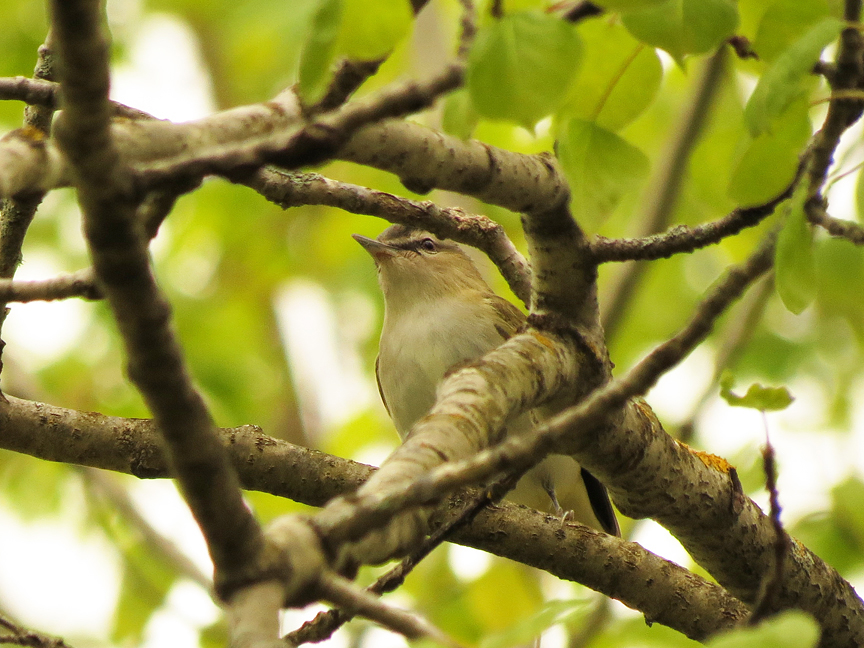 Red-eyed vireo. Now, a few decades later, I know nearly all the songs of the birds that hang out in my particular neighborhood of the planet, so when they return in spring (or when I happen upon the year-round residents in the off-season), I know them by their voices. Kind of like how I know the voices of my friends and family. I don’t need to see them to know they’re there. The uninitiated either think I’m some kind of magician, or they think I’m crazy. Meanwhile, I just keep going out into the woods and listening to birds.
Usually—at this time of year, at least—I listen and then I see. Or I don’t see. But I know they’re there.
It doesn’t always happen that way. Sometimes, your eyes are the important thing. You’ll be walking slowly around a curve of the trail and a woodcock will suddenly take wing right in front of you. Or you’ll be standing in a poplar grove, and tiny warblers will be flitting through the branches above you, and you’ll be checking them out with your binocs, and one will happen to be a magnolia warbler. But it never sang. Never made a peep. Just passing through.
This early morning on Beech Hill, as Jack and I started along a dark stretch of trail, I saw a large bird rise from the understory ahead of us and perch on a large branch. We stopped at once, of course, and I raised my camera. I thought it was a woodland hawk at first, but through the viewfinder I saw it was an owl. A barred owl—the commonest on the hill—and suddenly it was joined by another, also rising on silent wings to an overhanging limb. It posed for a photo.
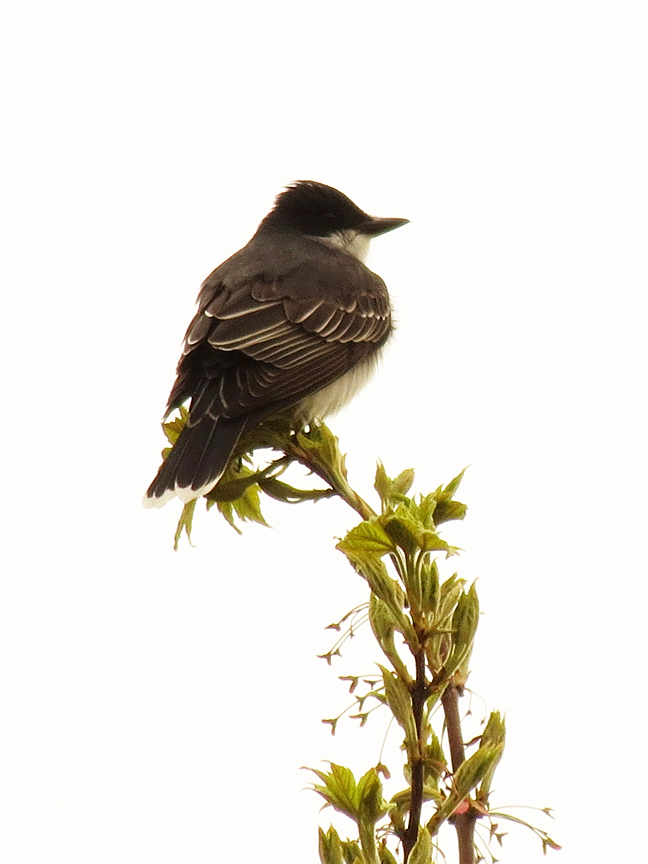 Eastern kingbird. The owls made no sound at all, but the kingbird did. I wouldn’t have seen it otherwise. As, earlier, the first-of-year blackburnian warbler had sung brightly in the lowlands. I never saw the warbler, but I knew it’s voice by heart, and it thrilled me just the same. Two other first-of-year birds—alder and great crested flycatcher—I never saw. But I did see the red-eyed vireo.
A moment ago, in late twilight, I stood out on my back deck and listened. House finch. Crow. Black-throated green warbler. Ovenbird. Cardinal. (I happen to know the individual cardinal, in fact, because half its call, oddly, imitates a song sparrow’s.) The only one I saw was the crow.
The time is now. Do it.
Note: After you’ve gotten a start, you might want to check out my friend Derek Lovitch’s new book, How to Be a Better Birder.
Beech Hill List
Beginning at 7 a.m., I hiked all trails.
1. Common yellowthroat
2. Hermit thrush (v)
3. Black-throated green warbler* (v)
4. Black-and-white warbler*
5. Black-capped chickadee*
6. Chestnut-sided warbler
7. Downy woodpecker (v)
8. Ovenbird*
9. Northern flicker (v)
10. Northern parula (v)
11. Veery
11. Blackburnian warbler‡
12. American crow*
13. Red-eyed vireo‡
14. Rose-breasted grosbeak (v)
15. Herring gull* (v)
16. American redstart
17. Gray catbird
18. Magnolia warbler
19. American robin*
20. Eastern towhee
21. Great crested flycatcher‡ (v)
22. Blue jay
23. Ruby-throated hummingbird
24. Song sparrow*
25. Eastern phoebe
26. White-throated sparrow (v)
27. Field sparrow (v)
28. Alder flycatcher‡ (v)
29. Nashville warbler (v)
30. Savannah sparrow
31. Mourning dove*
32. Tree swallow
33. Wild turkey
34. Eastern kingbird
35. American goldfinch*
36. Yellow warbler (v)
37. Barred owl
38. White-breasted nuthatch (v)
Elsewhere
39. House finch
40. Canada goose
41. Mallard
42. Northern cardinal
v = Voice only
*Also elsewhere
‡First-of-year bird
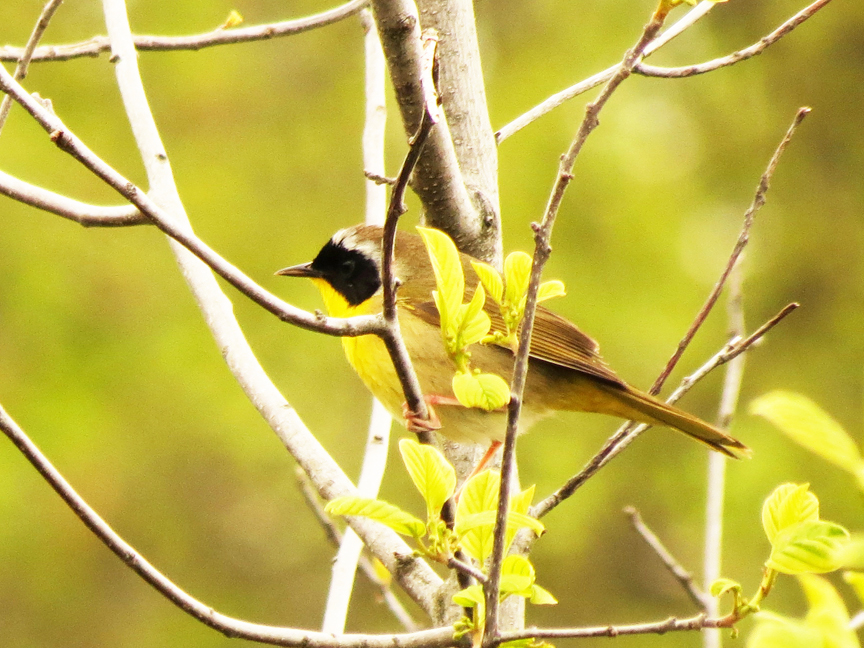 Common yellowthroat.
Tags: alder flycatcher, American crow, American goldfinch, American redstart, American robin, barred owl, black-and-white warbler, black-capped chickadee, black-throated green warbler, blackburnian warbler, blue jay, chestnut-sided warbler, common yellowthroat, downy woodpecker, eastern kingbird, eastern phoebe, eastern towhee, field sparrow, gray catbird, great crested flycatcher, hermit thrush, herring gull, house finch, magnolia warbler, mourning dove, Nashville warbler, northern cardinal, northern flicker, northern parula, ovenbird, red-eyed vireo, rose-breasted grosbeak, ruby-throated hummingbird, savannah sparrow, song sparrow, tree swallow, veery, white-breasted nuthatch, white-throated sparrow, wild turkey, yellow warbler
Posted in Lists, Observations | No Comments »
|
|
| |
| Bird Report is a (sometimes intermittent) record of the birds I encounter while hiking, see while driving, or spy outside my window. —Brian Willson |
|
|


