Showers forecast for this morning, but no rain had fallen when dog and I arrived at the trailhead. An odd morning, though—chilly, mostly overcast, and relatively quiet, bird-wise. Southerly breezes were herding the clouds along, but not much in the way of obvious migration.
Saw a hawk but couldn’t ID it. Heard a couple odd songs/calls but couldn’t spot their sources. Chased a vireo but couldn’t catch it. Saw what I thought was a titmouse but couldn’t confirm.
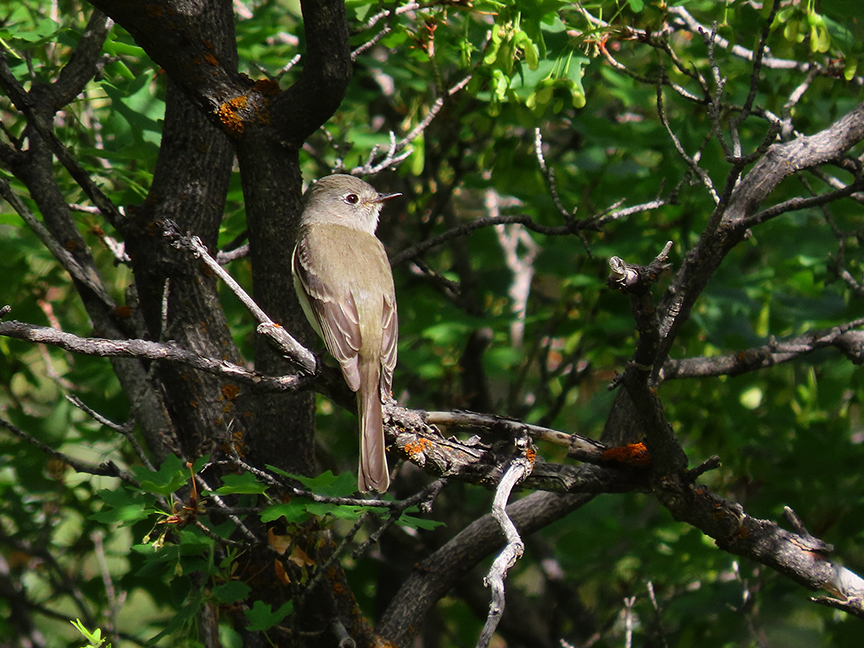
Finally did get a pic of a flycatcher. They’re always hard to identify, but this one (like another I’d caught a glimpse of earlier) had a distinctive whit! note. Plus, it pumped its tail a bit. Later, on consulting allaboutbirds.org, I placed the note, the tail-pump, and the general field marks—short primaries making the tail look longer, white eye-ring visible especially behind the eye—and am pleased to call it my second Dusky Flycatcher of spring.
Grandeur Peak Area List Beginning at 7:38 a.m. (8:38 MDT), I hiked a few hundred feet up a mountain.
Another morning with a nice bit of spring migration going on. Jack feelin’ good, what with all the smells, and me feelin’ good, what with all the empids.
Seriously, I didn’t expect any flycatchers (I’ve learned rarely to expect anything), let alone three. First came what I thought might be a Willow Flycatcher or a Western Wood-pewee (neither of which species I’m very familiar with); then came what I thought might be a willow or maybe Hammond’s Flycatcher; finally came what I was pretty sure was another Gray Flycatcher.
The first turned out to be a wood-pewee, the second turned out to be a Dusky Flycatcher—the second I’ve ever encountered. (The first, coincidentally came on 18 May 2020, exactly a year ago.)
Other cool birds, too. Still a little migration excitement left, I’ll bet.
Grandeur Peak Area List Beginning at 7:05 a.m. (8:05 MDT), I hiked a few hundred feet up a mountain.
1. Lazuli Bunting 2. American Robin* 3. Song Sparrow* (v) 4. Black-chinned Hummingbird 5. Woodhouse’s Scrub-jay 6. Spotted Towhee 7. Blue-gray Gnatcatcher 8. Rock Pigeon 9. Pine Siskin 10. Black-billed Magpie* 11. Mourning Dove 12. Western Wood-pewee† 13. Black-capped Chickadee 14. House Finch** 15. Chipping Sparrow 16. Warbling Vireo 17. Dusky Flycatcher† 18. Black-throated Gray Warbler (v) 19. Black-headed Grosbeak 20. Chukar (v) 21. Lesser Goldfinch** 22. Cooper’s Hawk 23. Gray Flycatcher 24. House Sparrow** (v)
Elsewhere
25. Eurasian Collared-dove (v) 26. California Quail
Mammals
Mountain Cottontail Rock Squirrel
(v) Voice only *Also elsewhere **Voice only elsewhere †First-of-year bird
A lovely hike with dog this clear, birdy morning. Before we’d barely left the switchback, in fact, I had more than a dozen species on my list—including a strange, unexpected bird perched in the big Russian olive tree.
A huge-beaked bird it was, but no Black-headed Grosbeak. Every several seconds it emitted a single bright note, a call I didn’t recognize. Had to be another grosbeak, but which could it be? Not until we got back home and I searched the Cornell Lab site for Utah grosbeaks did I realize what I’d seen: an Evening Grosbeak, a female or immature male.
. Every several seconds it emitted a single bright note, a call I didn’t recognize. Had to be another grosbeak, but which could it be? Not until we got back home and I searched the Cornell Lab site for Utah grosbeaks did I realize what I’d seen: an Evening Grosbeak, a female or immature male.
Decades ago, back in Maine, great flocks of Evening Grosbeaks descended during winter irruptions, and I got to know them very well. And then one year they didn’t return, and I hadn’t seen one since. Not in a span of at least 30 years—and never, I think, a solo individual.
Good to see you, great-beaked bird. I hope you find more of your kind.
Grandeur Peak Area List Beginning at 7:05 a.m. (8:05 MDT), I hiked a few hundred feet up a mountain.