Showers forecast for this morning, but no rain had fallen when dog and I arrived at the trailhead. An odd morning, though—chilly, mostly overcast, and relatively quiet, bird-wise. Southerly breezes were herding the clouds along, but not much in the way of obvious migration.
Saw a hawk but couldn’t ID it. Heard a couple odd songs/calls but couldn’t spot their sources. Chased a vireo but couldn’t catch it. Saw what I thought was a titmouse but couldn’t confirm.
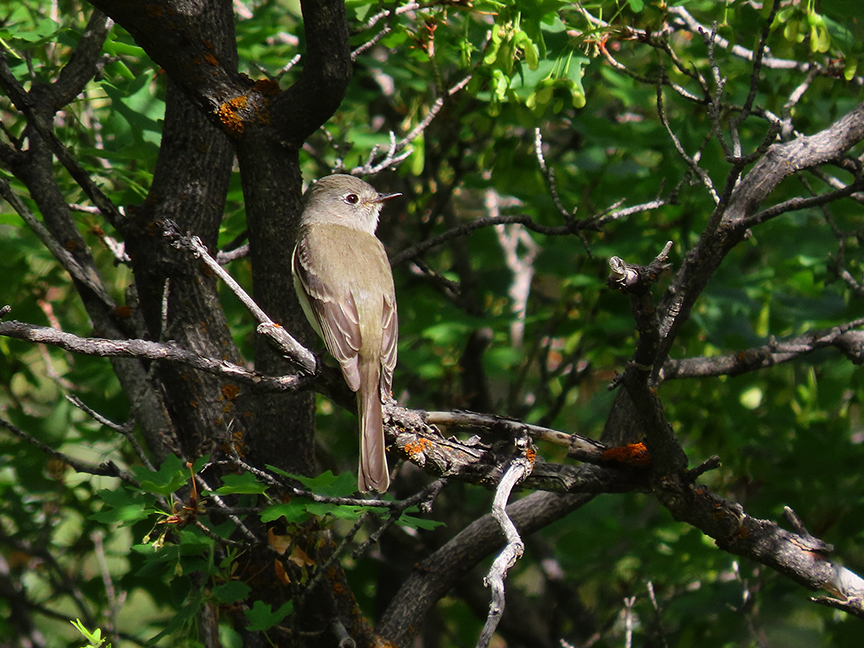
Finally did get a pic of a flycatcher. They’re always hard to identify, but this one (like another I’d caught a glimpse of earlier) had a distinctive whit! note. Plus, it pumped its tail a bit. Later, on consulting allaboutbirds.org, I placed the note, the tail-pump, and the general field marks—short primaries making the tail look longer, white eye-ring visible especially behind the eye—and am pleased to call it my second Dusky Flycatcher of spring.
Grandeur Peak Area List Beginning at 7:38 a.m. (8:38 MDT), I hiked a few hundred feet up a mountain.
Another morning with a nice bit of spring migration going on. Jack feelin’ good, what with all the smells, and me feelin’ good, what with all the empids.
Seriously, I didn’t expect any flycatchers (I’ve learned rarely to expect anything), let alone three. First came what I thought might be a Willow Flycatcher or a Western Wood-pewee (neither of which species I’m very familiar with); then came what I thought might be a willow or maybe Hammond’s Flycatcher; finally came what I was pretty sure was another Gray Flycatcher.
The first turned out to be a wood-pewee, the second turned out to be a Dusky Flycatcher—the second I’ve ever encountered. (The first, coincidentally came on 18 May 2020, exactly a year ago.)
Other cool birds, too. Still a little migration excitement left, I’ll bet.
Grandeur Peak Area List Beginning at 7:05 a.m. (8:05 MDT), I hiked a few hundred feet up a mountain.
1. Lazuli Bunting 2. American Robin* 3. Song Sparrow* (v) 4. Black-chinned Hummingbird 5. Woodhouse’s Scrub-jay 6. Spotted Towhee 7. Blue-gray Gnatcatcher 8. Rock Pigeon 9. Pine Siskin 10. Black-billed Magpie* 11. Mourning Dove 12. Western Wood-pewee† 13. Black-capped Chickadee 14. House Finch** 15. Chipping Sparrow 16. Warbling Vireo 17. Dusky Flycatcher† 18. Black-throated Gray Warbler (v) 19. Black-headed Grosbeak 20. Chukar (v) 21. Lesser Goldfinch** 22. Cooper’s Hawk 23. Gray Flycatcher 24. House Sparrow** (v)
Elsewhere
25. Eurasian Collared-dove (v) 26. California Quail
Mammals
Mountain Cottontail Rock Squirrel
(v) Voice only *Also elsewhere **Voice only elsewhere †First-of-year bird
Empids are hard. I’ve gotten to where I can tell them apart pretty dependably—those I know well, anyway—by their voices. But when a new species shows up and makes not a sound, what do you do?
Black-chinned Hummingbird.
Well, I spent a long time researching Utah flycatchers in the genus Empidonax, comparing field marks with several photos I took of this morning’s quiet bird. At first I thought it a Hammond‘s Flycatcher—but the beak seems too big and the primaries are too short. (Also, it didn’t pump its tail at all.) Finally settled on Dusky Flycatcher, whose tail looks longer (because its primaries are shorter) and has a longer beak.
(Both have white eye-rings and a whitish area about the lores.)
The habitat information also played a part: the dusky tends to lurk in shady greenery (where this bird was hanging out), whereas the Hammond’s will perch high.
I could be wrong, of course, but this is my educated guess. Hope to learn more about the flycatchers here over the course of the coming seasons.
Grandeur Peak Area List Beginning at 8 a.m., I hiked several hundred feet up a mountain.