


Cedar waxwing.
Not quite so warm today, but still muggy, and with seemingly more mosquitoes at Beech Hill. Also more cuckoos. I heard two calling at once: one at some distance, and one very near uttering a repeated one-note call of alarm (I assume), and I tried stalking the near one—walking very slowly, keeping Jack behind me—but they’re stealthy, skulk about in thick greenery, and are quick to take flight. I got a look at this one, at least, as it flew away from us down the trail toward the other, and began again to sound the alarm.
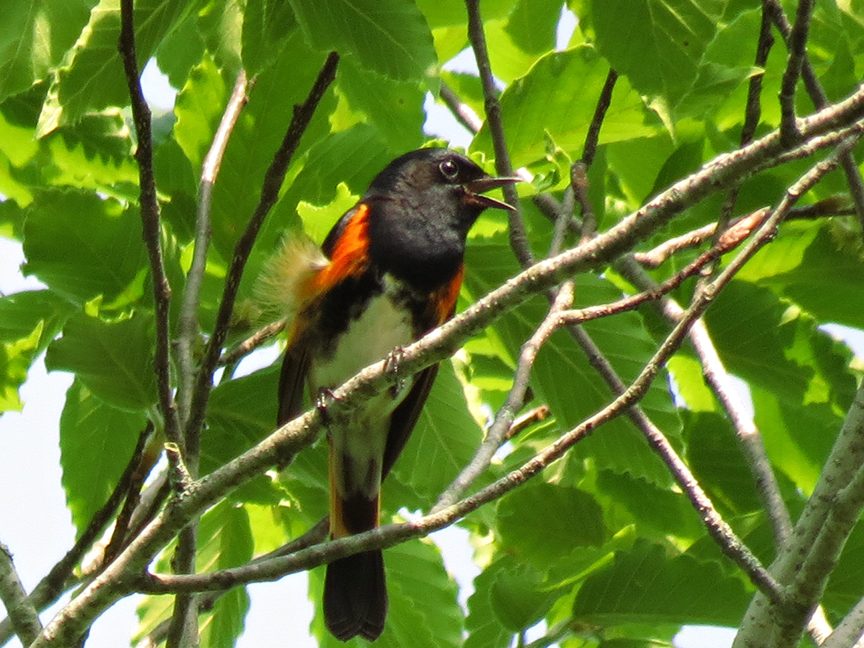
American redstart.
Plenty of other birds, mostly singing from fixed perches near nest sites, or passing quickly through—like a couple packs of waxwings I saw above the open fields. Plenty of flycatchers, which makes sense when you consider all the mosquitoes and black flies still buzzing about. (Saw a few dragonflies, too, and more butterflies.) Pewee, phoebe, alder flycatcher, great crested flycatcher. I heard a great crested out back of my place later in the day, in fact, and my hope is it’ll stick around in the great open area surrounded by the green foliage of tall oaks. I’d like to get a decent photo of this handsome bird.
Back on the hill, I noticed, too, there seems to be a minor tent-caterpillar infestation. Many folks think their bright webs unattractive and bad for plant life and would just as soon they disappear. I think how cuckoos like dining on tent caterpillars and so am happy they’re around. My best bet, come to think of it, might be to stand still for a while near a few of the webs and wait for a black-billed cuckoo to come along.
Because one thing’s for sure: you can’t stalk a cuckoo.
Beech Hill List
Beginning at 7:45 a.m., I hiked all trails.
1. Ovenbird** (v)
2. Wild turkey (v)
3. Red-eyed vireo**
4. Chestnut-sided warbler**
5. Black-throated green warbler** (v)
6. Hermit thrush (v)
7. American goldfinch
8. Gray catbird**
9. Black-and-white warbler**
10. American robin*
11. Rose-breasted grosbeak (v)
12. American redstart**
13. Veery (v)
14. Eastern towhee
15. Black-billed cuckoo
16. Common yellowthroat**
17. Yellow warbler**
18. Alder flycatcher
19. Great crested flycatcher**
20. Mourning dove*
21. Eastern wood-pewee** (v)
22. American crow*
23. Field sparrow
24. Tufted titmouse** (v)
25. Eastern phoebe**
26. Song sparrow**
27. Nashville warbler (v)
28. Savannah sparrow
29. Chipping sparrow** (v)
30. Blue jay** (v)
31. Cedar waxwing
32. Red-tailed hawk
33. Hairy woodpecker
34. Black-throated blue warbler (v)
35. Scarlet tanager (v)
Elsewhere
36. House finch
37. Herring gull
38. Green heron†
39. European starling
40. Common grackle
41. Laughing gull (v)
42. Canada goose
v = Voice only
*Also elsewhere
**Voice only elsewhere
†First-of-year bird
Tags: alder flycatcher, American crow, American goldfinch, American redstart, American robin, black-and-white warbler, black-billed cuckoo, black-throated blue warbler, black-throated green warbler, blue jay, Canada goose, Cedar waxwing, chestnut-sided warbler, chipping sparrow, common grackle, common yellowthraot, eastern phoebe, eastern towhee, eastern wood-pewee, European starling, field sparrow, gray catbird, great crested flycatcher, green heron, hairy woodpecker, hermit thrush, herring gull, house finch, laughing gull, mourning dove, Nashville warbler, ovenbird, red-eyed vireo, red-tailed hawk, rose-breasted grosbeak, savannah sparrow, scarlet tanager, song sparrow, tufted titmouse, veery, wild turkey, yellow warbler

