


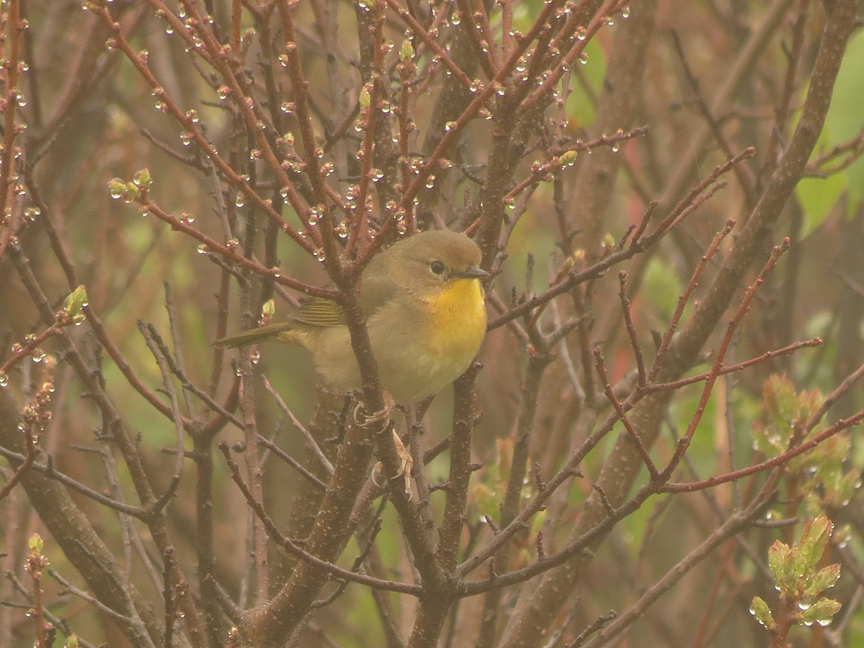
Common yellowthroat (female).
You might be surprised at how many birds you can spot on a foggy morning—at least at this time of year.

Northern parula.
Jack and I rose early today and hit the trail first thing. It had rained overnight and the canopy was drippy and the trail was muddy and fog kept descending and rising and descending again. Lots of warblers singing in the canopy, but would I see any?
You bet. With low visibility comes a certain degree of intimacy. Seems all I had to do was pick a likely spot along the trail—somewhere near an edge, between taller trees and a thicket, between a field and a hedgerow—and the birds would come to me. I stood beside an apple tree, and a northern parula popped into view. I paused along the trail near where I heard chestnut-sided warblers singing, and sure enough one flitted by. I stopped at the edge of the first upper field and got to watch two territorial yellow warblers chase each other around for a while.
Yellow warblers were moving through, apparently. So were redstarts. The two species were everywhere, it seemed. Down near the Beech Hill Road parking lot, I witnessed a dramatic redstart chase—around a little yard, through some small trees, and back around the yard again.

Black-throated green warbler.
On the open trail, a song sparrow hopped around ahead of us, plucking small morsels from the damp gravel. In a bit of scrub, Jack and I waited until a female yellowthroat burst out into the open to see who had arrived.
The morning was dark, though—not exactly conducive to wild bird photography. Still, I somehow managed to get maybe a half dozen clear photos amid at least a hundred that showed only blurry, fuzzy, swirling shapes of color.
Thanks to a bunch of agreeable little flitting, hungry, migratory, urgently territorial birds.
Beech Hill List
Beginning at 6:30 a.m., I hiked all trails.
1. Ovenbird*
2. Common yellowthroat
3. Chestnut-sided warbler
4. Black-throated green warbler
5. Eastern phoebe
6. Red-eyed vireo (v)
7. Black-and-white warbler
8. American crow*
9. American robin*
10. Northern parula
11. Black-capped chickadee*
12. Veery
13. American redstart
14. Rose-breasted grosbeak (v)
15. Herring gull* (v)
16. Blue jay* (v)
17. Great crested flycatcher (v)
18. Mourning dove*
19. Tufted titmouse* (v)
20. Eastern towhee
21. Gray catbird*
22. Mallard*
23. American goldfinch* (v)
24. Song sparrow*
25. Magnolia warbler
26. White-breasted nuthatch
27. Downy woodpecker
28. Yellow warbler*
29. Nashville warbler
30. Ruby-throated hummingbird
31. White-throated sparrow (v)
32. Tree swallow (v)
33. Savannah sparrow
34. Alder flycatcher (v)
35. Chipping sparrow
36. Blackpoll warbler (v)
37. Brown-headed cowbird (v)
38. Northern cardinal*
39. Wild turkey (v)
40. Northern flicker (v)
Elsewhere
41. House finch
42. Laughing gull
43. European starling
44. Rock pigeon
v = Voice only
*Also elsewhere

Song sparrow.
Tags: alder flycatcher, American crow, American goldfinch, American redstart, American robin, black-and-white warbler, black-capped chickadee, black-throated green warbler, blackpoll warbler, blue jay, brown-headed cowbird, chestnut-sided warbler, chipping sparrow, common yellowthroat, downy woodpecker, eastern phoebe, eastern towhee, European starling, gray catbird, great crested flycatcher, herring gull, house finch, laughing gull, magnolia warbler, mallard, mourning dove, Nashville warbler, northern cardinal, northern flicker, northern parula, ovenbird, red-eyed vireo, rock pigeon, rose-breasted grosbeak, ruby-throated hummingbird, savannah sparrow, song sparrow, tree swallow, tufted titmouse, veery, white-breasted nuthatch, white-throated sparrow, wild turkey, yellow warbler

