I’ll admit it: I’m a patch birder. For about a decade or so I’ve regularly birded one patch or other (with a rare—and delightful—excursion to Monhegan Island, one of my favorite places on the planet). Sure, patch birders might miss out on variety, rare vagrants, long life lists. But if you really want to get to know a place, it helps to get to know individual birds when they return to their particular trees each spring.
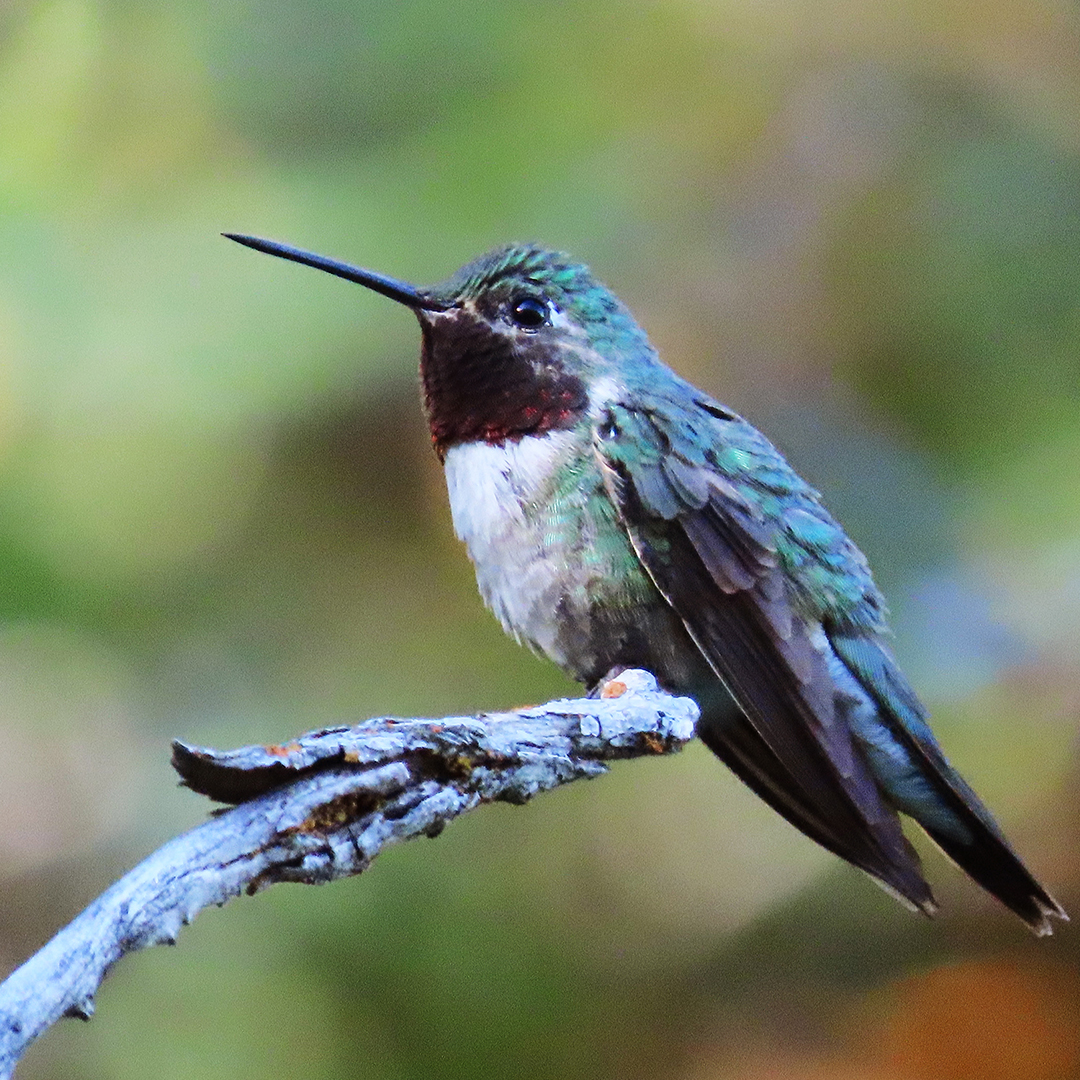
Broad-tailed Hummingbird (male).
I’m also an ear birder—that is, my very first true birding experiences involved chasing down songs until I found the birds that made ’em. (Fortunately, my ears remain more sensitive than my eyes even.)
In this new (well, almost year-old) Utah patch, I’ve gotten to know a bunch of new species, individual members of those species, their voices, their habits, their subtler sounds. Take, for instance, the Black-throated Green Warbler. Just today I confirmed that I can ID that species by its chip note. Tell you the truth, it feels kind of like a superpower.
Also today, I heard a chip note I had not yet learned. It sounded to me like a warbler’s, but it wasn’t a dry note (like the black-throated gray’s)—it had a touch of music to it. A tiny sweet tone. And then I spied the bird.
My next challenge is to be able to ID a Virginia’s Warbler by its chip. We shall see.
Grandeur Peak Area List Beginning at 8 a.m., I hiked a few hundred feet up a mountain.
1. Rock Pigeon* 2. Lazuli Bunting 3. Mourning Dove 4. House Finch* 5. Blue-gray Gnatcatcher 6. Brewer’s Sparrow 7. Spotted Towhee 8. American Robin** 9. Black-capped Chickadee (v) 10. Black-chinned Hummingbird 11. Broad-tailed Hummingbird 12. Cooper’s Hawk 13. Virginia’s Warbler 14. Woodhouse’s Scrub-jay (v) 15. Black-throated Gray Warbler 16. Pine Siskin (v) 17. Barn Swallow
Elsewhere
18. Black-billed Magpie (v)
(v) Voice only *Also elsewhere **Voice only elsewhere
Broad-tailed Hummingbirds have not been cooperative when it comes to posing for photos—until today.
I’ve caught glimpses of these high-elevation hummers in Coyote Canyon—the cool, shady valley that dog and I ascend each morning—as they zip around hunting tiny insects among the proliferous bigtooth maple leaves. But the light is dim, and hummingbirds are active, and I sort of gave up.
Today, though, there a few (or more) were making those cricket-like sounds with their wings above us as, so I stopped to watch and listen, and a male decided to perch right in front of me. (I rarely see males, either, since they’re basically chauvinist pigs who sleep around and the leave the nest-building, chick-rearing, and youngster-feeding to females.)
Male Black-throated Gray Warbler feeding fledgling.
Felt good to grab that photo.
In contrast, just beyond the hummers, I happened upon a male Black-throated Gray Warbler bring a small lacy-winged insect to a begging fledgling.
And so life goes on despite it all.
Grandeur Peak Area List Beginning at 8 a.m., I hiked a few hundred feet up a mountain.
Serious birders use shorthand for the species they see or hear—four-letter alpha codes (based on the English names) standardized by the Institute for Bird Populations. So when you hear somebody say they saw a MODO and a flock of BOWAs, what they really mean is they saw a Mourning Dove and a bunch of Bohemian Waxwings.
The rules are fairly easy to follow, but sometimes there are conflicts. Back in Maine, for instance, when I saw a Black-throated Green Warbler, I might refer to it as a BTGW—but now that I’m birding Utah, what if I spy a Black-throated Gray Warbler? Welp, gotta learn to refer to it as a BTYW.
Long story short: today I saw a BTYW.
Grandeur Peak Area List Beginning at 8 a.m., I hiked a few hundred feet up a mountain.