|
|
 |
|
|
Posts Tagged ‘black-billed cuckoo’
Saturday, September 22nd, 2012
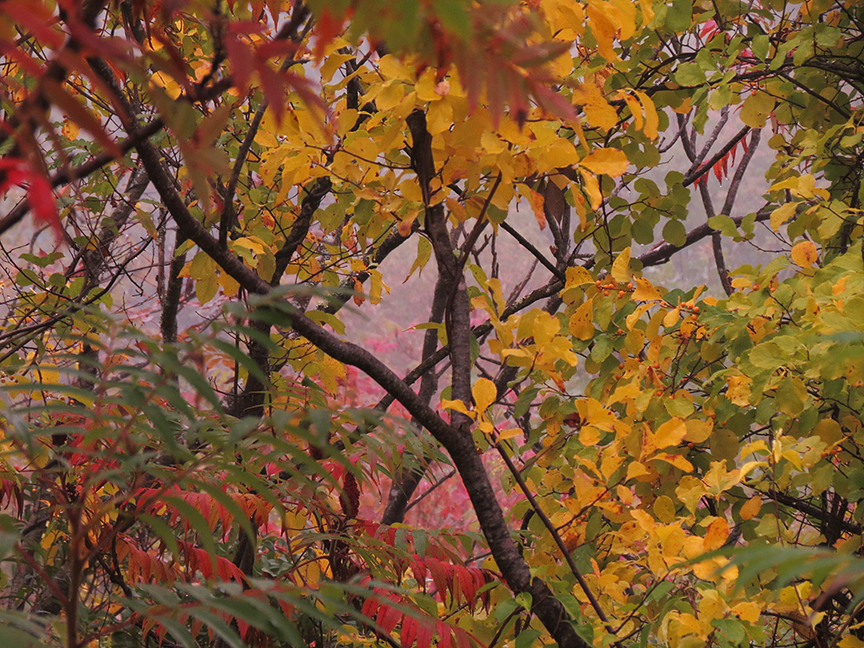 Some color. Fall is the sweetest equinox here on the 44th parallel. (The other one is spiteful and untrustworthy.) Today had drizzle and fog and birds on Beech Hill. In fact, at one point on my afternoon hike with Jack, a black-billed cuckoo hopped up onto a branch right in front of us, but by the time I’d lifted my camera, it had flown.
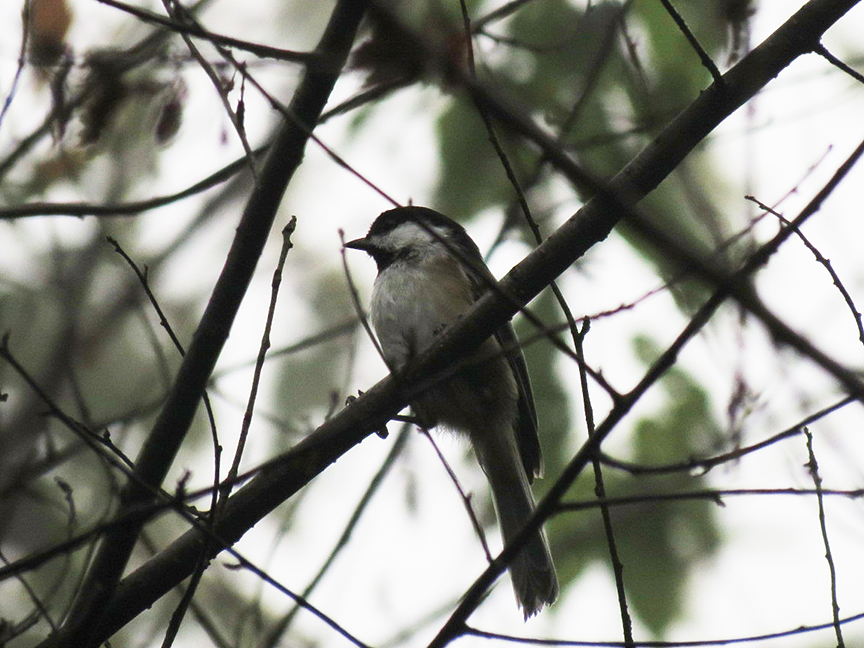 Black-capped chickadee. Tomorrow: Monhegan. Will keep you posted.
Beech Hill List
Beginning at 3:15 p.m., I hiked the wooded trails.
1. Black-capped chickadee**
2. Red-eyed vireo**
3. Gray catbird
4. Yellow-rumped warbler
5. American woodcock
6. American crow* (v)
7. Black-billed cuckoo
8. Eastern towhee (v)
9. Blue jay** (v)
10. Northern flicker (v)
Elsewhere
11. Herring gull
12. Rock pigeon
v = Voice only
*Also elsewhere
**Voice only elsewhere
Tags: American crow, American woodcock, black-billed cuckoo, black-capped chickadee, blue jay, eastern towhee, gray catbird, herring gull, northern flicker, red-eyed vireo, rock pigeon, yellow-rumped warbler
Posted in Lists, Observations | No Comments »
Friday, June 15th, 2012
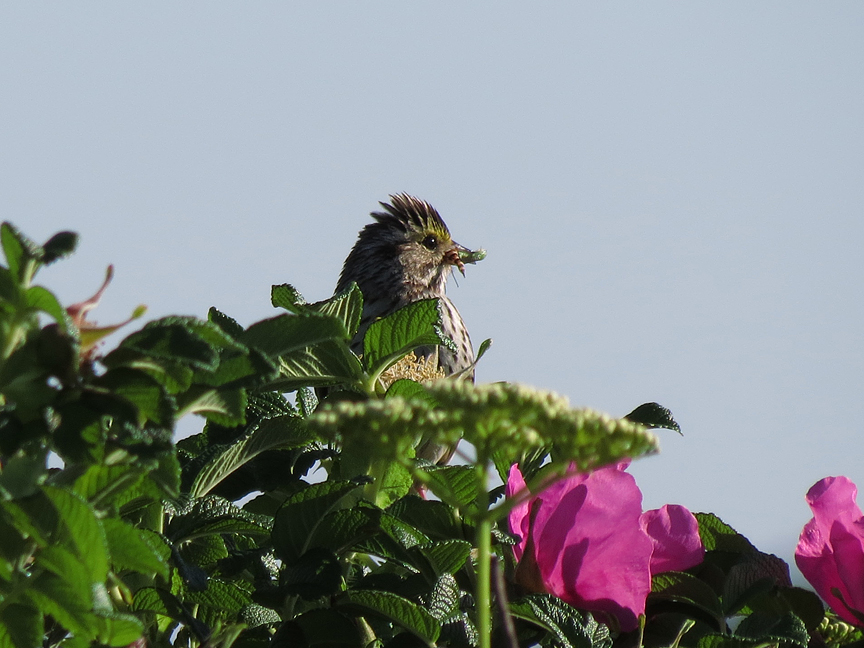 Savannah sparrow. One of the real treats of Beech Hill is that it appeals to Savannah sparrows. I just love those little guys.
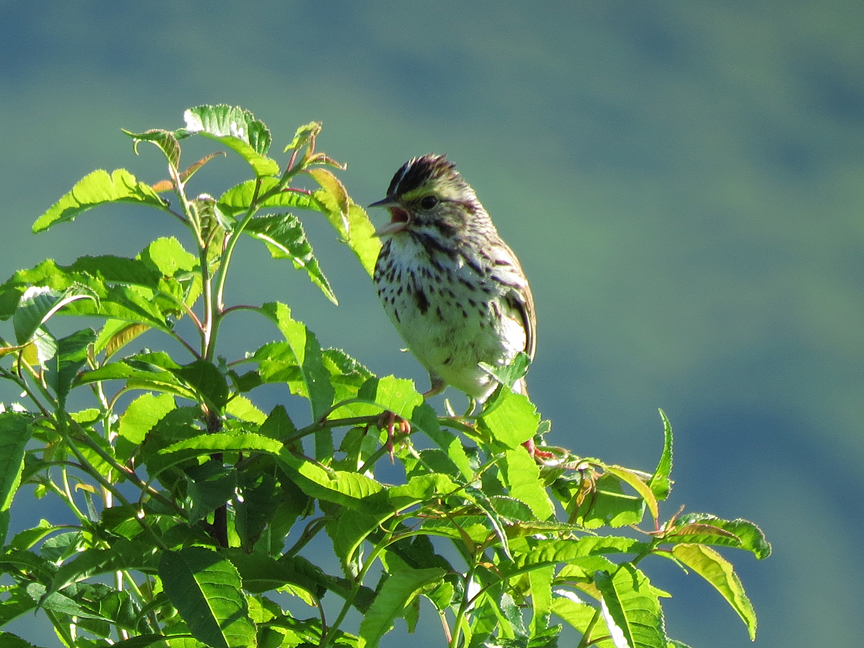 Savannah sparrow. Savannah sparrows aren’t uncommon, but they’re uncommonly recognized. At least I don’t usually notice them except on their breeding territory—and, conveniently, Beech Hill is perfect breeding territory for Savannahs. They like grassy, sedgy fields with a little protective cover here and there, where they build small, low hidden nests, which—at this northern latitude—they tend fairly briefly. Just now, they’re in the middle of not much more than a week of feedling hatchlings, I’m pretty sure. I say that because for the past few days I’ve seen ’em with beaks packed full of bugs, en route to feed the brood. Very soon, the chicks will fledge and fly.
Pretty amazing.
This afternoon, Jack and I had a nice little hike—still plenty of mosquitoes and ticks, but who cares?—and my list ended up with an fairly uncommon cuckoo on it. Resident thrushes, resident warblers, resident sparrows. I also saw song and field sparrows at the summit, but mostly I saw Savannahs.
Partly that’s because they tend to be rather visible. At least early (when the males claim territory) and now that they’re scrambling to feed chicks. I got a good look at three or four today, perched in rose bushes, perched on trailside posts, perched on the porch wall of Beech Nut. (Again I say—in hopes no one bothers them—that there’s a nest on the hut’s grassy roof.) Another thing I love about them is their call: a thin collection of trills and chips, ending in a little hiccup, reminiscent of some exotic cicada or other insect. Just really a thrill sound. to me.
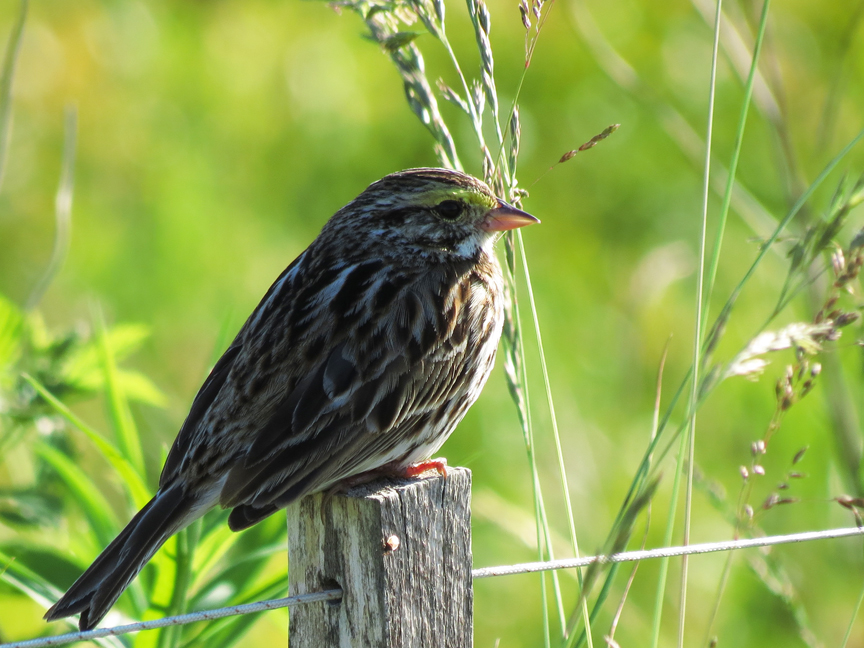 Savannah sparrow. And I like their feistiness. I have a theory that sparrows are smarter than most little songbirds, and that’s why they don’t mind staying fairly visible even during nesting season. I’m sure they feel differently about danger from above, but when a man and dog approach, they just instinctively know how close you can get before they’d better flee. And that’s pretty close. Which has made their comely appearance so familiar: the light, streaked underside, the tanish-coppery back and wings, the yellow puff in front of each eye, the fluffed head feathers, the darker upper bill. I’ve just got a thing for them, I guess.
And in what might be an interesting aside: this blog post is the first place I’ve ever capitalized the “Savannah” in “Savannah sparrow”—since I just found out they were named not for a bush-dotted grassland but for the city of Savannah, Georgia.
Beech Hill List
Beginning at 5:15 p.m., I hiked all trails.
1. Red-eyed vireo (v)
2. Chestnut-sided warbler* (v)
3. Veery
4. Ovenbird* (v)
5. American redstart* (v)
6. American crow* (v)
7. Eastern towhee (v)
8. Black-billed cuckoo (v)
9. Herring gull* (v)
10. Yellow warbler* (v)
11. Hermit thrush* (v)
12. Common yellowthroat* (v)
13. Gray catbird* (v)
14. Black-and-white warbler* (v)
15. American goldfinch* (v)
16. Song sparrow*
17. Cedar waxwing* (v)
18. Eastern phoebe
19. Savannah sparrow
20. Field sparrow
21. Alder flycatcher (v)
22. American robin*
23. Eastern wood-pewee (v)
24. Black-throated green warbler* (v)
25. Black-capped chickadee (v)
Elsewhere
26. House finch (v)
27. Tufted titmouse
28. Broad-winged hawk (v)
29. House sparrow
30. Rock pigeon
31. Chipping sparrow (v)
32. Northern cardinal (v)
v = Voice only
*Also elsewhere
Tags: alder flycatcher, American crow, American goldfinch, American redstart, American robin, black-and-white warbler, black-billed cuckoo, black-capped chickadee, black-throated green warbler, broad-winged hawk, Cedar waxwing, chestnut-sided warbler, chipping sparrow, common yellowthroat, eastern phoebe, eastern towhee, eastern wood-pewee, field sparrow, gray catbird, hermit thrush, herring gull, house finch, house sparrow, northern cardinal, ovenbird, red-eyed vireo, rock pigeon, savannah sparrow, song sparrow, tufted titmouse, veery, yellow warbler
Posted in Lists, Observations | No Comments »
Saturday, June 2nd, 2012
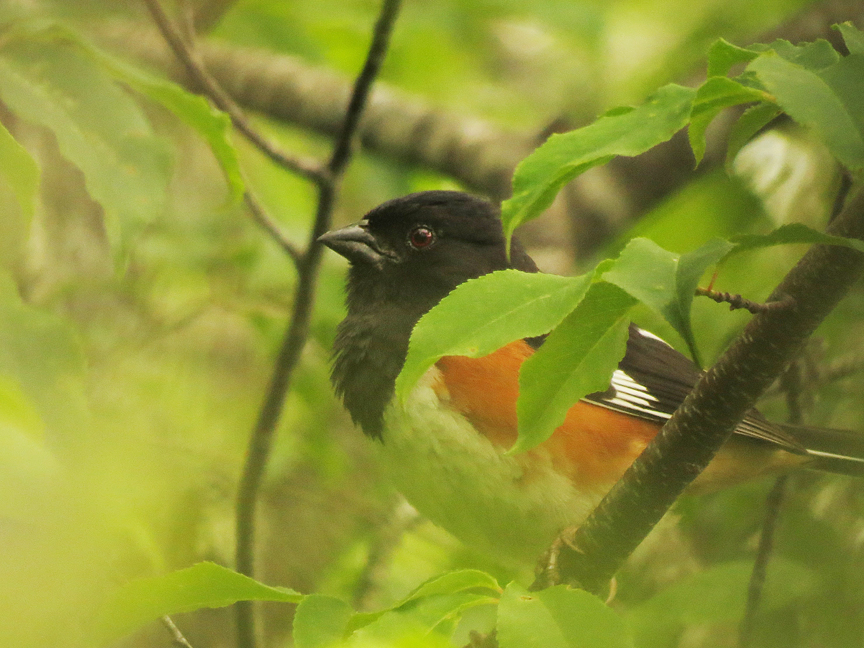 Eastern towhee. On my first full spring in Maine years ago—I’ve surely told this story before—I was slowly sneaking up on a booming grouse in hopes of seeing what I’d heard was a remarkable spring display. It was booming just over a wooded rise, and I had sunk to my belly on the leafy forest floor. I’d wait several seconds, then creep a few feet, wait, creep, repeat. When my eyes cleared the rise, I was dismayed to see a large fallen tree between the partridge and me. As I lay there, fully focused on the grouse, a snowshoe hare loped up from my right and stood just a few feet from me, sniffing, oblivious. Immediately, my full attention turned to the rabbit, which I watched lope obliviously away.
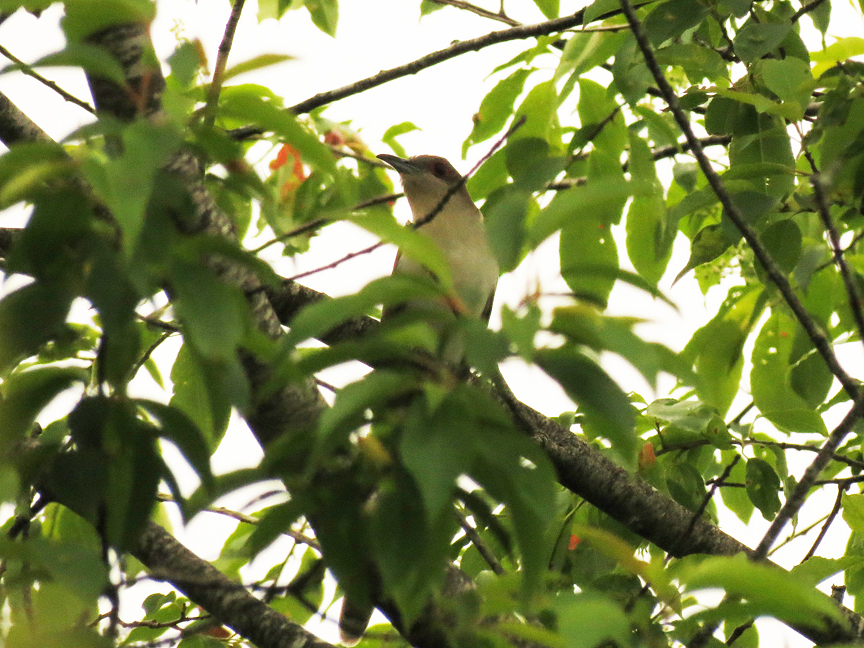 Black-billed cuckoo. Big rain in the forecast, so Jack and I hiked Beech Hill early. Mostly overcast, with an ominous, blustery breeze. Heard many birds singing, saw a few. I remembered to slow at all the muddy places in case of a woodcock, but no woodcock appeared. At the edge of the upper fields, I heard the faint peeping of an alder flycatcher that I know is nesting at a curve in the trail and decided to go slowly in hopes of a photo. Walked in slow motion, keeping Jack behind me—it’s a familiar routine to both of us at this point—until we rounded a leafy young tree. I could hear the flycatcher still but couldn’t find it in the next tree, so I figured it sat in a third tree beyond, and we continued our slow-motion stalk to the far side of the second tree then stopped. Only vaguely did I hear a yellowthroat singing behind us and the notes of a towhee far ahead of us and crows cawing in the distance, because my attention was fixed to the intermittent peeps of bird in front of us, just there, somewhere.
Abruptly, from some brush just to our left, there came a little burst of low squawks—not a familiar sound at all. My full attention turned. The bird made no further sound. Cuckoo, was my first thought. Or could it have been a turkey hen calling to her chicks? We waited a while, but the source of the squawks stayed hidden. After a minute or so, the flycatcher moved on, so we did, too.
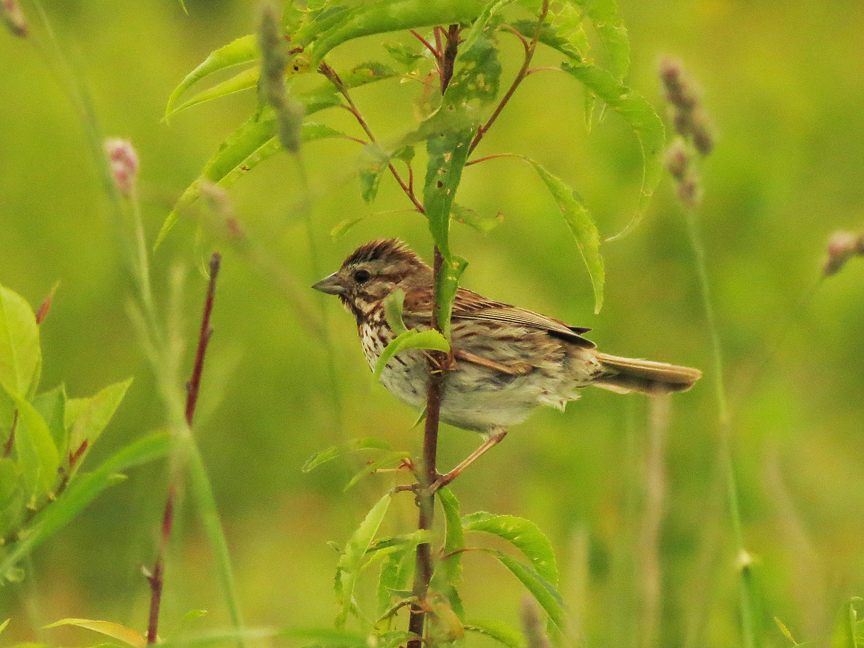 Song sparrow. Lots of redstarts on the hill this year. Plenty of the usual warblers, thrushes, and sparrows. Coming down the open trail, as I stood scanning the grass for the savannah sparrow directing tiny, angry chips at us, I heard the unmistakable voice of a bluebird, and my attention turned to the little birches around us. Then I saw the bluebird flying high over the hill, southbound.
Returning around the corner where I’d stalked the flycatcher earlier, we slowed in case it might present itself, or perhaps the yellow warbler I heard singing nearby. I’d assumed whatever had made the squawk was long gone—well, so much for assumptions. Because a sleek bird leapt suddenly out of the brush across the trail and lit in a shady branch of a little small tree. Sure enough, it was a black-billed cuckoo. First-of-year bird for me. And now I’ve added another vocalization to the three or four I already know cuckoos are prone to.
That’s one of the small dependable joys of birding—and life generally. You’re looking for one thing and end up finding another.
Beech Hill List
Beginning at 9:30 a.m., I hiked all trails.
1. Ovenbird (v)
2. Red-eyed vireo (v)
3. Common yellowthroat*
4. Chestnut-sided warbler
5. Rose-breasted grosbeak (v)
6. Alder flycatcher (v)
7. Veery (v)
8. Eastern towhee
9. American redstart
10. Black-and-white warbler (v)
11. Yellow warbler
12. Gray catbird (v)
13. Song sparrow
14. American robin* (v)
15. Blue jay
16. Nashville warbler (v)
17. Black-billed cuckoo‡
18. Black-throated green warbler (v)
19. Cedar waxwing (v)
20. Eastern phoebe
21. Savannah sparrow
22. Field sparrow (v)
23. American crow* (v)
24. Eastern bluebird
25. American goldfinch*
26. Tufted titmouse
27. Least flycatcher (v)
28. Purple finch (v)
29. Northern flicker
30. Hermit thrush (v)
31. Eastern wood-pewee (v)
32. Hairy woodpecker (drumming)
32. Black-capped chickadee (v)
Elsewhere
33. House finch (v)
34. Herring gull
35. Mallard
36. Mourning dove
37. Common grackle
v = Voice only
*Also elsewhere
‡First-of-year bird
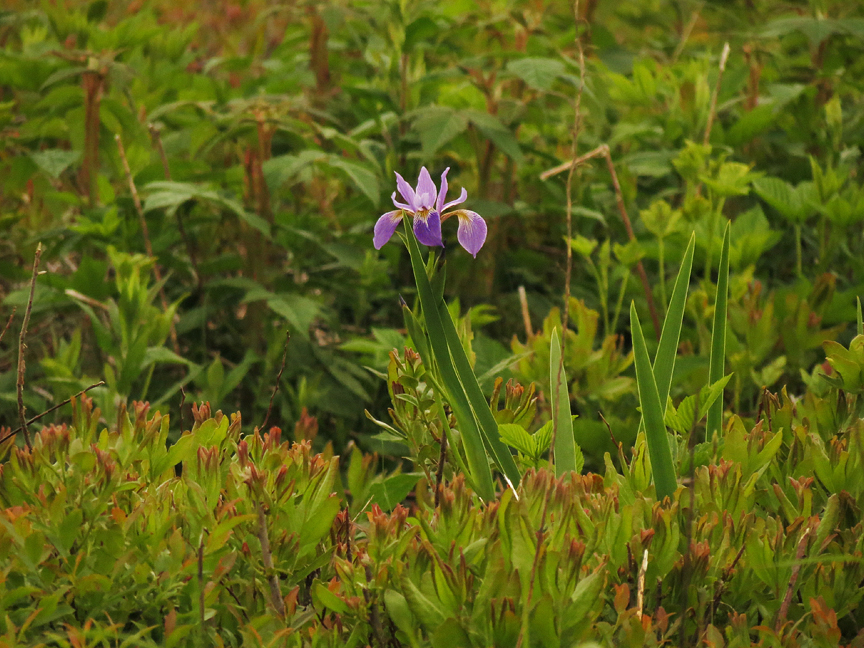 Wild iris.
Tags: alder flycatcher, American crow, American goldfinch, American redstart, American robin, black-and-white warbler, black-billed cuckoo, black-capped chickadee, black-throated green warbler, blue jay, Cedar waxwing, chestnut-sided warbler, common grackle, common yellowthroat, eastern phoebe, eastern towhee, eastern wood-pewee, field sparrow, gray catbird, hairy woodpecker, hermit thrush, herring gull, house finch, least flycatcher, mallard, mourning dove, Nashville warbler, northern flicker, ovenbird, purple finch, red-eyed vireo, rose-breasted grosbeak, savannah sparrow, song sparrow, tufted titmouse, veery, yellow warbler
Posted in Lists, Observations | No Comments »
|
|
| |
| Bird Report is a (sometimes intermittent) record of the birds I encounter while hiking, see while driving, or spy outside my window. —Brian Willson |
|
|


