


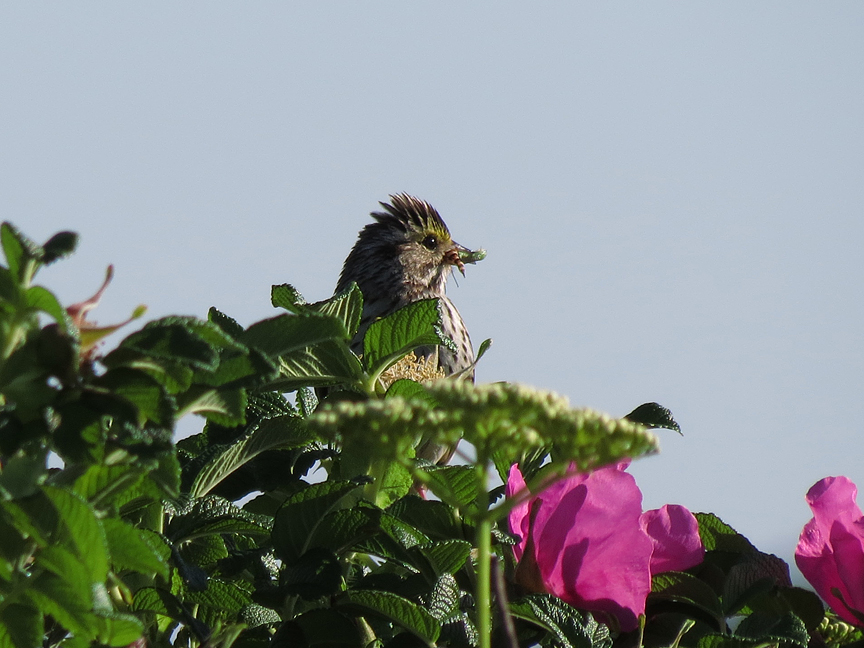
Savannah sparrow.
One of the real treats of Beech Hill is that it appeals to Savannah sparrows. I just love those little guys.
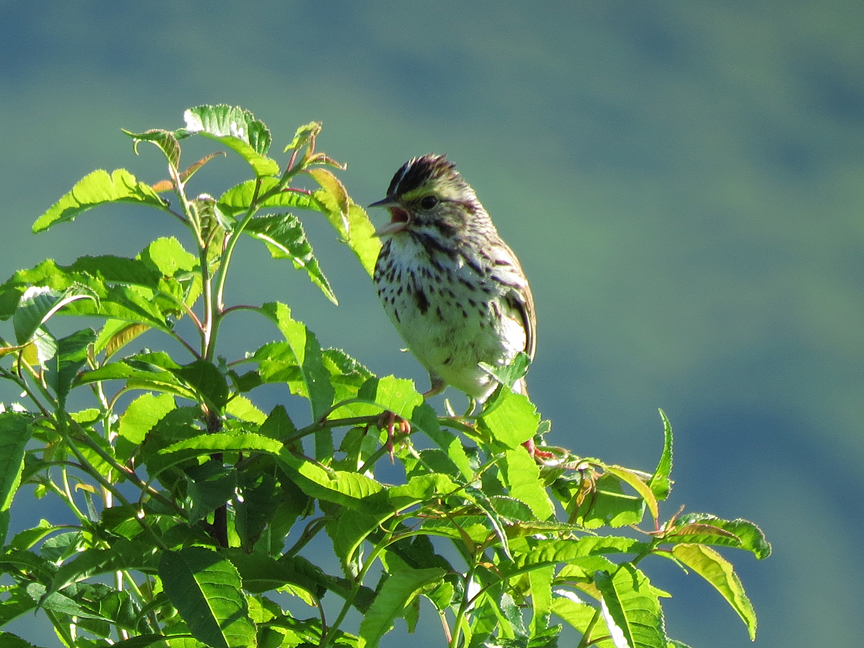
Savannah sparrow.
Savannah sparrows aren’t uncommon, but they’re uncommonly recognized. At least I don’t usually notice them except on their breeding territory—and, conveniently, Beech Hill is perfect breeding territory for Savannahs. They like grassy, sedgy fields with a little protective cover here and there, where they build small, low hidden nests, which—at this northern latitude—they tend fairly briefly. Just now, they’re in the middle of not much more than a week of feedling hatchlings, I’m pretty sure. I say that because for the past few days I’ve seen ’em with beaks packed full of bugs, en route to feed the brood. Very soon, the chicks will fledge and fly.
Pretty amazing.
This afternoon, Jack and I had a nice little hike—still plenty of mosquitoes and ticks, but who cares?—and my list ended up with an fairly uncommon cuckoo on it. Resident thrushes, resident warblers, resident sparrows. I also saw song and field sparrows at the summit, but mostly I saw Savannahs.
Partly that’s because they tend to be rather visible. At least early (when the males claim territory) and now that they’re scrambling to feed chicks. I got a good look at three or four today, perched in rose bushes, perched on trailside posts, perched on the porch wall of Beech Nut. (Again I say—in hopes no one bothers them—that there’s a nest on the hut’s grassy roof.) Another thing I love about them is their call: a thin collection of trills and chips, ending in a little hiccup, reminiscent of some exotic cicada or other insect. Just really a thrill sound. to me.
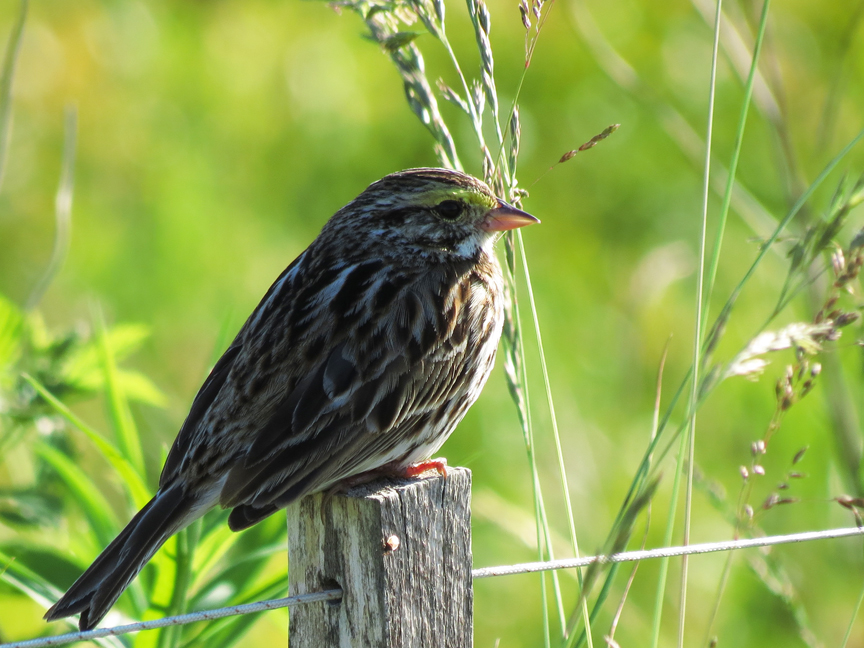
Savannah sparrow.
And I like their feistiness. I have a theory that sparrows are smarter than most little songbirds, and that’s why they don’t mind staying fairly visible even during nesting season. I’m sure they feel differently about danger from above, but when a man and dog approach, they just instinctively know how close you can get before they’d better flee. And that’s pretty close. Which has made their comely appearance so familiar: the light, streaked underside, the tanish-coppery back and wings, the yellow puff in front of each eye, the fluffed head feathers, the darker upper bill. I’ve just got a thing for them, I guess.
And in what might be an interesting aside: this blog post is the first place I’ve ever capitalized the “Savannah” in “Savannah sparrow”—since I just found out they were named not for a bush-dotted grassland but for the city of Savannah, Georgia.
Beech Hill List
Beginning at 5:15 p.m., I hiked all trails.
1. Red-eyed vireo (v)
2. Chestnut-sided warbler* (v)
3. Veery
4. Ovenbird* (v)
5. American redstart* (v)
6. American crow* (v)
7. Eastern towhee (v)
8. Black-billed cuckoo (v)
9. Herring gull* (v)
10. Yellow warbler* (v)
11. Hermit thrush* (v)
12. Common yellowthroat* (v)
13. Gray catbird* (v)
14. Black-and-white warbler* (v)
15. American goldfinch* (v)
16. Song sparrow*
17. Cedar waxwing* (v)
18. Eastern phoebe
19. Savannah sparrow
20. Field sparrow
21. Alder flycatcher (v)
22. American robin*
23. Eastern wood-pewee (v)
24. Black-throated green warbler* (v)
25. Black-capped chickadee (v)
Elsewhere
26. House finch (v)
27. Tufted titmouse
28. Broad-winged hawk (v)
29. House sparrow
30. Rock pigeon
31. Chipping sparrow (v)
32. Northern cardinal (v)
v = Voice only
*Also elsewhere
Tags: alder flycatcher, American crow, American goldfinch, American redstart, American robin, black-and-white warbler, black-billed cuckoo, black-capped chickadee, black-throated green warbler, broad-winged hawk, Cedar waxwing, chestnut-sided warbler, chipping sparrow, common yellowthroat, eastern phoebe, eastern towhee, eastern wood-pewee, field sparrow, gray catbird, hermit thrush, herring gull, house finch, house sparrow, northern cardinal, ovenbird, red-eyed vireo, rock pigeon, savannah sparrow, song sparrow, tufted titmouse, veery, yellow warbler

