


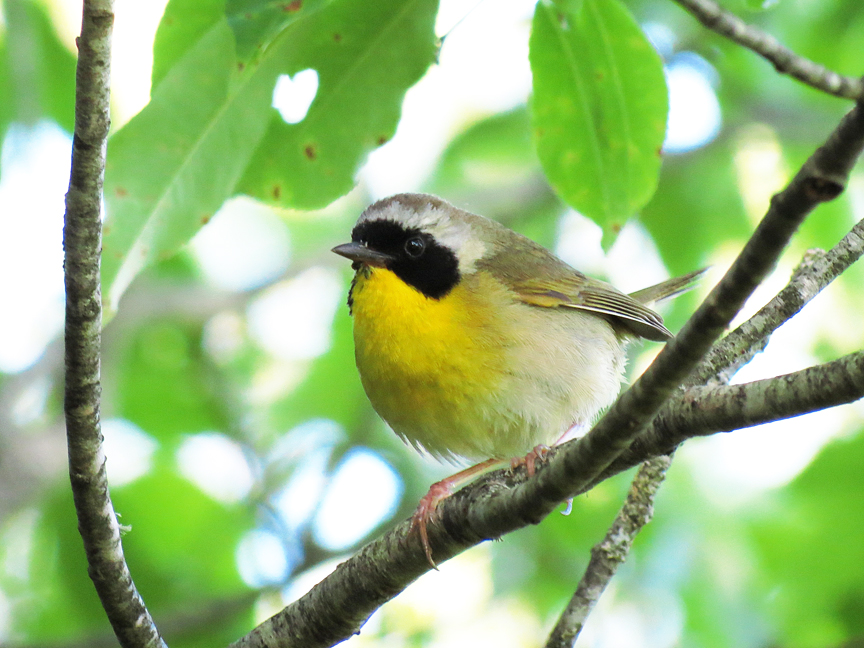
Common yellowthroat.
Along comes the solstice, and the little birds get stealthy. These couple-three weeks they’ve got well-established nests, eggs about to hatch, or—in many cases, nestlings to protect and feed. They’ll only be on the nest a week or two (depending on the species), so it’s a time of busy, secretive activity.
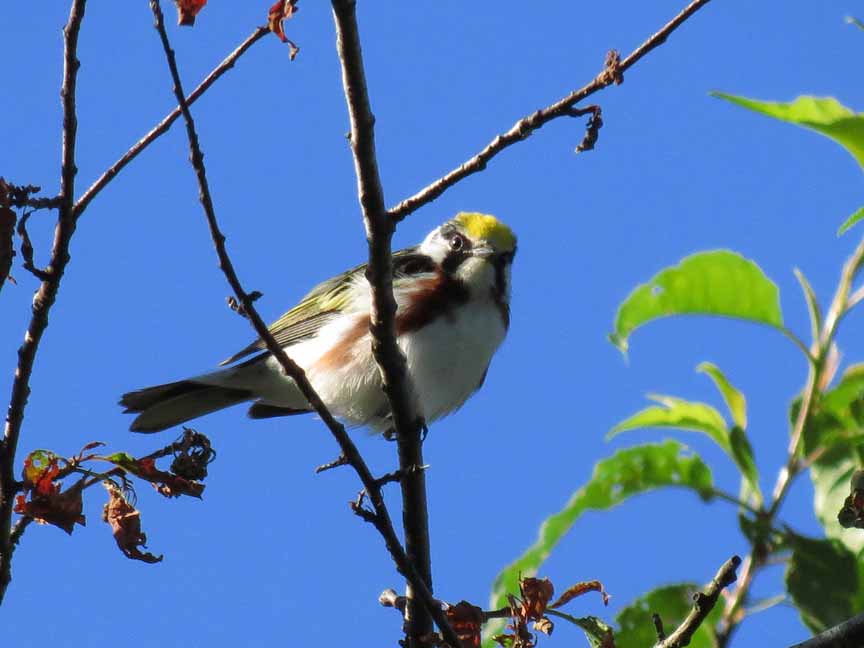
Chestnut-sided warbler.
Which, sort of ironically, makes for a few good photo opportunities.
The day was a cool one for being so close to true summer. Overcast for most of it, but the clouds moved away by the time Jack and I commenced to hiking up the wooded Beech Hill trail. The usual vireos calling. Ovenbirds singing loudly from the canopy. A yellowthroat in the undergrowth. Chestnut-sided warblers. About half-way up I heard a chestnut-sided calling from a perch, I figure, near its nest. The typical c-s warbler call—not the crazy later-season song. Could it have been teaching the melody to nestlings? Don’t know, but it didn’t move far, and we crept close enough for me to grab a couple photos.
At the upper fields, we moved slowly along the wood-edge as I listened for the quiet chips of alder flycatchers, and there came a sudden, louder chip from just behind us in the brush. I recognized it as belonging to a yellowthroat, and by now I know the drill. We just stood there, waiting for the bird to show itself—a male defending the area of its nest. I’ve managed quite a few photos of yellowthroats with their beaks crammed full of food in high season, and although I think it’s still a bit early, this particular male obliged me (though without a food-stuffed beak).
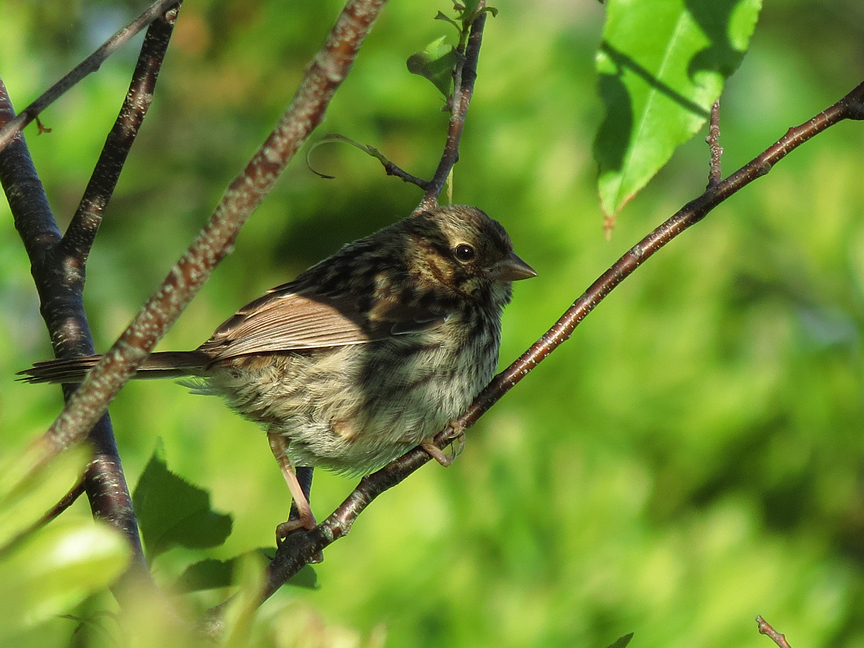
Song sparrow.
At the summit, I spied a Savannah sparrow—also chipping—clamped onto a green caterpillar. It sat atop a bush, waiting for us to pass. Snapped off a few photos.
And coming down, a song sparrow flitted suddenly from some undergrowth and perched in shadows, thinking (perhaps) about luring us away from its nest. Another photo.
But the surprise of the day was the turkey. We’d started swiftly down the lower wooded trail when a large bird rose from about twenty yards ahead of us and perched about half-way up a tree. Hawk? Owl? No, turkey. Hard to get a photo of that one. (Eventually, it flapped away to the east, so I doubt it had chicks running around.)
Otherwise, pretty quiet. Thrushes called, a single black-and-white warbler, just one gang of chickadees. No pewee singing today.
But that’s OK. They’re just hiding out. I completely understand.
Beech Hill List
Beginning at 5:30 p.m., I hiked the wooded trails.
1. Red-eyed vireo* (v)
2. Chestnut-sided warbler
3. Common yellowthroat*
4. Ovenbird* (v)
5. Eastern towhee
6. Black-capped chickadee (v)
7. American redstart (v)
8. Mourning dove*
9. Yellow warbler* (v)
10. Gray catbird* (v)
11. Song sparrow*
12. Veery (v)
13. Savannah sparrow
14. Eastern phoebe
15. American goldfinch* (v)
16. American robin* (v)
17. Alder flycatcher (v)
18. Wild turkey
19. Hermit thrush* (v)
20. Black-and-white warbler (v)
21. Great crested flycatcher (v)
Elsewhere
22. Northern cardinal (v)
23. Tufted titmouse (v)
24. House finch (v)
25. American crow
26. Herring gull
27. Common grackle
28. European starling
29. Double-crested cormorant
30. Red-tailed hawk
v = Voice only
*Also elsewhere
Tags: alder flycatcher, American crow, American goldfinch, American redstart, American robin, black-and-white warbler, black-capped chickadee, chestnut-sided warbler, common grackle, common yellowthroat, double-crested cormorant, eastern phoebe, eastern towhee, European starling, gray catbird, great crested flycatcher, hermit thrush, herring gull, house finch, mourning dove, northern cardinal, ovenbird, red-eyed vireo, red-tailed hawk, savannah sparrow, song sparrow, tufted titmouse, veery, wild turkey, yellow warbler

