


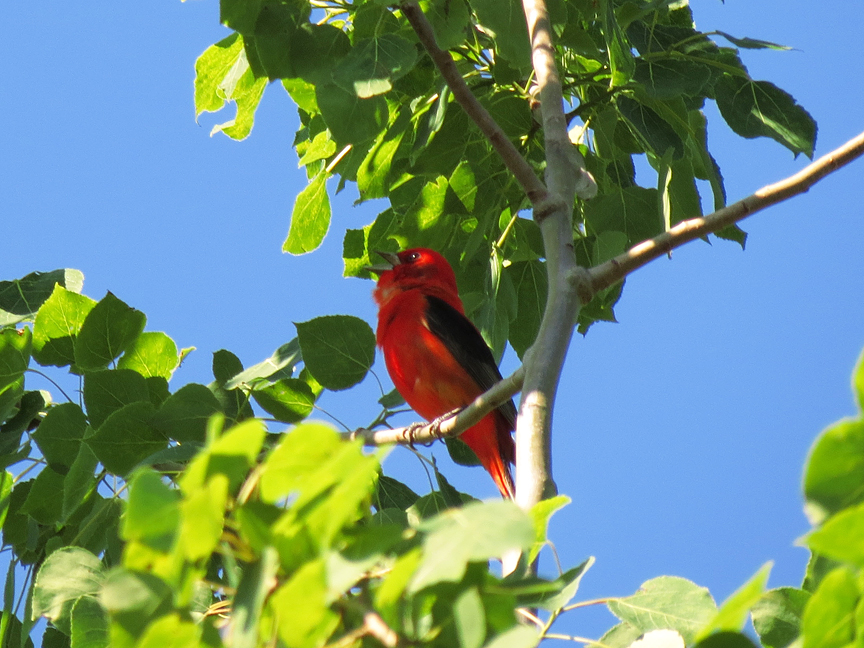
Scarlet tanager.
The first bird call I heard when Jack and I jumped out of the pickup at the Beech Hill trailhead this sunny morning belonged to a scarlet tanager. Oh, there were plenty of other birds singing, but the tanager stood out. Mainly because of two things: 1) tanagers are one of the most photogenic of our local songbirds, and 2) they’re not particularly common on the hill. They’re not exactly rare—I’ve seen or heard them two or three times this spring so far (and have even photographed one)—but they tend to grab my attention.
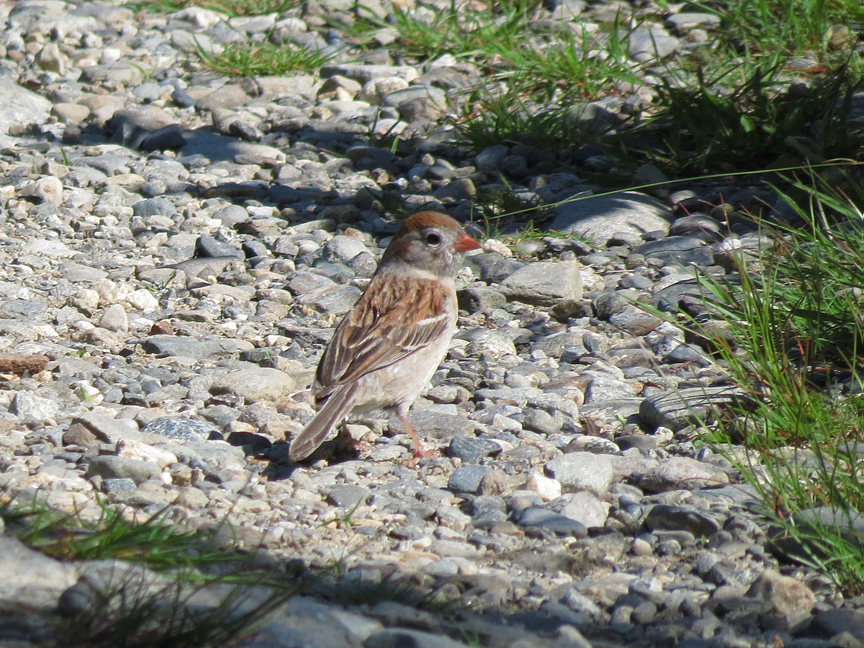
Field sparrow.
This tanager sang from high in the canopy above the sugarbush, off behind thick foliage. We crept near, and I peered up into the greenery but couldn’t spot the bird. Not surprising, as in my experience this species likes to stay high in the trees—which makes the photographic challenge somehow sweeter. Then I noticed its voice coming from farther away. It had flown to a tree farther along the trail.
We hurried our pace to get close again. The bird flew again. Its third perch, though, placed it on a branch visible to me through a window in the trees, and I grabbed a few photos. (It was visible also on its fourth perch but farther distant.) I never know until I download photos how good they are, but these turned out to be fairly decent—not least because of the sun and green and blue-blue sky beyond. And the thought that I might already have a colorful tanager photo made our hike particularly auspicious. At least for me.
But for Jack, too, I think—since we’re in that period between swarming mosquitos and biting deerflies, and it was nice and warm but not too warm, and there were plenty of smells to smell. And birds for me. Broad-wings again. Two species of swallow. Another great crested flycatcher. Even a more-or-less cooperative field sparrow. And again a savannah sparrow perching on the “Please Stay on the Trail” sign.
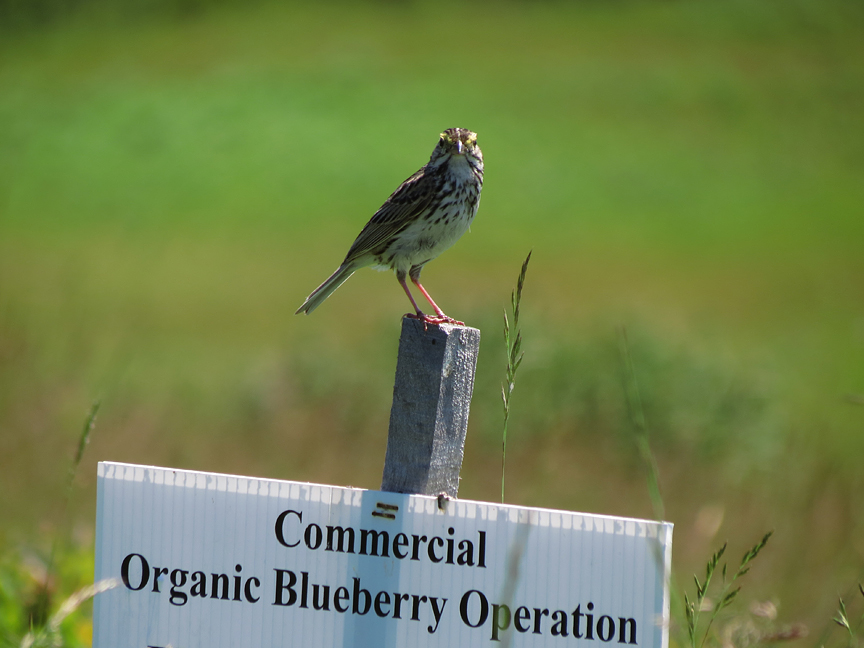
Savannah sparrow.
Then down along Beech Hill Road, I got a reminder of the crazy, less happy quirks of Nature: I watched a phoebe feeding a brown-headed cowbird chick. The cowbird was large and whiny, the phoebe seemed dutiful yet frazzled. Parasites are all a part of life on our tilted planet, I guess.
But so are scarlet tanagers.
Beech Hill List
Beginning at 8:45 a.m., I hiked all trails.
1. Scarlet tanager
2. Red-eyed vireo
3. Chestnut-sided warbler (v)
4. Ovenbird (v)
5. Black-throated green warbler* (v)
6. American crow* (v)
7. Eastern wood-pewee
8. American goldfinch*
9. Rose-breasted grosbeak (v)
10. Common yellowthroat*
11. Herring gull* (v)
12. Black-and-white warbler*
13. American redstart*
14. Black-capped chickadee (v)
15. Veery (v)
16. Eastern towhee (v)
17. Alder flycatcher
18. Yellow warbler*
19. Cedar waxwing*
20. Song sparrow* (v)
21. Tree swallow
22. Eastern phoebe
23. Barn swallow
24. Savannah sparrow
25. Broad-winged hawk
26. Field sparrow
27. Great crested flycatcher (v)
28. Turkey vulture
29. Tufted titmouse*
30. Blue jay (v)
31. American robin
32. Brown-headed cowbird
33. Ruby-throated hummingbird
34. White-breasted nuthatch (v)
Elsewhere
35. Mallard
36. Northern cardinal
37. Osprey
38. House finch
39. House sparrow
40. Rock pigeon
41. Chipping sparrow (v)
42. Mourning dove
43. Hermit thrush (v)
v = Voice only
*Also elsewhere
Tags: alder flycatcher, American crow, American goldfinch, American redstart, American robin, barn swallow, black-and-white warbler, black-capped chickadee, black-throated green warbler, blue jay, broad-winged hawk, brown-headed cowbird, Cedar waxwing, chestnut-sided warbler, chipping sparrow, common yellowthroat, eastern phoebe, eastern towhee, eastern wood-pewee, field sparrow, great crested flycatcher, hermit thrush, herring gull, house finch, house sparrow, mallard, mourning dove, northern cardinal, osprey, ovenbird, red-eyed vireo, rock pigeon, rose-breasted grosbeak, ruby-throated hummingbird, savannah sparrow, scarlet tanager, song sparrow, tree swallow, tufted titmouse, turkey vulture, veery, white-breasted nuthatch, yellow warbler

