|
|
 |
|
|
Posts Tagged ‘black guillemot’
Sunday, January 9th, 2011
 Purple sandpiper. A mix of sun and clouds this morning. Temperature inching toward freezing. Looked to be a fairly benign sort of day, weather-wise. I spent much of it going through photos from 2010—a chore long overdue—and culling throwaways. Hard to believe I took more than 40,000.
 Sky over Rockland Harbor. In fact, I’d only gotten through January, culling and labeling, when I looked up to find it was nearing 3 p.m. already. Time for some exercise. Figured Jack and I would head to the breakwater today for a change.
The air felt mild enough, surely above freezing, but I thought it wise to wear my down jacket anyway. Good thing I did: a stout wind had built up and was blowing hard from the west. Plus, it was pretty darn near peak high tide. A sprinkling of vehicles in the breakwater parking lot. A sprinkling of mallards down at the shore.
There was a good chop on the bay side by the time we stepped up onto the granite. Not many obvious birds right away—herring gulls, a few eiders. I saw a guy up ahead with a spotting scope who turned out to by a fellow birder, Jay. He mentioned seeing some purple sandpipers and some mergansers. No sooner had he mentioned the latter than I spotted a single male winging over the breakwater from behind us. And soon after that, I felt compelled to pull on my gloves.
A ring-billed gull flapped buoyantly past us toward shore. Spotted a couple great cormorants in flight and swimming. Also a few loons diving. Long-tailed ducks, as expected. And great black-backs.
 Sunset. We continued out, the wind at our backs. A fair-sized raft of eiders floated not far to windward, and I was snapping some photos when Jay asked if I’d seen the grebe among them. I hadn’t. I looked. Still didn’t see it. A horned grebe, I figured. Oh, well.
At the end, beyond the light, I’d just mentioned we were liable to see guillemots when one popped up not a dozen yards away, but it saw us and dove again immediately. I waited. And waited. It never reappeared—although a loon did, out of nowhere, not far beyond where I’d seen the gilly.
Although I wasn’t looking forward to the return trip into the wind, it seemed to have turned calmer. Nice. That is, until about five minutes later, when it began to gust again, prompting me to pull up my sweatshirt hood. The sun, until then mostly obscured by a bank of clouds above the harbor, poked through, creating a lovely sky. I mentioned that I’d like to see the sandpipers—and only a minute or two later, I spotted one standing on a piece of bay-side riprap a dozen feet or so away. It posed patiently for photos.
Not until I’d returned home and downloaded my pics did I notice the solitary grebe among the eiders I’d photographed—undeniably a red-necked (albeit a bit fuzzy). I supposed that made it OK to put it on my list.
 Red-necked grebe. Tonight, after a period of wind, things seemed to have calmed some. I watched the new moon set just before Jupiter.
Sirius is up there just now, chasing Orion.
Rockland Breakwater List
Beginning at 3 p.m., I walked the length of the breakwater.
1. Mallard
2. Herring gull
3. Common eider
4. Red-breasted merganser
5. Ring-billed gull
6. Great cormorant
7. Common loon
8. Great black-backed gull
9. Long-tailed duck
10. Red-necked grebe
11. Black guillemot
12. Purple sandpiper
Elsewhere
13. American crow
14. Black-capped chickadee
 Mallards.
Tags: American crow, black guillemot, black-capped chickadee, common eider, common loon, great black-backed gull, great cormorant, herring gull, long-tailed duck, mallard, purple sandpiper, red-breasted merganser, red-necked grebe, ring-billed gull
Posted in Lists, Observations | No Comments »
Sunday, January 2nd, 2011
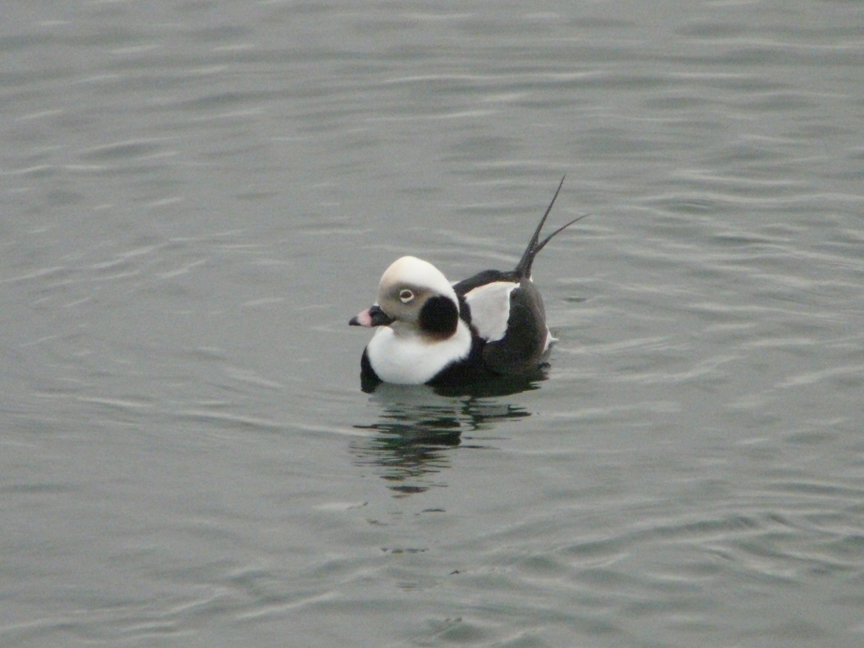 Long-tailed duck. Another warm one. An overcast, wet morning—a little rain passed through overnight—bringing quite a little additional thaw. Crows, house sparrows, chickadees, and a hairy woodpecker hanging around the homestead. The rushing sound of tires on the wet road.
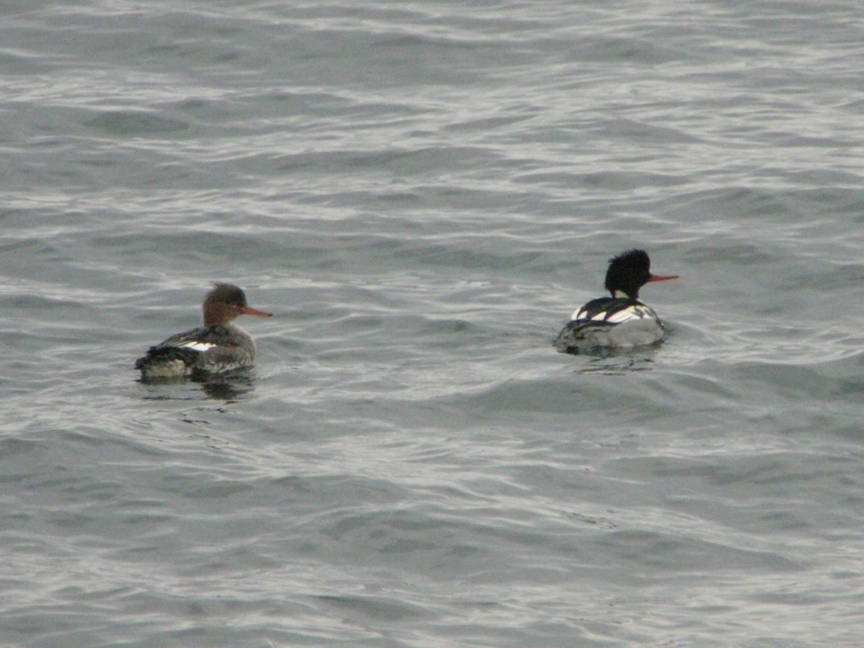 Red-breasted mergansers. Early on I decided we’d skip Beech Hill today, Jack and I. By mid-afternoon or so, it was time to head over to the Rockland Breakwater.
It’s a short trip. Just a couple vehicles in the parking lot when we arrived. Great, slushy snow drifts covered the access trail, so we climbed down and crossed the little beach. It appeared to be dead low tide.
Herring and black-backed gulls were hanging around the shore. I saw no dabbling ducks right away. We climbed onto the first great granite stones and I scanned offshore: a couple great cormorants perched on a big rock, and a solitary, light-colored harbor seal lounging on a smaller one. Saw a loon or two floating out there, too—and a handful of eiders.
Then I heard the distinctive, alluring chatterings of long-tailed ducks. I love the sound they make—which includes the three climbing notes of major chord—but they were too distant to get a good fix on. (For some reason, when I hear their calls, I always imagine the beginning of a symphony.) A gull stood on the breakwater in front of us with an urchin in its bill.
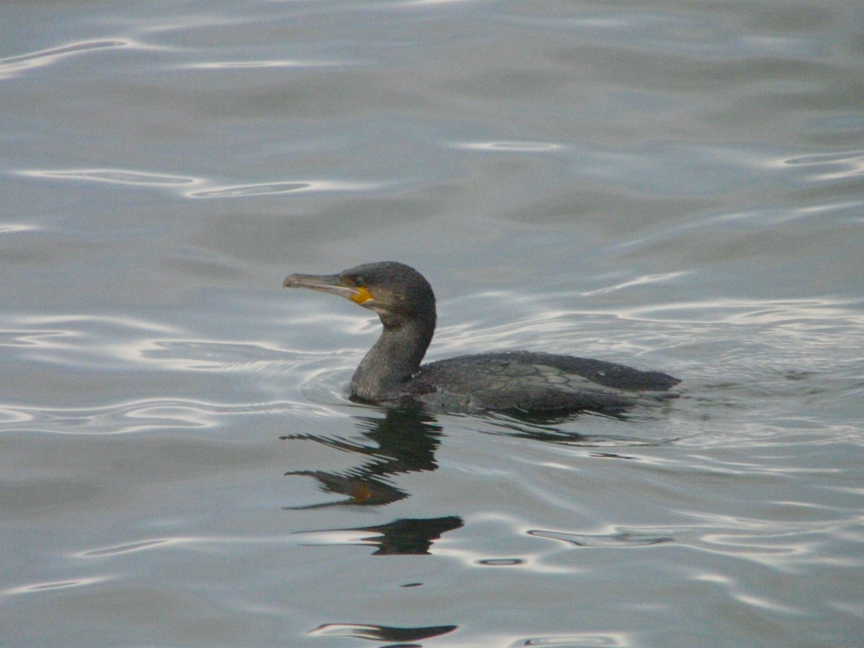 Great cormorant. Farther out, I spotted a pair of red-breasted mergansers floating nearby. Then, on the harbor side, a single male long-tail. It posed cooperatively before submerging.
More loons, eiders, long-tails—and a cormorant diving close to where we walked. We met a few people returning, in small pairs or singly. I heard a high-pitched whistling sound and at first thought it might be a purple sandpiper, but it turned out to be a black guillemot in winter plumage. In all I saw three or four out there today.
On our return, I noticed a few breaks in the even gray overcast—not enough to let any sunlight through, but enough to portend a clear day tomorrow. Mist hovered about half-way up the Camden Hills, and I looked fondly up at Beech Nut atop our usual hill straight down the breakwater toward shore.
We returned, carefully, along the slushy drifts covering the access trail. Wasn’t too hard going. And then I heard the familiar quacking: a half-dozen mallards dabbling about at the edge of the slowly rising tide.
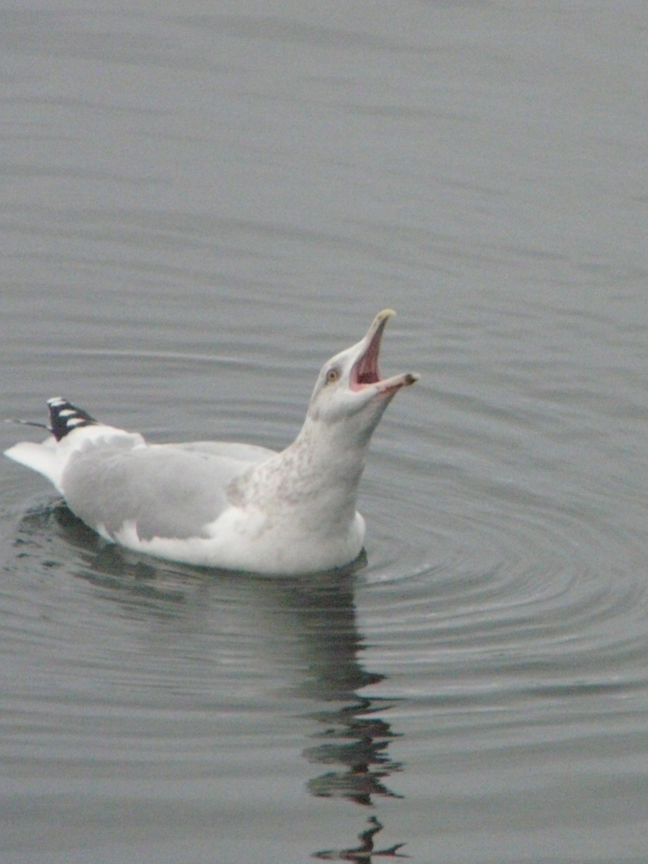 Herring gull. Rockland Breakwater List
Beginning at 2:45 p.m., I walked the breakwater.
1. Herring gull
2. Great black-backed gull
3. Great cormorant
4. Common loon
5. Common eider
6. Long-tailed duck
7. Red-breasted merganser
8. Black guillemot
9. Mallard
Elsewhere
10. American crow
11. Hairy woodpecker
12. Black-capped chickadee
13. House sparrow
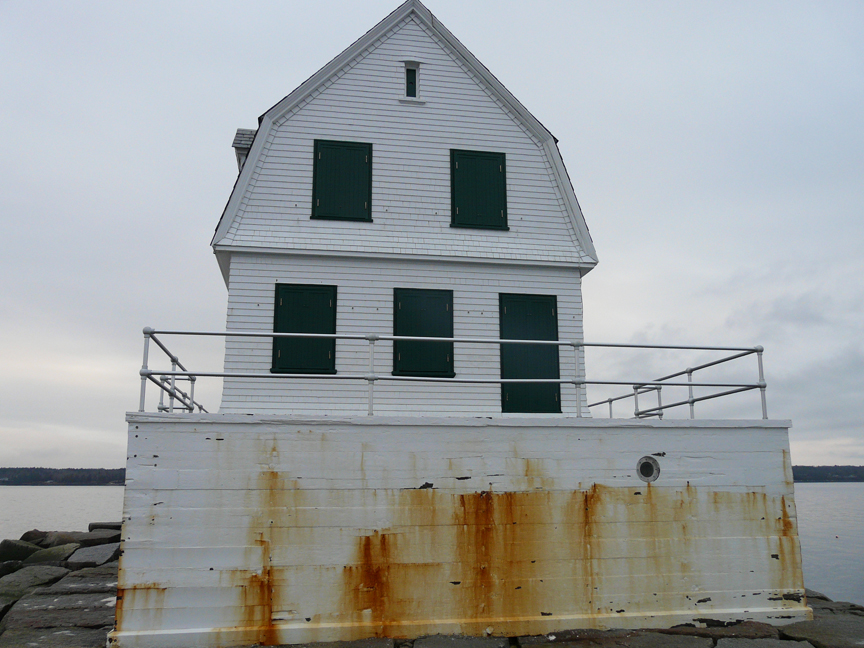 The breakwater lighthouse.
Tags: American crow, black guillemot, black-capped chickadee, common loon, great black-backed gull, hairy woodpecker, herring gull, house sparrow, long-tailed duck, mallard, red-breasted merganser
Posted in Lists, Observations | No Comments »
Saturday, December 18th, 2010
 American wigeon. The day began early. I rose and dressed in many layers, as I had an 8 a.m. date at the Rockland Breakwater—the nearly-mile-long granite structure that stretches out into Rockland’s wide harbor. In the past few years, it’s seemed that our local Christmas Bird Count happens to fall on one of the coldest, windiest days of the year so far. Today was a happy exception.
 Herring gull (juvenile). Oh, it was chilly. I was happy to have on a few layers. But the air was still, and the temperature soon rose into the upper-20s (F)—as opposed to the low-teens of recent years—and this mostly sunny day delivered an ample supply of birds.
As always, I met my friends Kristen and Paul, along with Joe from Coastal Mountains Land Trust. Notable was the state of the tide: high. I thought first, on seeing this, that we might miss out on purple sandpipers. In my experience, they seem to prefer mid-tide, when they can poke around in the marine plant life clinging low on the granite stones. But the thought soon vanished amid the calls of the large raft of Canada geese floating in the lee of the breakwater (a challenge to count) and the adult bald eagle that sailed overhead within minutes of the beginning of our excursion.
Soon we were counting eiders, guillemots, mergansers, gulls, long-tailed ducks, loons, great cormorants. Across the way, the Owls Head Light stood sentinel against a golden morning sky. And about half-way out—a sandpiper.
 Mallards. All told, we saw at least a half-dozen purple sandpipers. Herring and ring-billed gulls. And around the shore of the Samoset Resort property, goldeneyes, black-ducks, mallards, horned and red-necked grebes. The air warmed genially. Finally, with the fifteenth species, we counted a regular ol’ songbird: an American goldfinch.
In other locations nearby, we saw finches, sparrows, chickadees, woodpeckers, and other common passerines. We even saw a solitary great blue heron flapping away across the harbor. At Clam Cove, a large flock of small gulls swept in: Bonaparte’s. Soon after, we stopped at the entrance to a hillside subdivision, a place marked by alders and cattails, and spotted a small flock of common redpolls.
At the southern shore of Chickawakie Lake (also in our territory), we counted the usual dozens of mallards—but among them Kristen spotted a single American wigeon. A young bird, it seemed, and not very skittish. I managed many photos.
An adult eagle sat on the ice far across the lake. A tight-bunched collection of coots hung together just beyond. And overhead, a red-tailed hawk soared just this side of the sun.
 Purple sandpiper. I ditched the count in early afternoon—and no doubt Kristen and Paul found many more interesting species this afternoon—but that’s OK. I so appreciate this single momentous annual birding day. It seems even more momentous being so near the solstice.
Later, Jack and I walked Beech Hill, as usual. Only a crow and a flicker up there this afternoon—and I could only tell from their voices—but a lovely hillside, a few small groups of friendly humans (and one young dog), and a lovely rising moon. Our routine hike seemed the perfect ribbon with which to tie a bow on the gift that was this lovely, birdy day.
Beech Hill List
Beginning at 2:45 p.m., I hiked the open trail.
1. Northern flicker (voice)
2. American crow (voice)
Elsewhere
3. House sparrow
4. Canada goose
5. Bald eagle
6. Common eider
7. Red-breasted merganser
8. Herring gull
9. Bufflehead
10. Black guillemot
11. Ring-billed gull
12. Long-tailed duck
13. Common loon
14. Great cormorant
15. Purple sandpiper
16. Common goldeneye
17. American goldfinch
18. Black duck
19. Mallard
20. Horned grebe
21. Red-necked grebe
22. Blue jay
23. House finch
24. White-throated sparrow
25. Black-capped chickadee
26. Northern cardinal
27. Downy woodpecker
28. White-breasted nuthatch
29. Hairy woodpecker
30. American robin
31. Great black-backed gull
32. Great blue heron
33. European starling
34. Bonaparte’s gull
35. Tufted titmouse
36. Common redpoll
37. American coot
38. American wigeon
39. Red-tailed hawk
 Owls Head Light.
Tags: American coot, American crow, American goldfinch, American robin, American wigeon, bald eagle, black duck, black guillemot, black-capped chickadee, blue jay, Bonaparte's gull, bufflehead, Canada goose, common eider, common goldeneye, common loon, common redpoll, downy woodpecker, European starling, great black-backed gull, great blue heron, great cormorant, hairy woodpecker, herring gull, horned grebe, house finch, house sparrow, long-tailed duck, mallard, northern cardinal, northern flicker, purple sandpiper, red-breasted merganser, red-necked grebe, red-tailed hawk, ring-billed gull, tufted titmouse, white-breasted nuthatch, white-throated sparrow
Posted in Lists, Observations | No Comments »
|
|
| |
| Bird Report is a (sometimes intermittent) record of the birds I encounter while hiking, see while driving, or spy outside my window. —Brian Willson |
|
|


