


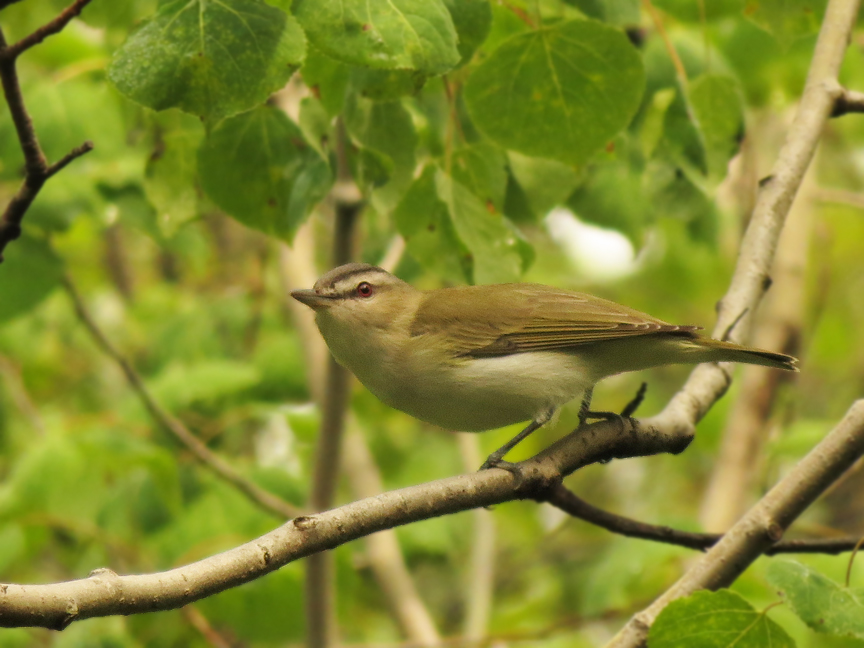
Red-eyed vireo.
There’s a great book on migration called Living on the Wind, by naturalist Scott Weidensaul. (If you haven’t read it, do.) Most thought-provoking, to me, is Weidensaul’s reminder that North American migratory bird species spend only a fraction of their lives where they nest—that most of their year is spent in warm, distant forests or tropical shores. Or, well, migrating.

Chestnut-sided warbler.
We think of them as “our” birds, assuming that nest equals home, when in fact nesting is more of an urgent imperative, a fast and furious adventure. Time is short. So much to do.
Is this their home, really? Or is this simply where their go for their annual mission to breed and hatch, to teach to fly and hunt and forage—only to return to the places they live and eat and hang out until it’s time again to fly?
I got to thinking about this today on Beech Hill with Jack, where clearly a lot of urgent business is going on.
At the trailhead, I met my friend Ron, who was leading a birding class. As Jack and I approached the large group, they had just spotted a phoebe near its nest, sending out notes of alarm. We slipped past. But during the rest of our hike up and over the hill I saw about three dozen other species doing pretty much the same thing.
Hidden nests are everywhere. Eggs are being laid. Birds are expending a lot of energy claiming territories, pairing off, building nests, laying eggs, and all the while fending off perceived threats to the business of reproduction.

Ruby-throated hummingbird.
Coming up the wooded trail we got hollered at by chestnut-sided warblers, towhees, hummingbirds, yellowthroats veeries. Other birds went silent—clammed up and disappeared on our approach. Alder flycatchers are shy that way. Field sparrows, too.
Down at the opposite parking lot, we surprised a pair of nesting redstarts, which burst off their nest (wherever it was) and chipped at us from two directions. Soon, when the ground birds’ clutches hatch, we’re sure to be duped by the noisy distractions of grouse, turkeys, and woodcocks leading us away from their young. Plus, even with all they have to accomplish, they’ve also got to eat.
Up with the dawn, busy all day. At rest during the shortening night. I have visions of lazy falls, winters, and early springs in teeming southern locales, with eating being the main mission (and avoiding being eaten).
But with ever the ticking clocks in their brains, some faint hint of anticipation of that next implausibly long, dangerous trip come spring.
Had a long, sweaty, delicious bike ride this afternoon. Near Aldermere Farm in Rockport, a large turkey burst out of the underbrush and flew across the road right in front of me, followed by a big galloping fluffy white dog. I stuck around to make sure the owner (who was dashing down her driveway) got her dog back.
There were geese at Aldermere Farm, grazing near Lily Pond. A goose has got to eat before it gets down to business.
Beech Hill Listf
Beginning at 8:15 a.m., I hiked all trails.
1. Ovenbird*
2. Red-eyed vireo*
3. American robin*
4. Black-throated green warbler*
5. Eastern phoebe
6. Common yellowthroat*
7. Chestnut-sided warbler*
8. American crow*
9. Veery
10. Black-capped chickadee*
11. American goldfinch* (v)
12. American redstart*
13. Eastern towhee
14. Alder flycatcher
15. Blue jay*
16. Gray catbird* (v)
17. Northern flicker
18. Yellow warbler*
19. Mallard* (v)
20. Ruby-throated hummingbird
21. Hermit thrush (v)
22. Black-and-white warbler
23. Song sparrow*
24. Tree swallow
25. Wood thrush (v)
26. Savannah sparrow
27. Rose-breasted grosbeak (v)
28. Field sparrow
29. Herring gull*
30. Purple finch (v)
31. Least flycatcher (v)
32. Brown-headed cowbird (v)
33. Tufted titmouse* (v)
34. Hairy woodpecker (v)
35. Eastern wood-pewee (v)
36. Blackburnian warbler (v)
37. Broad-winged hawk
Elsewhere
38. House finch (v)
39. European starling
40. Rock pigeon
41. House sparrow
42. Cedar waxwing (v)
43. Northern parula (v)
44. Wild turkey
45. Canada goose
46. Chipping sparrow (v)
47. Mourning dove
48. Northern cardinal (v)
v = Voice only
*Also elsewhere

Broad-winged hawk.
Tags: alder flycatcher, American crow, American goldfinch, American redstart, American robin, black-and-white warbler, black-capped chickadee, black-throated green warbler, blackburnian warbler, blue jay, broad-winged hawk, brown-headed cowbird, Cedar waxwing, chestnut-sided warbler, chipping sparrow, common yellowthroat, eastern phoebe, European starling, field sparrow, gray catbird, hairy woodpecker, hermit thrush, herring gull, house finch, house sparrow, least flycatcher, mallard, mourning dove, northern cardinal, northern flicker, northern parula, ovenbird, purple finch, red-eyed vireo, rock pigeon, rose-breasted grosbeak, ruby-throated hummingbird, savannah sparrow, song sparrow, tree swallow, tufted titmouse, veery, wood thrush, yellow warbler

