


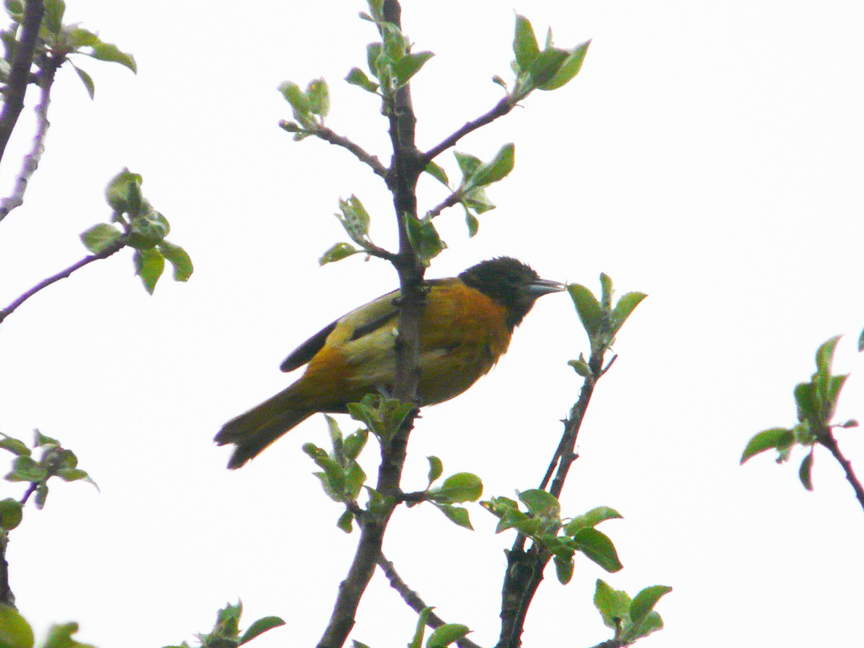
Baltimore oriole.
Rain this morning, as forecast. Not a lot of rain, though, first thing—just a little drizzle. Still, I had a date to lead a bird walk at the amazing L. C. Bates Museum in Hinckley, Maine. (I led a walk there last year, too, also in the rain.) Occupying a hulking, hundred-year-old brick school building on the campus of historic Good Will–Hinckley, the museum is a taxidermist’s dream, with dusty old specimens of just about every Maine critter you can imagine, along with exotic animals and birds from elsewhere in the world, and even a giant stuffed marlin caught by Ernest Hemingway. Seemingly in the middle of nowhere, it’s kind of a dark, cavernous, spooky place—yet also incredibly magical, inspiring, thought-provoking. You sort of feel like you’ve ventured back in time. Definitely worth a visit.
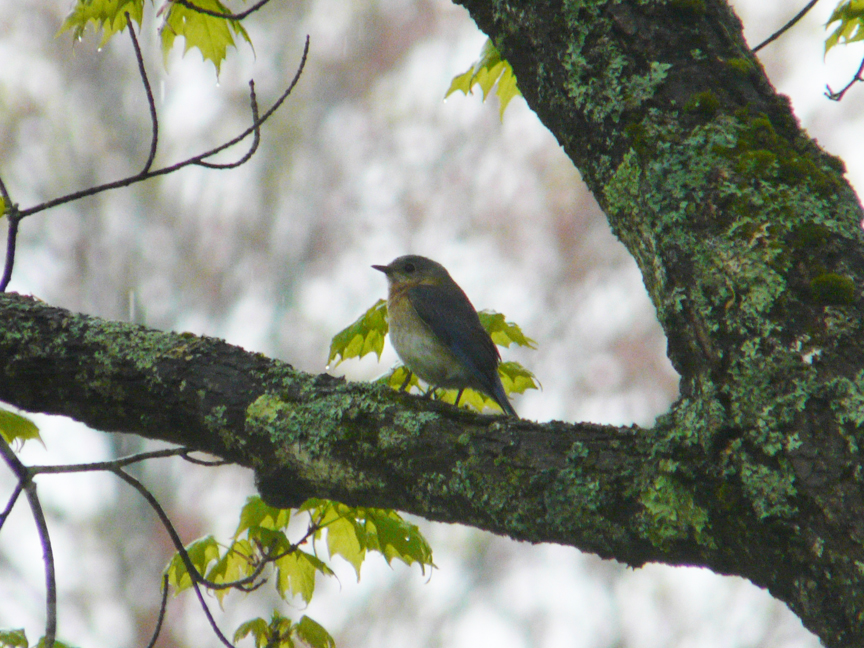
Eastern bluebird.
Spent the morning putting together some photos in case the rain got too heavy, then set out for Hinckley. (Jack stayed home.) En route, I saw a turkey hen hustling off the road in front of me—also roadside mourning doves and crows and grackles and a juvenile red-tailed hawk. The rain came and went, then settled into a light drizzle about the time of my arrival.
Despite the rain, about a dozen people showed up—maybe half grown-ups and half kiddos. We set off at a not-ideal time for a bird walk (1 p.m.), and in the drizzle, and yet right away we heard a bobolink, heard a phoebe, saw a starling, heard a chipping sparrow and a yell0wthroat, and one of the group spotted a bluebird. And immediately after the bluebird sighting, we saw a pair of orioles hopping around in a tree nearby. Very nice to be able to show the group some impressive-looking birds so quickly (which also happened to be first-of-year birds for me!).
We also saw a pair of chipping sparrows, a black-and-white warbler, a yell0w warbler, and a dark, silent warbler (at least I think it was a warbler) that I couldn’t identify. A crow flew over. And suddenly—in a shock to all—a ruby-throated hummingbird zipped right toward us from across the little rain-spattered pond, hovered for a moment in front of our brightly colored rain gear, then zipped away. (Another first-of-year bird for me!)
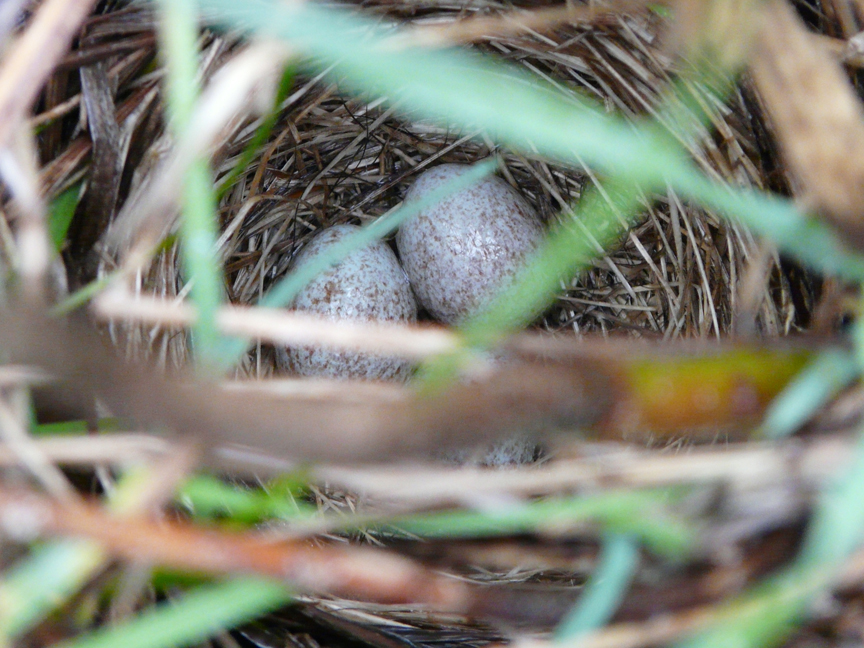
Secret nest.
The rain soon grew stronger, so we turned back. But on the way, one eagle-eyed young lady somehow spotted a small bird’s nest in a clump of grass by the road overhanging a little stream. It had three grape-sized, speckled eggs in it. Some kind of warbler, I imagine. A yell0wthroat? Or could it have been a chippy nest? Not being a nest expert (eggs-pert?), I’ll likely never know. (16 May 2011 update: I think it might belong to a song sparrow.)
Then we withdrew indoors, where I showed off photos and played bird calls. It was a really nice occasion. I bet some folks who stayed home on account of the weather would’ve enjoyed it, too.
An uneventful trip home, and then I grabbed patient Jack for a quick, wet hike up Beech Hill. And, yes, it was wet. Rained the whole time. We stuck to the wooded trails, spent about forty-five minutes up there. Listed fifteen birds—the most notable probably being the last one, a black-throated green warbler, that I spied flitting about in the trees right beside the parking lot. It didn’t make a peep.
Back home, I stepped out to check the nuthatch hole, and sure enough one of the pair was sticking its head out. Then I heard what at first sounded like the repeated peep! of a chickadee. I looked for it, saw a little bird poking around in the bark of the big leaning oak, and figured that was the chickadee. But it didn’t look exactly like a chickadee to my naked eye—maybe a nuthatch? No. In fact, in the wet dimness, it sort of resembled a golden-crowned kinglet. I went in for my fieldglasses, took a look, and right away pegged it for a black-and-white warbler. But wait. It was surely not emitting a b-and-w chip note. Too clear and sweet. I looked again. It was a blackpoll warbler. Another first of the year.
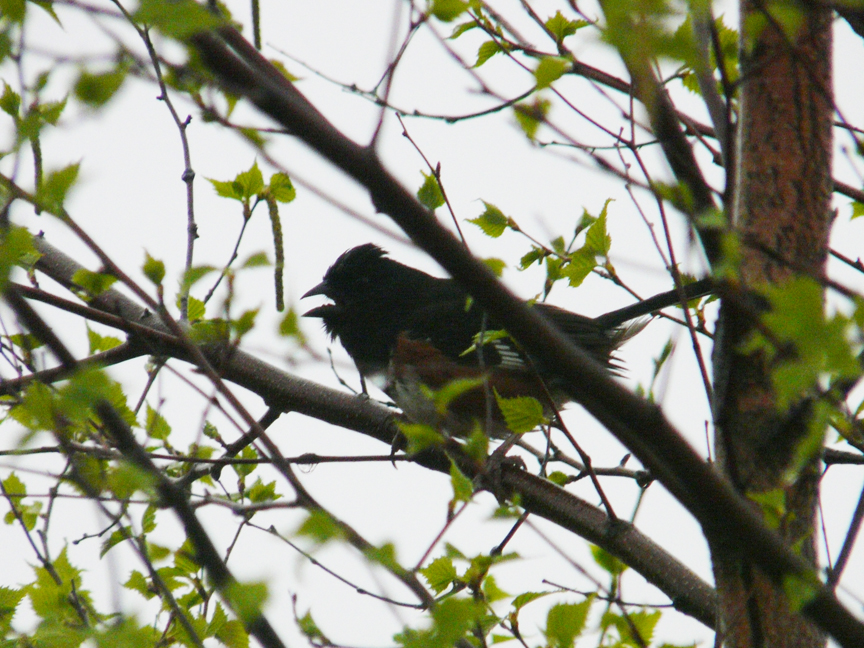
Eastern towhee.
Five FOY birds today. That takes me over a hundred for the year. A rainy, cold, wet, wonderful day.
Note: I found very helpful this chip-note blog.
Beech Hill List
Beginning at 4:15 p.m, I hiked the wooded trails.
1. Ovenbird (voice)
2. Eastern phoebe
3. Veery (voice)
4. Eastern towhee
5. White-throated sparrow
6. Black-capped chickadee
7. Black-and-white warbler
8. Common yellowthroat
9. Song sparrow
10. Yellow-rumped warbler (voice)
11. Herring gull (voice)
12. Gray catbird (voice)
13. American robin (voice)
14. American goldfinch (voice)
15. Black-throated green warbler
L.C. Bates Museum List
Beginning at 1 p.m., I led a walk out back in the rain.
Eastern phoebe
16. Bobolink
17. European starling
18. Chipping sparrow
Common yellowthroat
19. Eastern bluebird
20. Baltimore oriole
21. American crow
22. Yellow-warbler
Song sparrow
Black-and-white warbler
23. Ruby-throated hummingbird
24. Brown-headed cowbird
Elsewhere
25. House finch
26. Wild turkey
27. Red-tailed hawk
28. Common grackle
29. White-breasted nuthatch
30. Northern cardinal
31. Blackpoll warbler
Tags: American crow, American goldfinch, American robin, Baltimore oriole, black-and-white warbler, black-capped chickadee, black-throated green warbler, blackpoll warbler, bobolink, brown-headed cowbird, chipping sparrow, common grackle, common yellowthroat, eastern phoebe, eastern towhee, European starling, gray catbird, herring gull, house finch, northern cardinal, ovenbird, ruby-throated hummingbird, song sparrow, veery, white-breasted nuthatch, white-throated sparrow, wild turkey, yellow warbler, yellow-rumped warbler

