


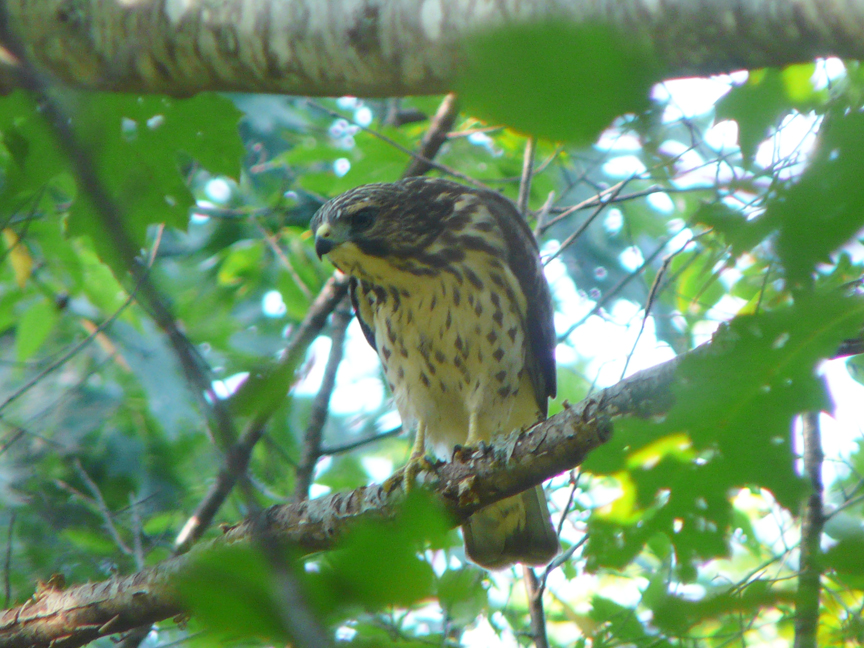
Broad-winged hawk (juvenile).
If yesterday was hot, today might’ve even been hotter. Aw, not all that hot, really, for a guy who grew up in Texas—not 90 degrees, I don’t think. But probably mid- to upper-80s (F). In fact, before 7 a.m., as Jack and I were climbing the green, wooded hillside this first day of September, the air must’ve been at least room temperature. Maybe even 75 or so.
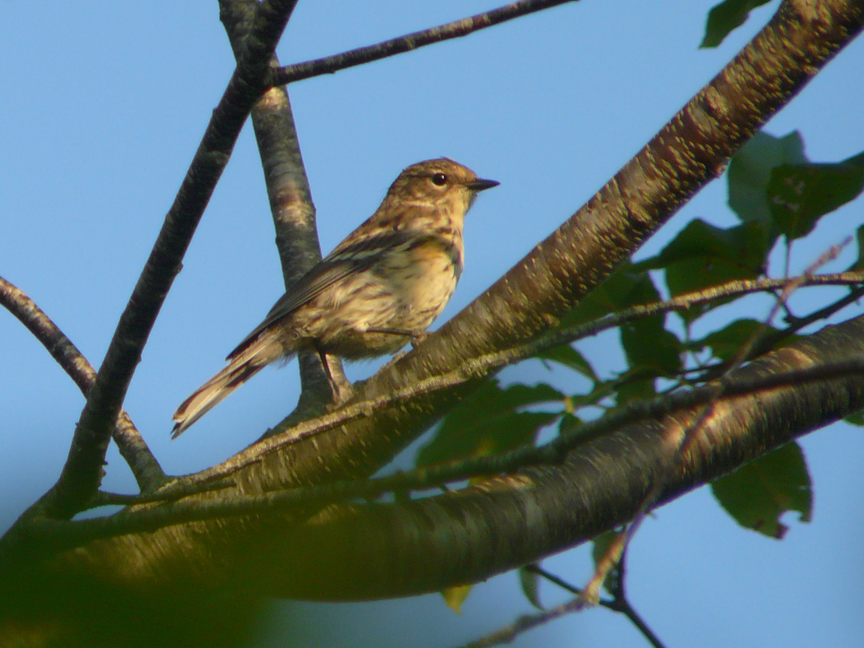
Yellow-rumped warbler.
Not too many birds occurred right away. They were silent, hunkered down out of the heat, hiding out. I heard the usual summer residents—catbird and yellowthroat seem always near each other—including a brief tut-tut of a robin. (They’re extremely quiet up there these days.) More young yellow-rumps chipping about in the foliage, both the young hardwoods coming up and the grove of spruces up top. And flickers—in fact, as we came up over the summit and descended the open trail, there appeared up ahead a family of at least five flickers (foraging along the trail with a single mourning dove).
They took flight as we approached, the flickers—one by one, in undulating flight, their white rumps flashing, emitting their wicka-wicka-wicka calls. I have to say I rather like flickers. I like the little red heart tattoo they wear on the backs of their necks.
Steamy out in the bay. Owls head jutted out into the bay amid a cloud of haze.
Saw both phoebes and alder flycatchers perched in the tips of trees. Their chip notes are similar, those two.

Common yellowthroat.
On our return trip—Jack panting quickly, my T-shirt soaked with sweat—we eagerly dove into the shady wooded section. I’d counted eighteen birds by then and didn’t expect but maybe a couple more. But the lower wooded trail surprised: first a pewee’s lazy, poignant, dying-summertime call; then the exaggeratedly elongated call of a pileated woodpecker just beyond sight through the trees; then a black-and-white warbler’s somewhat abbreviated call lower down; and finally, as we were only a couple hundred yards from the parking lot, the sudden appearance of a young broad-winged hawk.
A broadwing is a wonderful thing. This young bird checked us out, Jack and me, then flapped up to a more distant branch and observed us head on (alas, my auto-focus betrayed me). Finally, it flapped silently out of sight. I found myself wondering if this bird is the reason for the couple piles of remnant feathers I’ve seen the past week or so along the wooded trails.
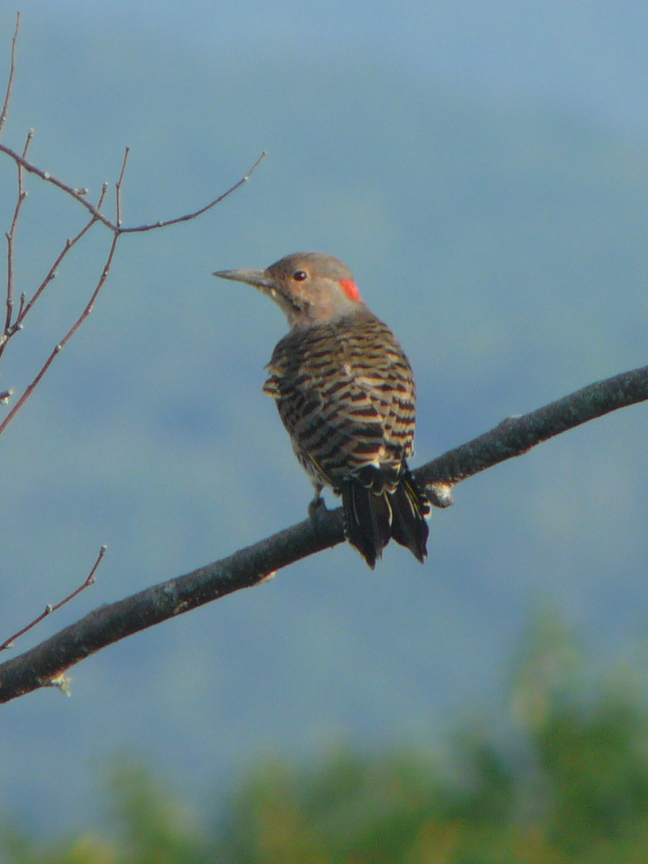
Northern flicker.
Beech Hill List
Beginning at 6:45 a.m., I hiked all trails.
1. American goldfinch
2. Black-capped chickadee
3. Cedar waxwing
4. Gray catbird
5. Common yellowthroat
6. American robin (voice)
7. White-breasted nuthatch (voice)
8. Yellow-rumped warbler
9. Song sparrow
10. Eastern towhee (voice)
11. White-throated sparrow
12. Mourning dove
13. Eastern phoebe
14. Alder flycatcher
15. Blue jay (voice)
16. Savannah sparrow
17. Northern flicker
18. American crow (voice)
19. Eastern wood-pewee (voice)
20. Pileated woodpecker (voice)
21. Black-and-white warbler (voice)
22. Broad-winged hawk
Elsewhere
23. House sparrow
24. Northern cardinal
25. Herring gull
26. European starling

Red squirrel.
Tags: alder flycatcher, American crow, American goldfinch, American robin, black-and-white warbler, black-capped chickadee, blue jay, broad-winged hawk, Cedar waxwing, common yellowthroat, eastern phoebe, eastern towhee, eastern wood-pewee, European starling, gray catbird, herring gull, house sparrow, mourning dove, northern cardinal, northern flicker, pileated woodpecker, savannah sparrow, song sparrow, white-breasted nuthatch, white-throated sparrow, yellow-rumped warbler

