


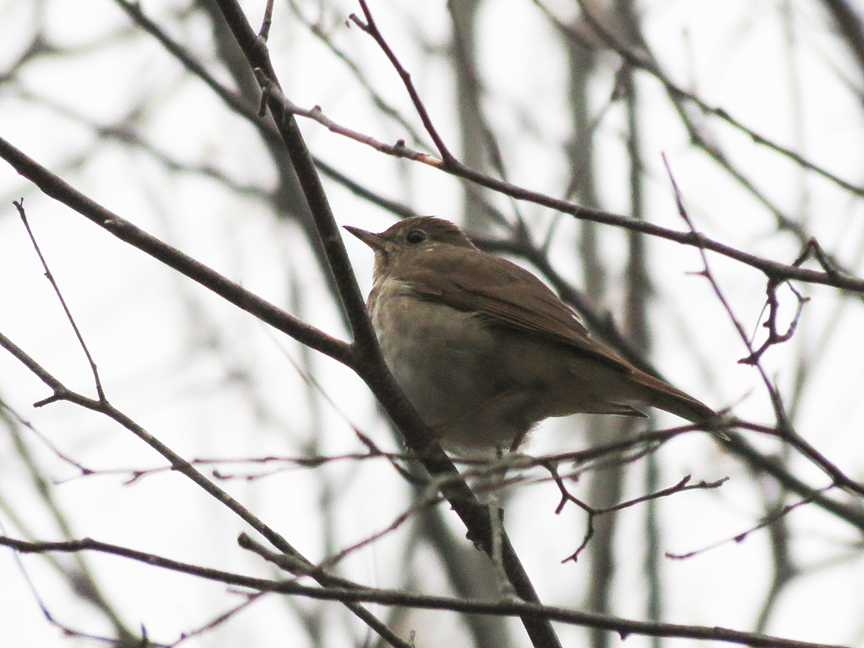
Hermit thrush.
Fog shrouded the landscape by the time Jack and I made it to Beech Hill late in the day. It had rained off and on, and the world was wet. Right away, I heard the first hermit thrush’s song.
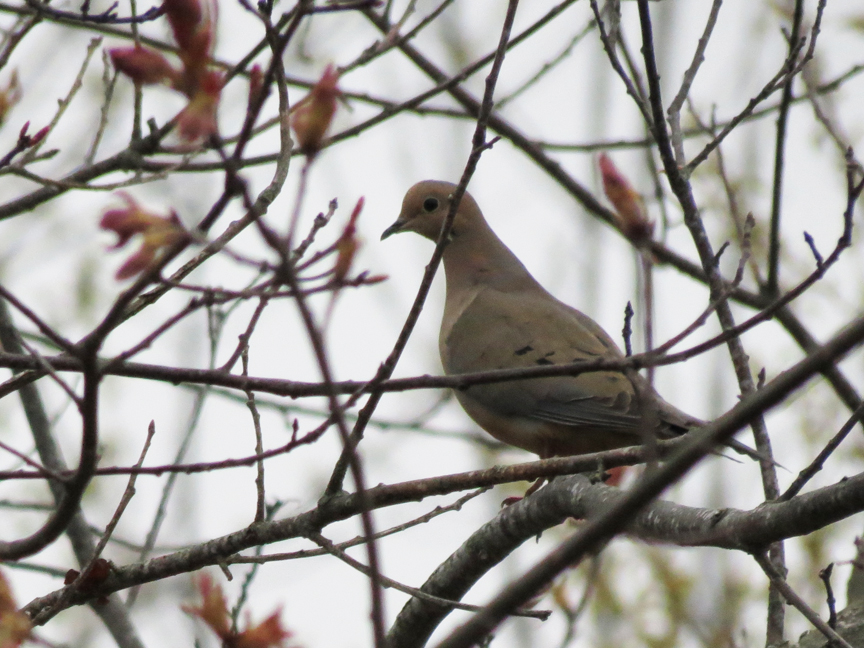
Mourning dove.
I’d wager that the song of the hermit thrush tops most people’s list as the most beautiful natural sound in the American Northeast. It’s hard to describe—it’s hard even to imagine such ethereal fountains of music coming from the throat of any creature. All thrushes are wondrous singers: wood thrush, Swainson’s thrush, veery—even our familiar robin has a certain magic in its voice. I think back to when I first heard The Beatles’s “Blackbird” and wondered what was so special about a blackbird’s call, but that was before I understood that the common European blackbird is in fact a thrush, whose song I since have heard. And it’s sure enough amazing.
Today, hiking the soggy trail in fog, the songs of hermit thrushes echoed in the wood. They’re staking out their territories—plain, brown, speckle-breasted birds lurking furtively in the understory. At one point while walking slowly along a well-worn path between field and trees, I had a sort of genetic memory, a realization that for thousands of years humans had walked just as I was walking, had seen just what I was seeing, had heard just what I was hearing. Certainly the song of the thrush filled their hearts with wonder, prompted them to dream up myths and stories of nymphs and fairies. And who’s to say they were wrong?
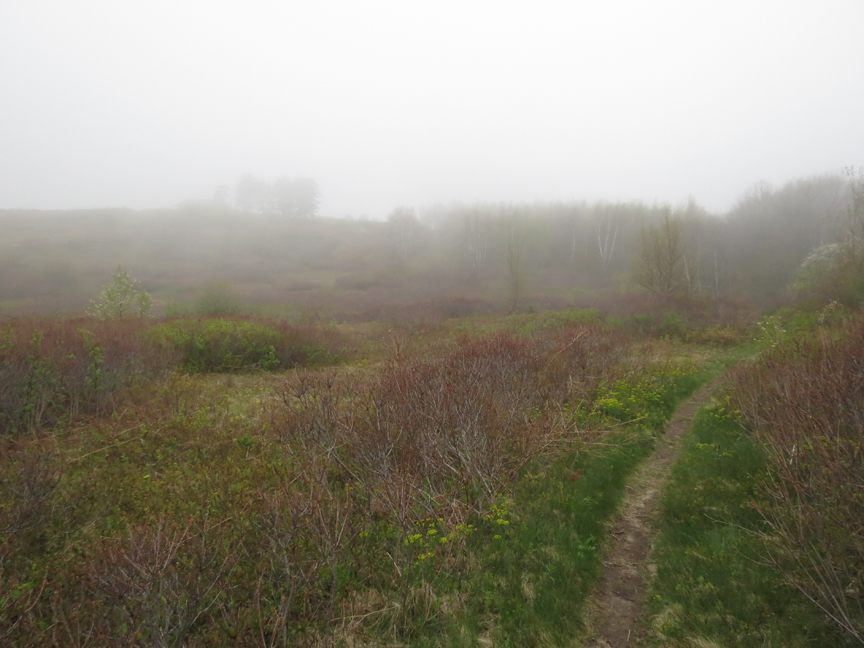
Fog.
Hermit thrushes are secretive and well camouflaged, and more than once I’ve stood for long minutes within a few dozen yards of a singing bird without ever laying eyes on it. Any decent sighting is a thrill. And today, in the little wooded slope below the summit, I got such a thrill—stood with my dog on a particularly muddy stretch of trail looking up at a singing bird, marveling at how it could open its bill, extend its throat feathers, and casually turn the foggy woodlands into a place of sheer magic.
I haven’t yet heard a veery up there this year, but soon I will. I did hear a wood thrush the other day, and there will be more. But the hermit thrush, most miraculous of all, will always sing the Music of the Fog.
Beech Hill List
Beginning at 4:45 p.m., I hiked the wooded trails.
1. Hermit thrush
2. American robin* (v)
3. Ovenbird
4. Song sparrow (v)
5. American goldfinch* (v)
6. Black-throated green warbler
7. Black-capped chickadee*
8. Common yellowthroat
9. Herring gull* (v)
10. Chestnut-sided warbler (v)
11. Gray catbird (v)
12. Rose-breasted grosbeak (v)
13. American woodcock
14. Eastern towhee (v)
15. Mourning dove*
16. Northern cardinal (v)
17. Black-and-white warbler (v)
18. White-throated sparrow
19. American crow* (v)
20. Wild turkey (v)
21. Eastern phoebe (v)
Elsewhere
22. House finch (v)
23. Common grackle
24. Rock pigeon
25. European starling
v = Voice only
*Also elsewhere
Tags: American crow, American goldfinch, American robin, American woodcock, black-and-white warbler, black-capped chickadee, black-throated green warbler, chestnut-sided warbler, common grackle, common yellowthroat, eastern phoebe, eastern towhee, European starling, gray catbird, hermit thrush, herring gull, house finch, mourning dove, northern cardinal, ovenbird, rock pigeon, rose-breasted grosbeak, song sparrow, white-throated sparrow, wild turkey

