|
|
 |
|
|
Posts Tagged ‘black guillemot’
Sunday, January 24th, 2010
 Long-tailed duck pair. I slept a little late this morning. The sun had been up a little while when I first looked out to see a mostly overcast day with a few strips of morning blue. The temperature hung a few degrees (F) above freezing, and the still air seemed nearly warm. Crows flapped and cawed and otherwise social-networked, as usual. And my friend Kristen and I decided to walk the Rockland breakwater.
 Two seals. Only trouble was, the tide would be near low—which concerned me some. In my experience, you see more different birds when the bay is brimming and waves are crashing against the windward rocks. Purple sandpipers, for one, I’ve never seen at low tide. And the diving birds can get nearer the breakwater itself and so provide better picture-taking opportunities. OK, yeah, I suppose I’m a photo snob. But as we descended from the parking lot onto the beach, right away our beach-combing instincts kicked in: little snails, smooth black rocks, coarse and interesting textures. A solitary common goldeneye floated a ways offshore, and group of buffleheads bobbed in a pool nearby.
And as soon as we climbed onto the stones of the granite structure itself, I scanned the bay and spotted seals. Another sight you won’t see at high tide, the seals. They like to relax on the tops of the small rocks that low tide exposes. There were a pair of very light-colored seals on one stone—I don’t know my pinnipeds well, and so wondered if they might be grays or some other species but decided they were simply light-colored harbor seals.
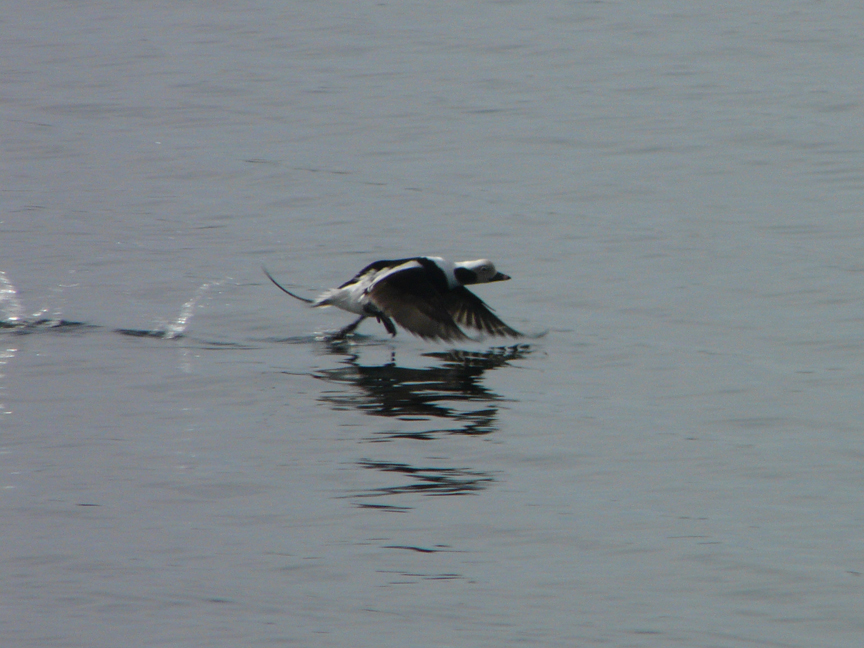 Long-tailed duck at takeoff. Still there were plenty of diving birds, too. Common loons, red-breasted mergansers, a black guillemot, and several little collections of long-tailed ducks. The long-tails, in fact, provided ample entertainment—preening, profiling, giving out their little distinctive three-note yodels. I even got their yodels stuck in my head, after deciding I’d like to devote to long-tails a movement of a symphony I’d like someday to write. If you’ve heard these yammering ducks, you know the sound I mean. (In the height of politically incorrectness, the species was for years called “oldsquaw” because of the gossipy nature of the sound.) But today I realized their calls amount to the rising components of a perfect major chord. And so I got ’em stuck in my head—and must remember to bring my digital recorder next time.
 Great cormorant. Also on the breakwater with us today were three great cormorants. They’d perch on the stones ahead of us, and when we’d get to close, they’d fly into the harbor or veer around to another part of the breakwater. A number of times we caused them to fly. I got a couple photos.
The air today stayed as still as night air, and it never dipped below freezing. Our walk was my warmest out there since last summer. Turns out low-tide ain’t all that bad.
* * *
Tonight, with temperatures in the mid-thirties (F), it has begun to rain. It’s drizzly now, but heavier rain—and wild winds—are forecast for tomorrow. Rain in mid-winter always discombobulates me. Just seems weird.
I wonder what the long-tailed ducks are up to.
Today’s List
American crow
Herring gull
Mallard
Ring-billed gull
Bufflehead
Common goldeneye
Black duck
Common loon
Common eider
Black guillemot
Long-tailed duck
Great cormorant
 Low tide still life.
Tags: American crow, black duck, black guillemot, bufflehead, common eider, common goldeneye, common loon, great cormorant, herring gull, long-tailed duck, mallard, ring-billed gull
Posted in Lists, Observations | No Comments »
Sunday, January 17th, 2010
 Blue Hill, from the Rockland Breakwater. Today dawned overcast—and twenty degrees colder than yesterday. Appropriately for this time of year, the temperature never made it out of the 20s (F) all day. But I had a hankering for a little birding-slash-exercise and so in early-afternoon, seeing the motionless anemoter, thought, I’ll just bundle up and walk the breakwater, see a few birds. I mean, it’s so close by, and all.
 Black guillemot. I knew I’d be contending with some wind—there’s always wind when you’re nearly a mile out in open water—and I dressed, well, appropriately for this time of year: warm coat over hooded sweatshirt, scarf, insulated gloves. I arrived to find at least half a dozen vehicles in the parking lot, so the chill air hadn’t deterred any Sunday walkers. Down the little escarpment and along the water’s edge all felt warm enough. Up onto the granite blocks, though, and the ocean breeze picked up a tad. No problem. About half-way out is when my fingers started going numb.
 Purple sandpiper. I couldn’t help but contrast my benumbed fingers with the naked pink feet of the herring gulls standing on the stones, or the red legs of the guillemot paddling in the frigid harbor. Common loons and great cormorants submerged themselves for a minute or more in the chilly depths—emerging, in the case of one loon, with a crab that proved a challenge to gulp down. I counted perhaps five or six loons, in fact, each sailing lazily along like a riverboat, plenty cozy in their miraculously patterned feathers. The long-tailed ducks, too. And the common eiders. And red-breasted mergansers. I even watched a pair of purple sandpipers fairly frolick in the bubbly swell, with seemingly no circulation troubles in their tiny legs and toes.
Ducks got feathers, seals got blubber. Before figuring out how to wear the skins of animals, we humans never saw this latitude in winter, that’s for sure—or if we did, we surely died in a hurry from cold.
 Herring gull. On the walk back, I had a tail-wind. More like a tail-breeze, really, but it made a difference. I even took off my gloves to snap a photo of a tourist couple from an Asian country, perhaps Japan. Back in the parking lot, I noticed license plates from New York and Massachusetts. The Maine coast gets visitors even at a wintry time of year.
Today’s List
1. American crow
2. Herring gull
3. Common eider
4. Red-breasted merganser
5. Ring-billed gull
6. Common loon
7. Black guillemot
8. Great cormorant
9. Long-tailed duck
10. Canada goose
11. Bufflehead
12. Mallard
 Tidal rocks.
Tags: American crow, black guillemot, bufflehead, Canada goose, common eider, common loon, great cormorant, herring gull, long-tailed duck, mallard, red-breasted merganser, ring-billed gull
Posted in Lists, Observations | No Comments »
Saturday, January 16th, 2010
 Iceland gull (immature). This must be what they call a January thaw. Just a gorgeous day today, sunny and warm. Well, sunny starting about late morning, after an early glowing overcast, but warm—well up into the 40s (F)—for much of the day. After a few Saturday errands, I couldn’t resist chasing down some birds.
I say “chasing down,” because Don Reimer had already spotted them. And if Don can’t lay claim to the title of No. 1 Local Birder, I have no clue who can. Yesterday he reported kittiwakes, razorbills, and northern shrikes at the Owls Head Light, black-headed and iceland gulls at Owls Head Harbor, a great blue heron at Weskeag Marsh, and a slew of uncommon ducks in Warren Village. So I jumped in my pickup and headed for Owls Head.
 Black-headed gull preening. I drove first to the lighthouse park. The early afternoon sunlight had turned things vividly colorful. I saw eiders afloat, Bonaparte’s gulls in flight, red-breasted mergansers and long-tailed ducks and guillemots in the bay, but no kittiwakes, razorbills or shrikes. I did hear a raven. And you can hardly match the view from the light of the inland hills.
Next I drove the short distance to Owls Head Harbor. As I pulled in, I spotted a few other birders already scanning the waves. They, too, had seen Don’s report—and in fact had already spotted the gulls over at the nearby lobster pound. I walked over and saw them, too. A couple, possibly three black-headed gulls, and at least a pair of icelands. Both species posed on pilings, and the iceland obliged me with a good look on the wing. I also counted buffleheads, loons, mallards, and herring gulls.
Then I figured I’d swing by Weskeag, but I honestly didn’t expect to see a solitary great blue heron in all those acres. Wrong: there he was, just standing there preening. I followed someone’s footprints down the slope, snapping photos. When I got near enough to bother the bird, it flew off into some shadows a safe distance away.
Finally, I figured I’d take a quick hike up Beech Hill. En route, I spied a red-tailed hawk on a power pole off Old County Road.
 Great blue heron at Weskeag Marsh. I half expected to see yesterday’s barred owl at the wooded trailhead, but I didn’t. The air remained warm, and the snow on the trail had gone soft enough to slip beneath my feet. Coming up the lower trail, I kept hearing slight single calls that sounded something like golden-crowned kinglets, but I saw nothing. Then, nearing the top, I heard a soft rapping—a downy woodpecker. And soon after, there came the high call again, and a small bird flitted to the trunk of a tree not twenty feet away. I didn’t get a great look, but it appeared to be a brown creeper. And there, another one higher up on a trunk just beyond. As they zipped from trunk to limb, I snapped off some photos; I could confirm it later from the blurry images: creepers.
The hike was exhilarating. I spotted numerous trails of turkeys, like wavy dotted lines in the snow, all heading to what must be a roosting spot amid tangles near the summit. I saw deer tracks. And coming down, a ruffed grouse exploded out of a thicket off the trail.
 Great blue heron. Today’s List
1. Black-capped chickadee (voice)
2. American crow
3. Herring gull
4. Ring-billed gull
5. Rock pigeon
6. Common eider
7. Black guillemot
8. Bonaparte’s gull
9. Long-tailed duck
10. Red-breasted merganser
11. Common raven
12. Black-headed gull
13. Iceland gull
14. Common loon
15. Mallard
16. Bufflehead
17. Great blue heron
18. Red-tailed hawk
19. Downy woodpecker
20. Brown creeper
21. Ruffed grouse
 The coastal hills, from Owls Head Light.
Tags: American crow, black guillemot, black-capped chickadee, black-headed gull, Bonaparte's gull, brown creeper, bufflehead, common eider, common loon, common raven, downy woodpecker, great blue heron, herring gull, iceland gull, long-tailed duck, mallard, red-breasted merganser, red-tailed hawk, ring-billed gull, rock pigeon, ruffed grouse
Posted in Lists, Observations | No Comments »
|
|
| |
| Bird Report is a (sometimes intermittent) record of the birds I encounter while hiking, see while driving, or spy outside my window. —Brian Willson |
|
|


