


Long-tailed duck pair.
I slept a little late this morning. The sun had been up a little while when I first looked out to see a mostly overcast day with a few strips of morning blue. The temperature hung a few degrees (F) above freezing, and the still air seemed nearly warm. Crows flapped and cawed and otherwise social-networked, as usual. And my friend Kristen and I decided to walk the Rockland breakwater.

Two seals.
Only trouble was, the tide would be near low—which concerned me some. In my experience, you see more different birds when the bay is brimming and waves are crashing against the windward rocks. Purple sandpipers, for one, I’ve never seen at low tide. And the diving birds can get nearer the breakwater itself and so provide better picture-taking opportunities. OK, yeah, I suppose I’m a photo snob. But as we descended from the parking lot onto the beach, right away our beach-combing instincts kicked in: little snails, smooth black rocks, coarse and interesting textures. A solitary common goldeneye floated a ways offshore, and group of buffleheads bobbed in a pool nearby.
And as soon as we climbed onto the stones of the granite structure itself, I scanned the bay and spotted seals. Another sight you won’t see at high tide, the seals. They like to relax on the tops of the small rocks that low tide exposes. There were a pair of very light-colored seals on one stone—I don’t know my pinnipeds well, and so wondered if they might be grays or some other species but decided they were simply light-colored harbor seals.
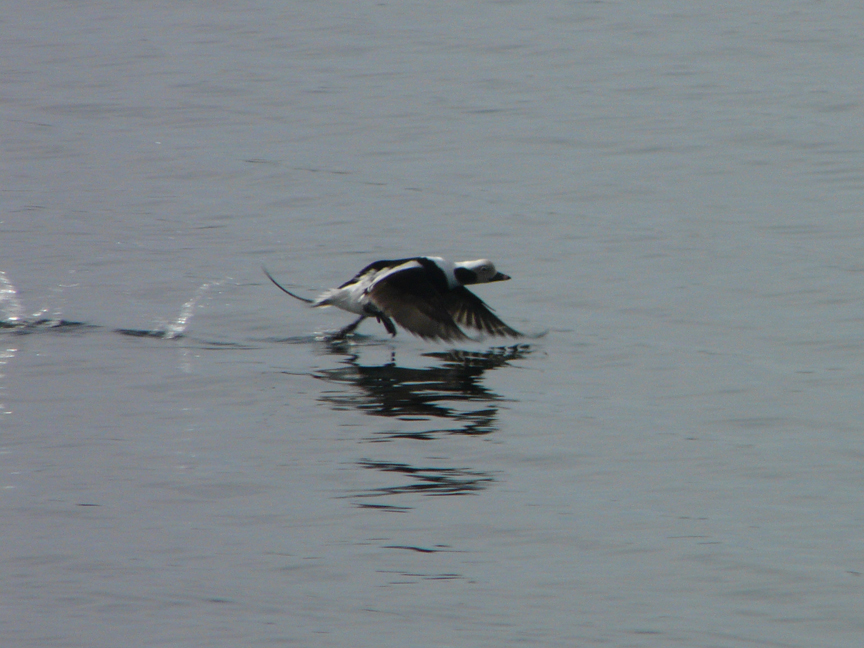
Long-tailed duck at takeoff.
Still there were plenty of diving birds, too. Common loons, red-breasted mergansers, a black guillemot, and several little collections of long-tailed ducks. The long-tails, in fact, provided ample entertainment—preening, profiling, giving out their little distinctive three-note yodels. I even got their yodels stuck in my head, after deciding I’d like to devote to long-tails a movement of a symphony I’d like someday to write. If you’ve heard these yammering ducks, you know the sound I mean. (In the height of politically incorrectness, the species was for years called “oldsquaw” because of the gossipy nature of the sound.) But today I realized their calls amount to the rising components of a perfect major chord. And so I got ’em stuck in my head—and must remember to bring my digital recorder next time.

Great cormorant.
Also on the breakwater with us today were three great cormorants. They’d perch on the stones ahead of us, and when we’d get to close, they’d fly into the harbor or veer around to another part of the breakwater. A number of times we caused them to fly. I got a couple photos.
The air today stayed as still as night air, and it never dipped below freezing. Our walk was my warmest out there since last summer. Turns out low-tide ain’t all that bad.
* * *
Tonight, with temperatures in the mid-thirties (F), it has begun to rain. It’s drizzly now, but heavier rain—and wild winds—are forecast for tomorrow. Rain in mid-winter always discombobulates me. Just seems weird.
I wonder what the long-tailed ducks are up to.
Today’s List
American crow
Herring gull
Mallard
Ring-billed gull
Bufflehead
Common goldeneye
Black duck
Common loon
Common eider
Black guillemot
Long-tailed duck
Great cormorant

Low tide still life.
Tags: American crow, black duck, black guillemot, bufflehead, common eider, common goldeneye, common loon, great cormorant, herring gull, long-tailed duck, mallard, ring-billed gull

