


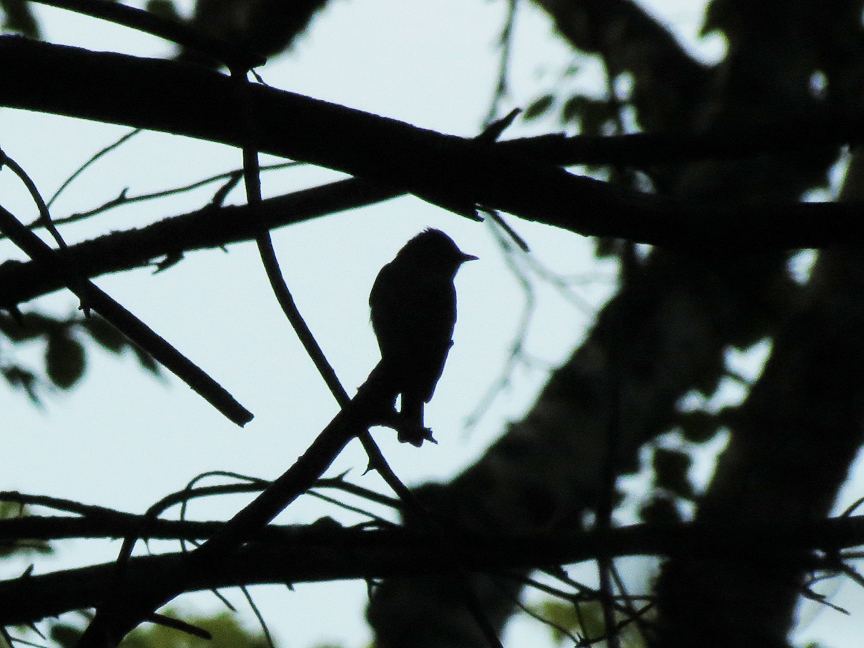
Eastern wood-pewee.
It’s a voice in the wilderness, like the lonesome howls of distant wolves or the yipping cries of coyotes—but smaller, more pensive, more intimate. I think it’s my favorite bird call. The song of the eastern wood-pewee.
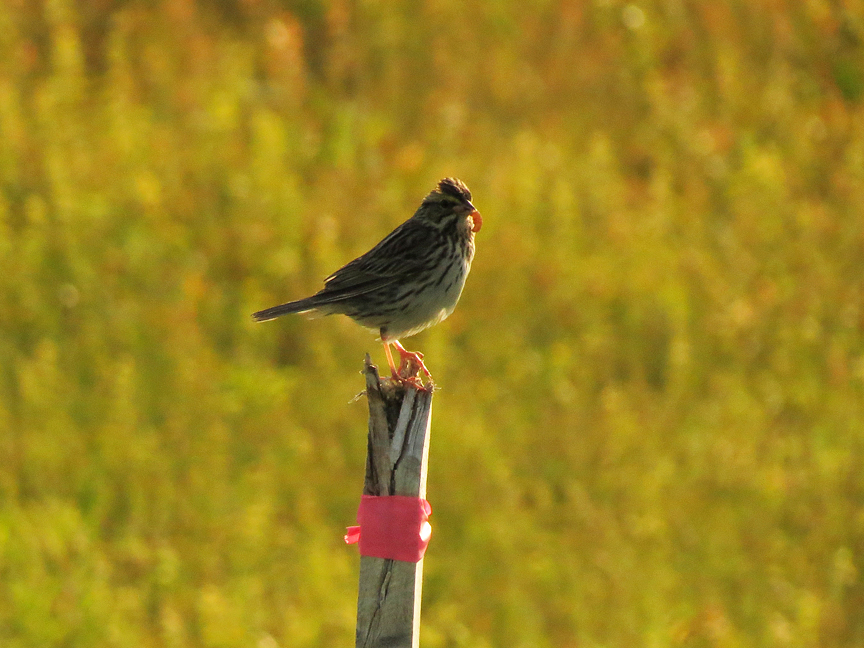
Savannah sparrow.
Jack and I didn’t make it to Beech Hill until late on this sunny, clear, dry, lovely day. The woods were mostly quiet, with intermittent calls of warblers and thrushes and other native species. Afternoon sunlight angled through the thickening foliage, illuminating tight, bright patches of undergrowth, guiding us up the trail. I heard many birds but saw few. There’re nests to attend to, after all.
Alder flycatchers have taken delivering abbreviated calls—or simply peeping. A few towhees sang, but only a handful of warblers did. A couple of vireos called. I heard the mystical notes of a veery. At the summit, American ladies were still fluttering about Beech Nut, but only singly or in pairs. Caught sight of a savannah sparrow in the grass—it had caught a grub or caterpillar and fluttered to a perch on a flagged stake. I heard the chips of another savannah above and behind us, coming from the grassy roof of the hut. And then I heard human music: unbeknownst to Jack and me, a hiker had come up the open trail, arrived at the porch, and received a cell phone call.
We returned down the lower wooded trail, where a hermit thrush was singing. And a black-throated green warbler.
And a pewee.
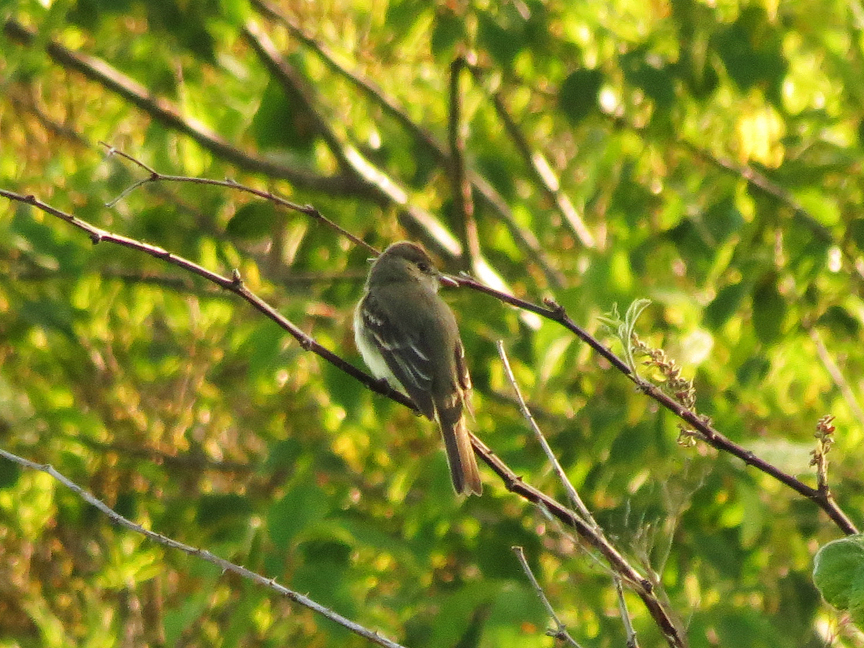
Alder flycatcher.
I well remember the first time I heard the song of a wood-pewee. It was at a rest stop along a highway, where my partner and I had stopped. I heard it before I saw it. Its voice impressed me then as it does now. (I had to look it up: 31 August 1981, 12:45 p.m., along I-71 in Ohio, near Mt. Gilead, calling from a deciduous wood.)
I think the thing about a pewee’s call that grabs me most is the fact that it’s not a typical quick, complex birdsong—it’s a drawn-out series of slow phrases, with pauses in between. Pee-o-weee! [Pause of many seconds.] Pee-o-weee! [Pause of many seconds.] Pee-o-weee! [Pause of many seconds.] Pee-ohhh. True, sometimes they get distracted and miss the last phrase, or they’ll skip one of the early three. But the long, plaintive, almost melancholy series of notes just clutches at my heart. It’s a sound like a solitary walk along a lake in late afternoon, or a goodbye to a summer love just before school begins again, or a pensive moment along a wooded trail when your thoughts turn to lost people and places of many years ago.
I’ve got a sound file somewhere. I’ll post its song here soon.
Beech Hill List
Beginning at 6 p.m., I hiked the wooded trails.
1. Red-eyed vireo* (v)
2. American robin*
3. Ovenbird (v)
4. Chestnut-sided warbler
5. American redstart* (v)
6. Gray catbird (v)
7. Veery (v)
8. Eastern towhee
9. Alder flycatcher
10. Yellow warbler (v)
11. American goldfinch*
12. Common yellowthroat (v)
13. Song sparrow
14. Eastern phoebe
15. Savannah sparrow
16. Field sparrow (v)
17. American crow* (v)
18. Hermit thrush (v)
19. Black-throated green warbler (v)
20. Eastern wood-pewee
Elsewhere
21. House finch (v)
22. Northern cardinal (v)
23. Herring gull
24. European starling
25. Rock pigeon
26. Mallard
v = Voice only
*Also elsewhere
Tags: alder flycatcher, American crow, American goldfinch, American redstart, American robin, black-throated green warbler, chestnut-sided warbler, common yellowthroat, eastern phoebe, eastern towhee, eastern wood-pewee, European starling, field sparrow, gray catbird, hermit thrush, herring gull, house finch, mallard, northern cardinal, ovenbird, red-eyed vireo, rock pigeon, savannah sparrow, song sparrow, veery, yellow warbler

