


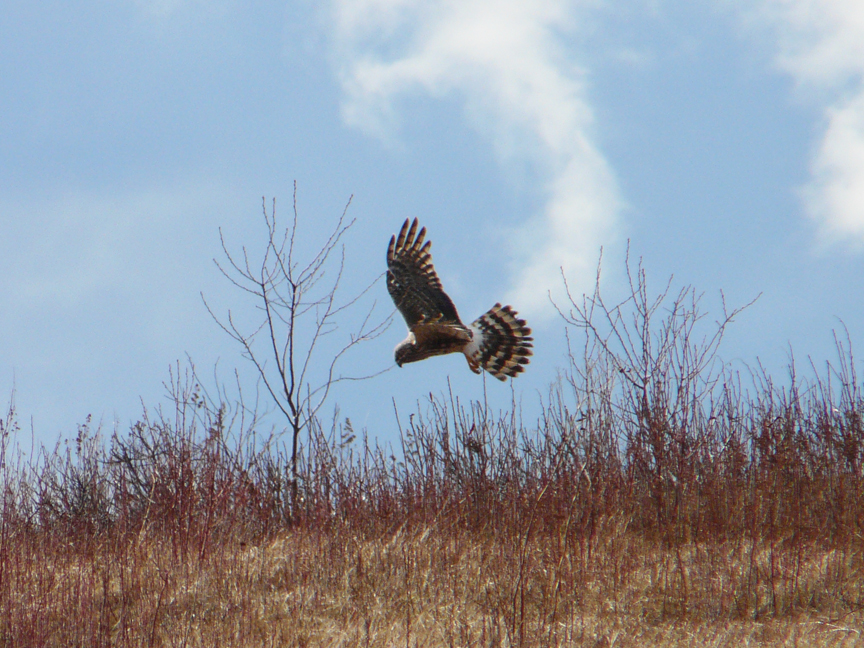
Northern harrier.
We’re closing in on that time of year that a birder considers golden—at least at this latitude. The last half of April trembles like the calm before a storm, as occasional migrants arrive in little ripples (e.g., yesterday’s pine warbler), yet the tsunamis of May are yet a couple weeks away. This morning, though, the weather didn’t appear cooperative: last night’s high wind and rain persisted, as the upper edge of the big, sharp front that spawned tornadoes down south moved through. A howling, roaring wind, in fact (though not absolutely pouring rain). I was grateful that the storm’s bulk had mostly passed by the time I took Jack out for his morning pee.
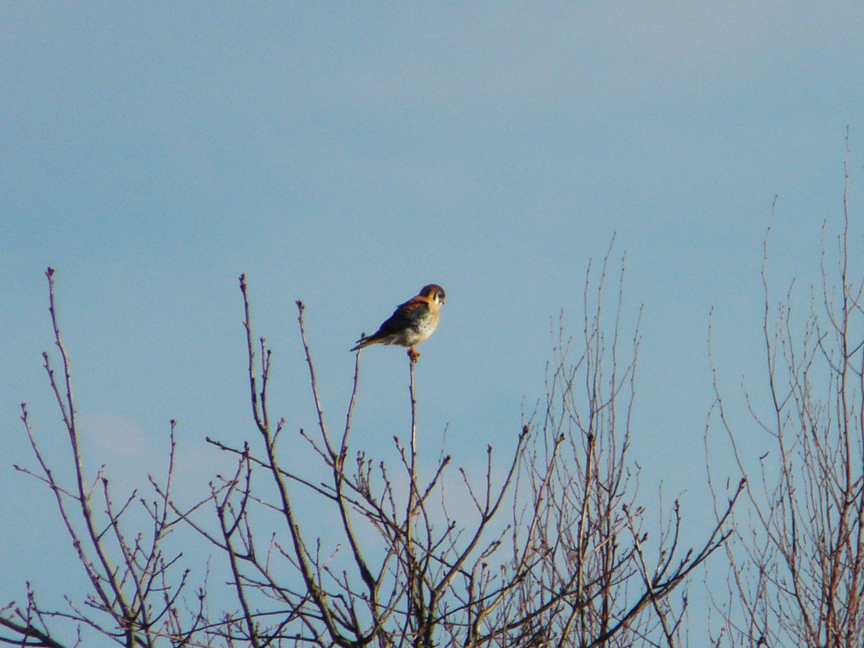
American kestrel.
Didn’t expect many birds to make an appearance so soon after such a big blow, but a few did: house finch, crow, song sparrow—and a solitary flier that at first I took for a cormorant until it got nearer and I realized, from its light coloration, it must have been a loon.
Took care of some chores inside while the day brightened, the sun emerged, and innocuous high white clouds moved over. The temperature warmed to 60 (F), at least, and the runoff from the rain dried quickly. By late-afternoon, we couldn’t wait any longer. The drive to Beech Hill was swift, and before we knew it, dog and I were striding up the wooded trail.
Right away, I heard a phoebe calling (the first of many on the hill). And a crow. And gulls from shoreward. And a solitary song sparrow, with its chatters and chimes. About half-way up, I heard the cries of a flicker—then I wingbeats, and looked up, and I saw one of the handsome bronze woodpeckers perched on a leafless snag in the middle distance. Heard the voices of lovesick chickadees, as well.
Jack and I stopped near the top of the trail to listen to what I thought might be a bird scratching about, when a sudden commotion behind us made us turn just in time to see a shoeshow hare skedaddle through the trees and off across a secluded glen. The rabbits fur was a light bronze, almost yellowish. Only the second hare I’ve seen up there (the other being a white winter rabbit a year or so ago). Soon after, we ran into a couple and their dog. I told them about the snowshoe hare.
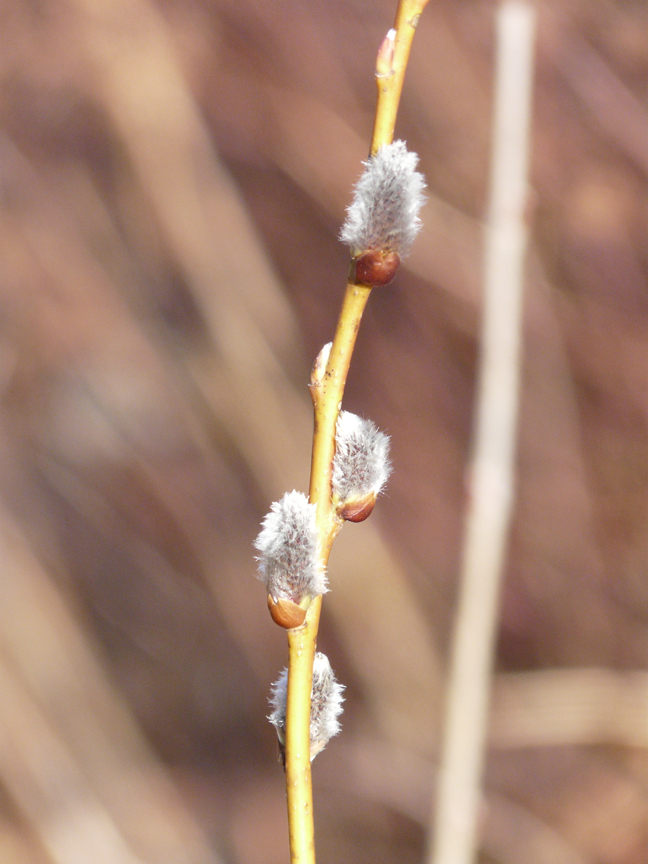
Pussy willow.
Coming into the upper fields, I scanned for the kestrel, didn’t see it right away, but then spotted it in the upper reaches of a tree a bit farther off along the hedgerow. A male. Climbing the last ascent, I heard more song sparrows and a couple robins. And one of the pair of phoebes that will nest in the eaves of Beech Nut flitted away at our approach, just as it had done a couple days ago.
I’d been looking for the harrier but hadn’t seen a sign of it—that is, until we started down the open trail, when it appeared (as it often seems to do) low above the field from behind a crest in the hill. A little wind was blowing from the west, and the hawk turned and faced the wind and hung there for a few beats before dipping down to earth. I couldn’t tell if it caught anything, but I managed to grab a couple photos before it sailed away down the western slope. A short time later I spotted it soaring off toward the road, circling, and zipping quickly back east down along the southern slope.
Nearing the road, I heard the strident notes of a nuthatch-in-love, the fluting of a titmouse, and the screams of a jay. Also a cardinal singing. As we reached the parking lot, two vehicles pulled in in quick succession—Jay and Amy again, in separate cars—and I heard the high, thin notes of a kinglet from the little grove of conifers there. The robin sat high in a tree laying vociferous claim to its territory.
Back up and over, I could hardly keep my eyes off the spectacular sky. No more sign of the harrier (or much of anything else)—but what a sky. We didn’t linger, headed straight back into the woods and down the lower trail.
Encountered quite a few downed branches from last night’s blow, and one small felled tree obstructing the trail. I moved it away as completely as I could. Heard crows, another phoebe, gulls. Then, just as we entered the big oak grove, I heard the strident calls of some bird. Sounded like a hawk. We stopped so I could listen. Repeated, loud, clear calls with a little yodel at the end. I looked in the direction of the sound but saw nothing—and then suddenly it flew. I got a distant look at it. A hawk for sure, a ruddy-breasted one. It traveled maybe a hundred feet away to perch on a limb of another tree, where I heard its continuing cries. Tried for another look but got only a flash of wings as it took off again and flapped away to the northeast, calling the whole way. As we moved through the oaks I could heard its calls continue, growing distant.
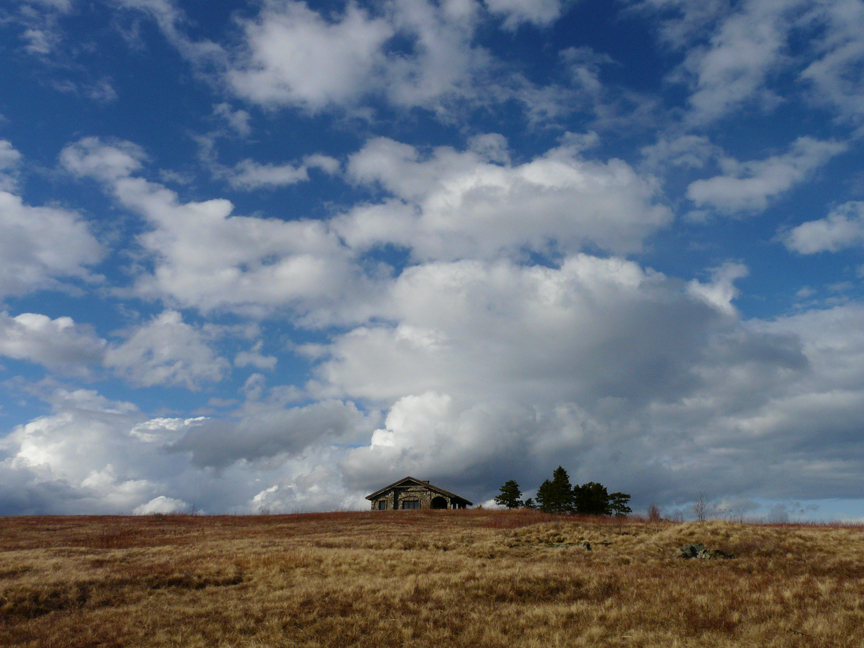
Beech Nut.
Not being an expert at hawk calls, I thought it might’ve been an accipiter—I’ve seen both coopers and sharp-shins up there—but when I got back home and dialed up the Cornell Lab’s website to take a listen, I got confirmation. What I’d heard was a red-shouldered hawk. First of the year, and first ever that I’ve seen on Beech Hill.
As evening fell, I heard the chips of the resident cardinal out back. Remnant clouds were flowing under the rising new moon.
(Just a minute ago I stepped out again to see a cloudless, moonlit sky.)
Beech Hill List
Beginning at 4 p.m., I hiked all trails.
1. Eastern phoebe
2. American crow (voice)
3. Herring gull (voice)
4. Song sparrow
5. Northern flicker
6. Black-capped chickadee
7. American kestrel
8. American robin
9. Nothern harrier
10. White-breasted nuthatch (voice)
11. Tufted titmouse (voice)
12. Blue jay (voice)
13. Golden-crowned kinglet (voice)
14. Red-shouldered hawk
Elsewhere
15. House finch
16. House sparrow
17. Common loon
18. Northern cardinal
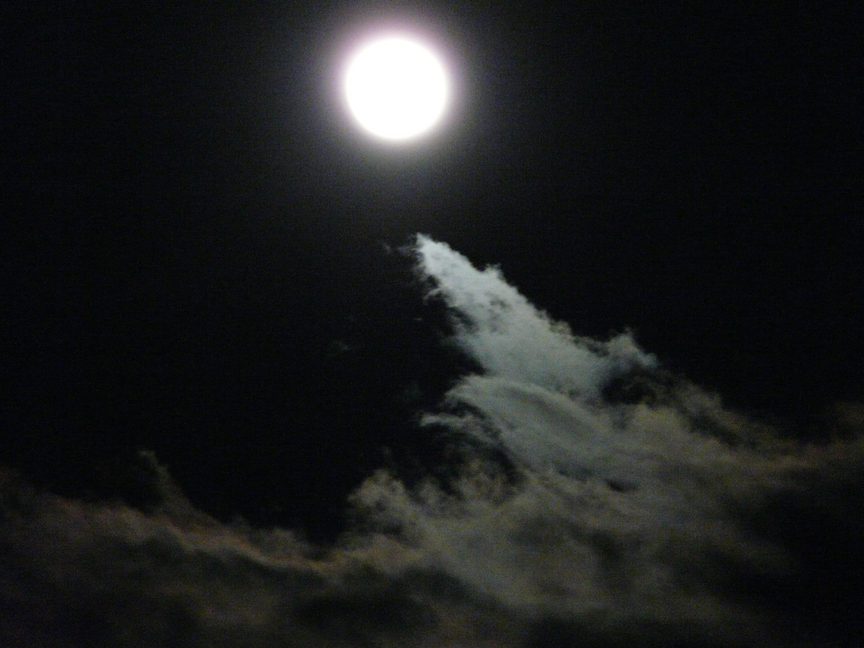
Full moon.
Tags: American crow, American kestrel, American robin, black-capped chickadee, blue jay, common loon, eastern phoebe, golden-crowned kinglet, herring gull, house finch, house sparrow, northern cardinal, northern flicker, northern harrier, red-shouldered hawk, song sparrow, tufted titmouse, white-breasted nuthatch

