


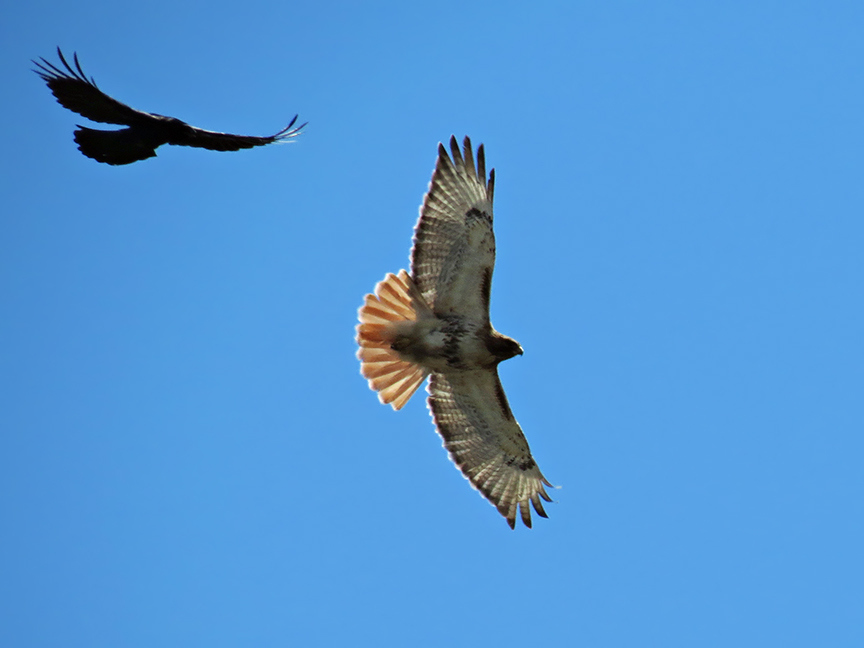
Crow and red-tail.
Fiddling with glyph outlines at the kitchen table this sunny morning, I heard from outside a commotion of crows. The kind of commotion I’ve learned to interpret to mean, essentially: Hawk! Hawk! It’s my cue to grab my camera and step out the door.
Which I did, and right away I saw a handsome red-tailed hawk circling in the blue, relatively unfazed by the three or four crows that were diving at it from all angles. Not an unfamiliar sight hereabouts, but it was nice to get a fairly decent photo or two of the red-tail—including one in particular that I liked, showing the hawk with wing and tail feathers spread as a crow approached from above.
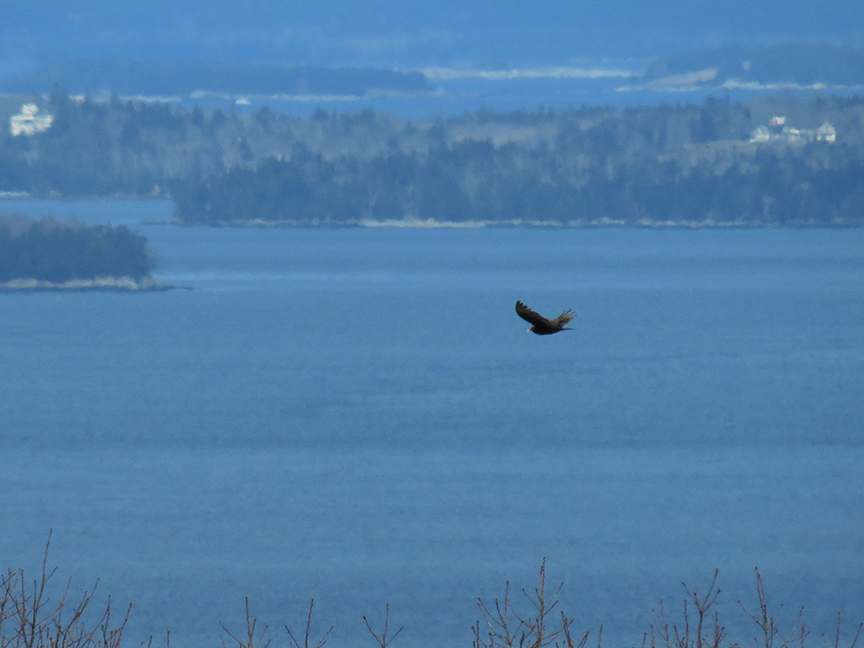
Turkey vulture.
I couldn’t take my eyes off the hawk’s feathers, especially its fanned reddish tail feathers back-lit by the sun. I could easily count the tail feathers. There were twelve. Only twelve. That didn’t seem like a lot. So I turned my attention to its wing feathers and saw what looked to be twenty on either wing, ten primary and ten secondary flight feathers each. Just thirty-two feathers on wings and tail—light, intricate, delicate feathers—will move an agile red-tailed hawk through the air. Thirty-two feathers will let it ride a thermal, using only the slightest movements of individual feathers, each controlled by small sensitive nerves and muscles. Thirty-two feathers to send it diving after a rabbit or small bird. Feathers on wings and tail that can be neatly folded away when not in use.
As I looked at the photo, I saw that the crow, too, had a similar configuration of feathers. As most birds do. For centuries, millennia, millions of years, a few dozen feathers have carried untold numbers of birds around—an idea that struck me as perhaps the height of evolutionary perfection.
Butterflies, dragonflies, bees, beetles—other creatures move miraculously in three dimensions. But what pieces of work are the wing and tail feathers of birds.
Beech Hill List
Beginning at 2:30 p.m., I hiked the open trail.
1. Black-capped chickadee** (v)
2. American crow*
3. Turkey vulture
4. American kestrel
Elsewhere
5. Eastern phoebe (v)
6. House finch (v)
7. Song sparrow (v)
8. Red-winged blackbird
9. Red-tailed hawk
10. Herring gull
11. European starling
12. Mourning dove
13. Rock pigeon
14. House sparrow (v)
v = Voice only
*Also elsewhere
**Voice only elsewhere
Tags: American crow, American kestrel, black-capped chickadee, eastern phoebe, European starling, herring gull, house finch, house sparrow, mourning dove, red-tailed hawk, red-winged blackbird, rock pigeon, song sparrow, turkey vulture

