


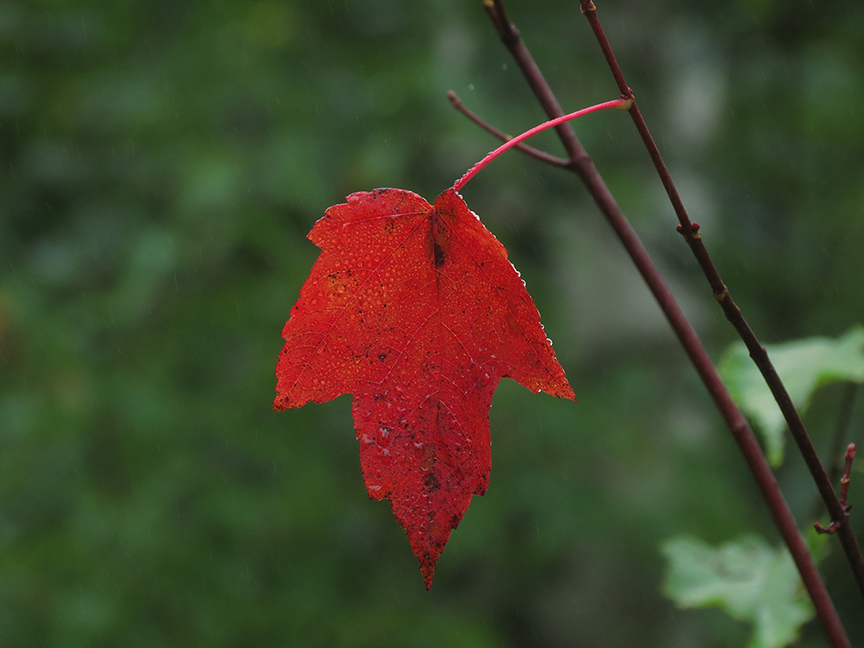
Sole Survivor.
Why do the leaves of hardwoods turn brilliant colors in fall?
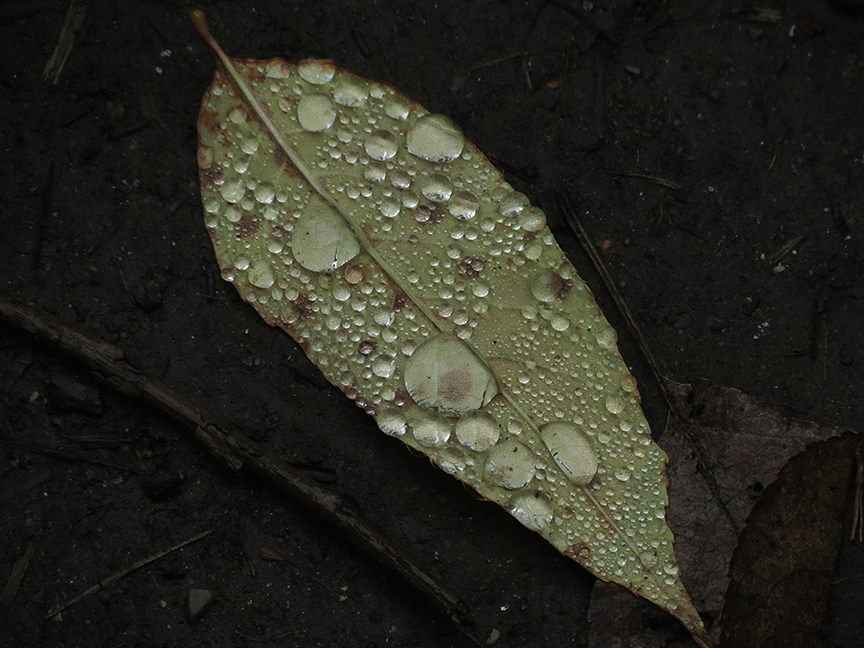
Orbs, Beech Hill Preserve, Rockport, Maine, 04 October 2014.
I don’t mean, by that question, why it happens scientifically—what chemical process takes place, and how the light gets refracted, and all that scientific jazz. I mean for what sensible, practical reason does it happen? What forms of life are aided by the change of color? What advantage do the reds and yellows make for what species? Whom does it benefit?
That and other mysteries occupied my mind today.
I also thought about the miraculous elixir of our planet—water. This, because it came in curtains from the sky, in tiny droplets, so many of them, unfurling in great chill blankets to cover everything. Fog and drizzle. The tiniest droplets imaginable. But, collected, these tiny droplets became larger rounded orbs of water on surfaces such as leaves. A red maple leaf. The backside of a fallen leaf on the Beech Hill trail. Orbs and rounded shapes of different sizes. Reflective. Lovely.
And rare, from what I know. Water itself is not that exotic—an easily made molecule of oxygen and hydrogen—but rare in the universe, is what I imagine. Peculiar to our precious tilted planet.
Just mysteries, that’s all.
Beech Hill List
Beginning at 12:30 p.m., I hiked the open trail.
1. White-throated Sparrow (v)
2. Black-capped Chickadee** (v)
3. Yellow-rumped Warbler
4. American Crow*
5. Song Sparrow
6. Blue Jay (v)
7. Eastern Towhee (v)
8. Northern Flicker
Elsewhere
9. Herring Gull
10. Rock Pigeon
11. European Starling
v = Voice only
*Also elsewhere
*Voice only elsewhere
Tags: American crow, black-capped chickadee, blue jay, eastern towhee, European starling, herring gull, northern flicker, rock pigeon, song sparrow, white-throated sparrow, yellow-rumped warbler

