|
|
 |
|
|
Posts Tagged ‘common goldeneye’
Monday, February 15th, 2010
 Horned grebe. I’d only been awake a few minutes when I heard it: the clear, sweet, repeated notes of a northern cardinal. Mid-way through February, the day after Valentine’s, and this bird clearly had love on his mind. The song continued for more than five minutes, at least. I sort of got a little horny just by association.
But it’s still winter. High 20s (F) early, up into the mid-30s late. Crows stalked the half-bare yards, as usual, occasionally letting out their four- or five-note calls.
 Penobscot Bay. I didn’t get out, really, until the usual time, about 4 p.m. Decided on the breakwater today. Above freezing still, and only a little wind from the northwest. A couple cars were in the lot, and sixteen mallards were at the shore. Also a couple buffleheads and several herring gulls. About half-tide, and receding.
The harbor side held the rougher water for a change; the bay spread out like an enormous mirror. Right away I spotted three or four harbor seals on their customary rocks a few hundred yards out. Black ducks and red-breasted mergansers in the protected cove. Then I spotted the grebe. A solitary horned grebe diving very near the breakwater. I spent a lot of time watching it and taking pictures. Such an amazing-looking bird—even in its relatively plain winter plumage. Its red eyes sort of mesmerize.
Black-backed, herring, and ring-billed gulls patrolled the granite stones, up and back. They seemed particularly interested in urchins. They kept close watch as more intertidal real estate slowly emerged. On the harbor side I saw a pair of long-tailed ducks—and only a pair. Surprisingly, there were no loons.
 Great cormorant. Nearing the lighthouse I surprised a great cormorant perched on seaweed near the waterline. It stuck around for a portrait.
Returning, the wind picked up some, and some chop appeared in the bay. It occurred to me I’d seen neither common loons nor common eiders, so I scanned the water for a while—and sure enough spotted about a half-dozen of the latter. It wasn’t until I’d covered perhaps three-fourths of the return trip that I got my loon. A solo bird, harbor side. The loon, like the mergansers, kept plunking its face into the water, looking for grub.
The grebe was still diving in about the same place, though now amid newly exposed rocks. At right about 5, with the sun going down behind me, I watched a half-dozen species in a loose assembly dive and emerge, dive and emerge: black ducks, buffleheads, eiders, mergansers, goldeneyes—and a single horned grebe.
Today’s List
Northern cardinal
American crow
Herring gull
Mallard
Bufflehead
Black duck
Red-breasted merganser
Horned grebe
Great black-backed gull
Ring-billed gull
Common goldeneye
Long-tailed duck
Common eider
Common loon
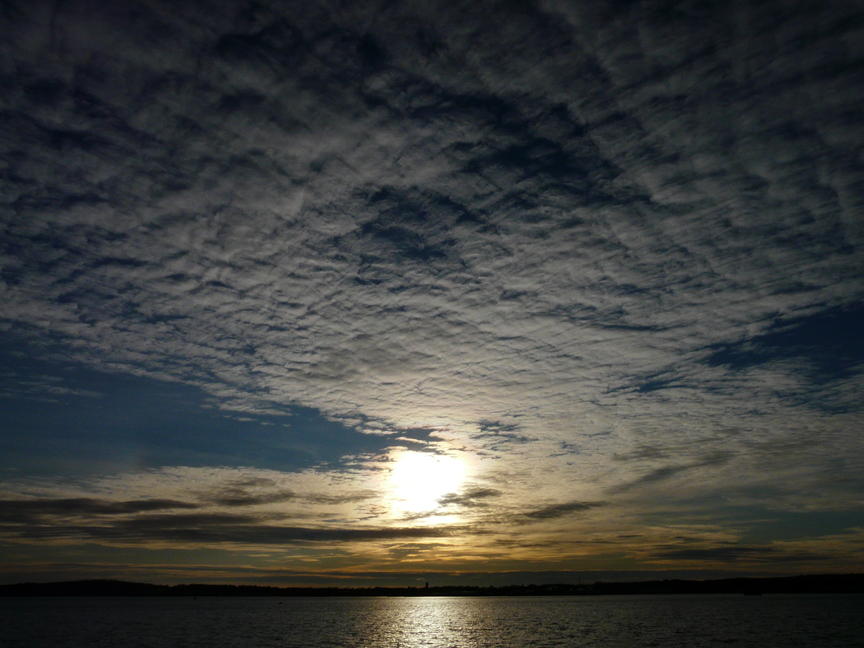 Sky over Rockland Harbor.
Tags: American crow, black duck, bufflehead, common eider, common goldeneye, common loon, great black-backed gull, herring gull, horned grebe, long-tailed duck, mallard, northern cardinal, red-breasted merganser, ring-billed gull
Posted in Lists, Observations | No Comments »
Monday, February 8th, 2010
 Wedge of blue sky. The day dawned calm and hazy. Temps in the 20s (F), a sky that seemed unable to decide whether to stay cloudy or let the sun shine through. Early on, I heard the single squeal of a winter robin out back, then the friendly voices of chickadees, then the soft call of a white-breasted nuthatch. From my desk in morning I could see crows alighting in the crown of a great oak down the road a ways—the same tree whose foliage, in summer, takes on the shape of a human head or face. The crows would alight, then leave; then they’d return, then they’d leave again.
 Great black-backed gull. I’d had all the desk work I could stomach by about 3:30 p.m., and so decided to head out the breakwater to look for the king eiders rumored to be hanging out on the bay side these past couple weeks. I’ve only ever seen common eiders there, but you never know. After a quick trip to town—herring and ring-billed gulls, rock pigeons, the usual—I turned down and parked and grabbed my gloves and scarf. The temperature had warmed to slightly above freezing, but I’ve learned to respect the raw exposure you feel out on the granite stones. Still, I stuck my gloves in my pockets at first and didn’t zip my parka.
Not much wind really. The usual collection of mallards by the shore. On the island side of the breakwater, I saw black ducks and common goldeneyes; on either side were loons.
Maybe a hundred yards out, the wind rose suddenly. I pulled on my gloves and zipped up. A solitary gentleman I often meet returning from his walk warned me of ice out toward the lighthouse. A loon rose as by magic from the swell not a dozen feet away.
 Great cormorant. He was right about the ice. I had to keep closer tabs than usual on where I put my feet—and you generally have to pay attention to your footing out there, lest you step between the stones and break an ankle (a fairly common occurence)—and a couple times slipped and slid. Once I looked up surprised to see a great black-backed gull floating above me maybe twenty feet or so. Wings out, motionless in the wind. Taking its photo proved a challenge, however, as it was pretty close for my telephoto lens. I’d focus, it’d move; I’d focus, it’d move. It hovered directly above me for quite a few seconds—to the point that I wondered if I’d get pooped on.
Then the gull did an odd thing: at once it veered into the waves, plunged its head in, and when it emerged it had what looked like a long worm in its mouth—I couldn’t tell if it was eating the worm or trying to spit it out. In fact, I wasn’t entirely sure it was a worm. Perhaps it was some kind of string or line, or maybe the gull’s long tongue. (Except I can’t imagine gulls have tongues that long.) Maybe it was dining on saltwater worms. The tide was semi-low, and it looked like it was hunting.
I saw a single great comorant. I saw no long-tailed ducks. And this is noteworthy: I saw no eiders at all, let alone a king eider. I can’t remember the last time I headed out the breakwater in winter without seeing at least a dozen or so.
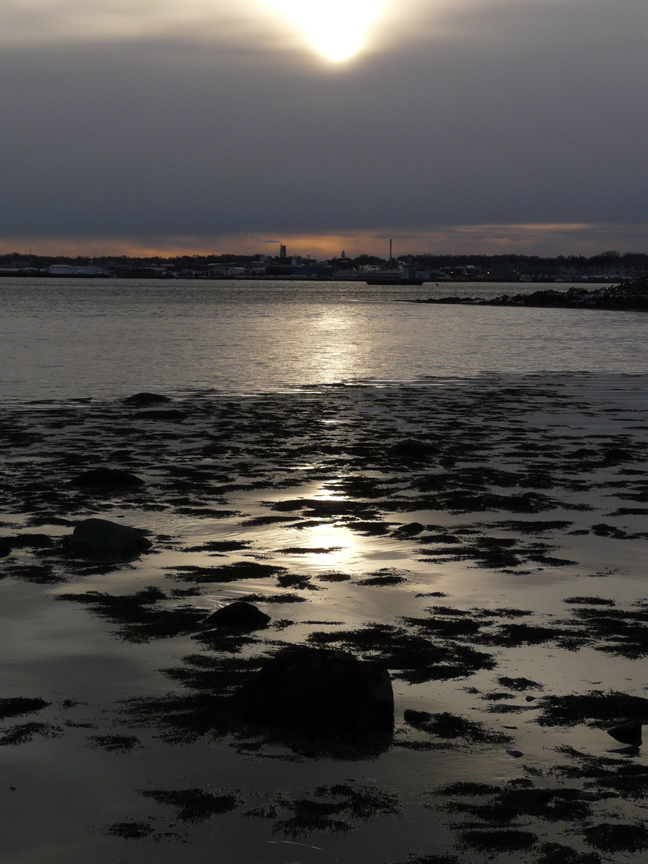 Sunset over Rockland. I made it to the end and turned back. The sun was setting. The light in the sky was lovely. On my return, I met a young couple headed out and said, motioning behind me with a smile, “Kind of precarious.”
“We’ll be careful,” they said, as if I were a parent.
My cheeks grew numb in the wind. Loons and cormorants and goldeneyes dove for seafood. A great black-back gulped down worms—or not. And as I stepped off the breakwater and returned to my pickup, I saw a solitary duck, a female common eider, floating in the protected cove at gloaming and swallowing what might’ve been a mussell or other shellfish. She was the only eider I saw today.
Today’s List
American robin
Black-capped chickadee
White-breasted nuthatch
American crow
Herring gull
Ring-billed gull
Rock pigeon
Mallard
Common loon
Black duck
Common goldeneye
Red-breasted merganser
Great black-backed gull
Great cormorant
Common eider
 The bay.
Tags: American crow, American robin, black duck, black-capped chickadee, common eider, common goldeneye, common loon, great black-backed gull, great cormorant, herring gull, mallard, red-breasted merganser, ring-billed gull, rock pigeon, white-breasted nuthatch
Posted in Lists, Observations | No Comments »
Thursday, February 4th, 2010
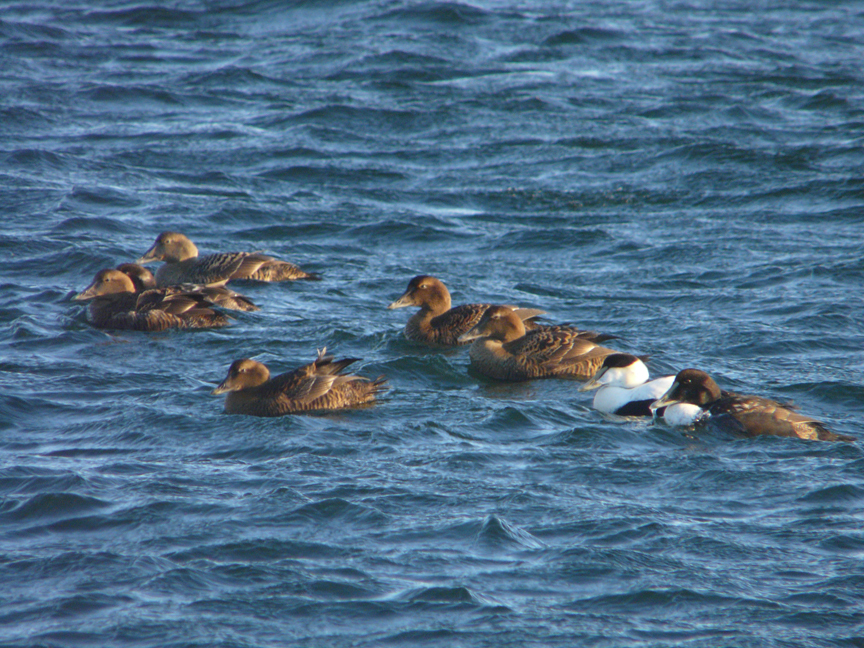 Common eiders. Soon after rising, showering, dressing, making and eating breakfast, and heading downstairs to the office with coffee, I ended up shoveling snow again. The morning beamed with the sort of gloriousness only possible when bright sun meets fresh snow. While on the deck tossing shovelfuls off into the brisk north wind, I heard the clear, unabashed, unmitigated song of a house finch coming from the bare limbs of the big overhanging oak above me. I dropped the shovel and ducked in for my camera. It took me a good three or four minutes of tipping my head to find the bird—which sat in one of the tree’s highest branches, giving forth lusciously cascading warbles of sound. Too obstructed by twigs for a decent photo, though, alas.
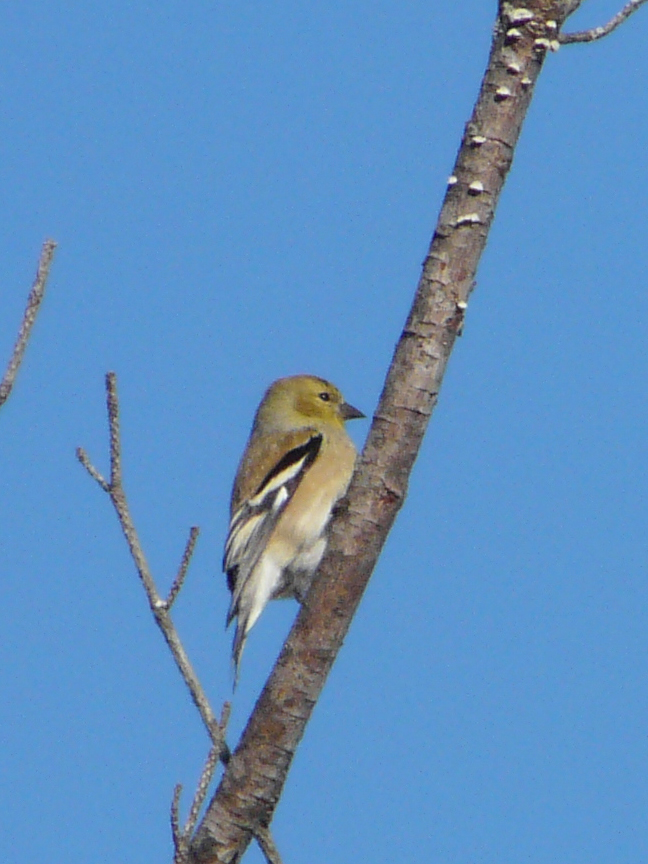 American goldfinch (♀). From somewhere up the hill, meantime, came the chip of a northern cardinal. While scanning for the cardinal, I caught sight of a small bird flitting into the crown of the sickly pine at the property line. A goldfinch. And while all this was going on, I heard the ever-present voices of American crows.
The bright sun crossed the sky slightly higher than it did yesterday, and snow melted, and icicles formed. By mid-afternoon, I had a hankering to move and thought first of the breakwater. It had to be close to high tide. My friend Kristen joined me again, and en route we wondered about the wind. Would it counteract the seeming warmth of the afternoon? I was beginning to think not—until I saw the chop in the harbor. So instead we wondered if the torturous headwind would afflict us outbound or returning. Heading out, we hoped; alas, it was returning.
It seems most of the sensible ocean birds stuck to the protected coves, the shelter of the lee. But a few braved the bare, raw waves: a good-sized raft of eiders, several loons (as usual), a great cormorant, a male long-tailed duck. A couple herring gulls floated alongside the ducks, and one ring-billed flew the length of the breakwater—up and back, up and back—I suppose looking for something edible.
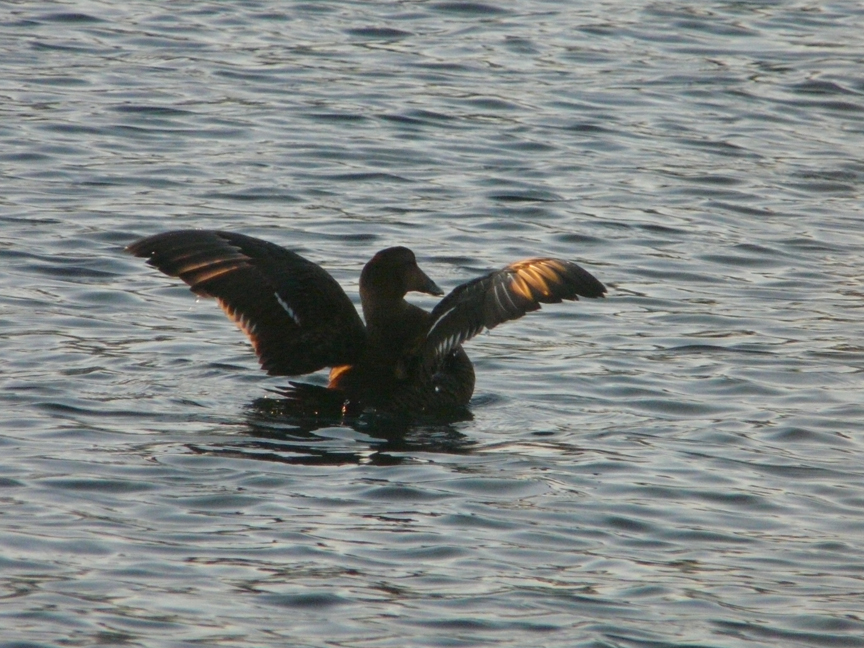 Common eider (♀). The way out was nice: bright, mild enough, and with snow enough that you had to make a point to avoid the hidden cracks between the granite blocks. Heading back, temperatures in the 20s (F) combined with a stout northwest wind to cause an ice-like pain right in the middle of my forehead. Surf splashed over the stones from the shoreside. Out on Vinalhaven, the great turbines, too, turned their faces into the wind. But it let up some about half-way back. A female eider floated calmly to the left of us. To our right, in the little cove, goldeneyes dove and mergansers sailed as the sun headed for the horizon.
When my father was a toddler, his family conspired to have him sit on the lap of one Charles Goodnight, a famous rancher known as “the father of the Texas Panhandle.” Goodnight was by then an elderly cowman—he was born in 1836—and late in his own life I recall my dad marveling at how between the two of them they’d witnessed upwards of 170 years.
I thought of Dad and Mr. Goodnight this week when I read the news of “Herbie,” an American Elm in Yarmouth, Maine, that finally died of Dutch Elm Disease and was cut down on 20 January. After counts and recounts of its rings, arborists finally judged the enormous tree to be 217 years old. When it was but a sapling, George Washington was president. Perhaps another ancient elm in its vicinity back then had lived to a similar age—it would’ve been around before New England was even a glimmer in any European’s eye.
I figure the older you get, the more you consider time. You consider the swiftness of its arc, the brevity of a day, the lifespans of mayflies, the breadth of an ice age. Today, returning against the wind in Rockland Harbor, time seemed long and lazy; tonight already I’m lamenting the loss of this day, 04 February 2010.
Today’s List
House finch
Northern cardinal
American goldfinch
American crow
Herring gull
Common loon
Common eider
Great cormorant
Ring-billed gull
Long-tailed duck
Common goldeneye
Red-breasted merganser
 Rockport Harbor (from the Rockland Breakwater).
Tags: American crow, American goldfinch, common eider, common goldeneye, common loon, great cormorant, herring gull, house finch, long-tailed duck, northern cardinal, red-breasted merganser, ring-billed gull
Posted in Lists, Observations | No Comments »
|
|
| |
| Bird Report is a (sometimes intermittent) record of the birds I encounter while hiking, see while driving, or spy outside my window. —Brian Willson |
|
|


