|
|
 |
|
|
Posts Tagged ‘black guillemot’
Friday, February 26th, 2010
 Dichotomy. The wind roared last night. Roared. Steady, constant, loud. Dimly I remember awakening in darkness to a particularly strong roar—the wee hours, most likely. But when dawn broke and I looked at my bedside clock, the digital time display didn’t flash, so the power hadn’t gone out. And when I checked the sky, I saw blue. And when I stepped out on the deck for the first time today, the air felt positively warm—40-something degrees.
Crows flitted around during the day. I heard the song of titmouse and house finch. But then the clouds moved in again, and the wind picked up again, and the sky began to spit mist and spray.
In afternoon, I drove to town and saw no gulls or pigeons in the places they usually frequent, like the roof of the old stitching factory, now a local college. I did see some herring gulls floating in the empty gray sky. Off in the harbor, the line of the breakwater extended visibly from north to south, and I decided to walk the length of it.
 Black guillemot. The bay side had waves and whitecaps and wind-whipped mist; the harbor side had calm swells and a few red-breasted mergansers. The wind and spray quickly soaked the left side of my jeans on the way out, and I nearly turned back—but I didn’t, in part because of the crazy divergence of the height of the tide on either side of the breakwater. The tide was rising, I knew, and had reached about middle height. And the bay side seemed maybe five or six feet higher than the harbor side. Was this an illusion, perhaps the result of the chop on the bay side? Or was this in fact the case—did the incoming tide perhaps take some time to move around this long granite boundary?
As I wondered this, small groups of long-tailed ducks began flying on rapid wing-beats over the breakwater out toward the islands. Over the course of several weeks of walking out here—at usually late afternoon�—I’ve notice the long-tails take up and head out late in the day. They must have special places out in the bay where they lay up overnight, then head back to feed at the rich, calm harbors and coves near mainland during the day.
Then I spotted a solitary black guillemot. A nice surprise. It’s plumage seemed closer to its summer attire than its winter wardrobe. In the minutes I watched it, it never dove.
As I approached the lighthouse, its fog whistle began to blow. The ferries to and from the island passed, as they do, I’ve learned, this time of day. The gray, the wind, the waves, the foghorn—I felt enveloped, surrounded, even protected by a wet, chilly marine world.
On the way back, I saw more long-tails flying eastward, as well as a big flock of gulls also heading that way. A male and two female eiders floated on the harbor side, preening.
Walking back up to my truck, I listened for a minute to the wind—and saw a pair of mallards at the shore.
Today’s List
American crow
Herring gull
Tufted titmouse
House finch
Red-breasted merganser
Long-tailed duck
Black guillemot
Common eider
Mallard
 Surf off the Rockland Breakwater, Rockland, Maine, 26 February 2010.
Tags: American crow, black guillemot, common eider, house finch, long-tailed duck, mallard, red-breasted merganser, tufted titmouse
Posted in Lists, Observations | No Comments »
Saturday, January 30th, 2010
 The bay. My temperamental weather station showed things got a bit chilly last night—down at least to 5 degrees (F). Still single digits at first light, but apparently none of the whipping winds of yesterday. Sunny. An achingly blue sky. From the back deck I heard the voices of crows, chickadees, and a downy woodpecker.
On a trip to town, I counted the usual herring and ring-billed gulls and saw a single European starling in flight.
 Horned grebe. Then, despite the cold, my birding friend Kristen and I ventured out to the breakwater not long after high tide, where rime ice coated most of it granite surface. Somewhat surprisingly, several other couples and groups hazarded a Saturday walk along the narrow strip of ice-free stone. And there was wind—there’s always wind—but relatively light and northwesterly. The stroll out wasn’t too bad. On either side we saw loons, great cormorants, long-tailed ducks, eiders. We saw buffleheads, goldeneyes, mallards, guillemots. Kristen quickly ID’d a horned grebe in winter plumage. Herring gulls, of course.
On the way back we headed more or less straight into the wind. Despite my hat, hood, and scarf, my ears and forehead grew numb in a hurry. But once we’d covered about three-fourths of a mile, we’d reached the lee of the shore, and my face thawed. In fact, we took a little side trip northeast, to a little cove we visit during our area’s annual Christmas Count, to check on a pair of red-breasted mergansers and a group of black ducks.
 Red-breasted merganser (♀), bufflehead, black duck. But the most impressive sight came as we drove back, at Clam Cove—a wide tidal flat just a stone’s throw from my place. The tide was going out, and a dozens of crows stalked the icy mud together, poking around for grub. And if the crow party below caught our attention, so did a similarly large collection of small gulls floating far out in the open water: Bonaparte’s gulls, maybe sixty of them. They were pretty far away, but they appeared to have their heads tucked under their wings, snoozing.
Humans, loons, long-tails, black ducks, crows, gulls—all going about their Saturday business in the company of like-minded individuals. Not that I’d describe cold January as miserable, exactly, but it does seem true that most species do love company. (Ironically, I got one photo that features three wildly different ducks.)
After our walk, as Kristen headed home, I heard the spring warble of a house finch coming from across the road.
Today’s List
American crow
Black-capped chickadee
Downy woodpecker
Herring gull
Ring-billed gull
European starling
Mallard
Common loon
Bufflehead
Common goldeneye
Greater black-backed gull
Common eider
Horned grebe
Black guillemot
Long-tailed duck
Great cormorant
Black duck
Red-breasted merganser
Bonaparte’s gull
House finch
 Crows and Clam Cove.
Tags: American crow, black duck, black guillemot, black-capped chickadee, Bonaparte's gull, bufflehead, common eider, common goldeneye, common loon, downy woodpecker, European starling, great cormorant, greater black-backed gull, herring gull, horned grebe, house finch, long-tailed duck, mallard, red-breasted merganser, ring-billed gull
Posted in Lists, Observations | No Comments »
Tuesday, January 26th, 2010
 The Rockland breakwater. A liquid morning. As light came into the eastern sky, a thaw was underway. I heard the liquid sounds from bed—the drippings and rushings of car tires on wet pavement. All night rain must’ve dribbled from the low-hanging clouds that yet clung to the hillside this morning.
 Tidal stones. And I could hardly recognize the hillside: the even whiteness had gone, and in its place spread a mostly brown landscape, with patches of snow widely interspersed. I could hardly fathom so swift and efficient a snowmelt. Five or six crows spent the morning stalking the yard next door, and the fringes of the parking lot, whose fragrant floor lay now uncovered. Old acorns, I imagine, and possibly even earthworms. I’m not sure the temperature dipped below 40 (F) all night.
By early afternoon rays of sunlight began to flash intermittently through the cloud-cover. And suddenly, a wide clearing sky. That’s about when I felt drawn again to the breakwater. I’d heard tell of a king eider being been spotted there—who knows what I might see?
 Ring-billed gull. The soles of my Merrells hit the great granite blocks at shortly past three. Oddly, the shoreside held the greatest chop; the waves on the island side seemed calm by comparison. Right away I spotted a little raft of eiders. All common eiders—for some reason hanging out with a greater black-backed gull. Nearby, a collection of little buffleheads bobbed in the bouncing waves. The three species got flung together then—eider, black-back, buffleheads—and the little ducks, I noticed, kept an attentive eye on the big, carnivorous gull.
The waxing moon had reached a high point, and the tide was rising. Perhaps because of the warmth, a group of tidal rocks glowed almostl unnaturally green with algae. Though really, of course, the green was entirely natural.
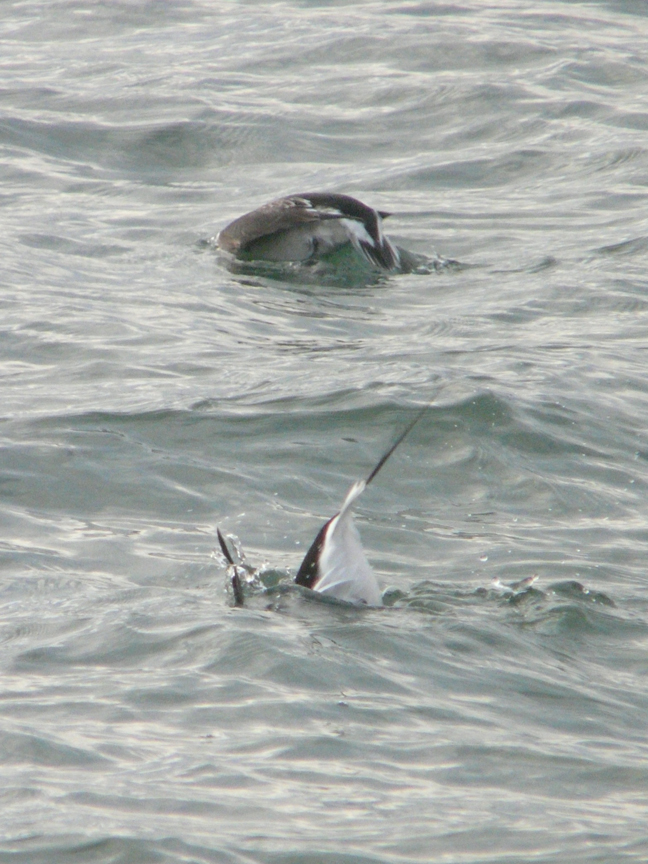 Pair of long-tailed ducks (diving). I saw a large group of loons, five or six of them, sticking together a hundred yards or so away. I saw three black ducks in the protected cove at the base of the breakwater. Farther out, especially on the harbor side, I first heard, then saw, numerous long-tailed ducks—again marveling at their amazing musical call. (I’ve still, in facxt, got their voices stuck in my head.) Small bunches of red-breasted mergansers. Herring and ring-billed gulls. Another group of eiders to the east—but no kings among them, that I could see.
The semi-clearing sky was inspiringly lovely.
After walking its seven-eighths-mile length, head into a southwesterly wind, I paused in the lee of the lighthouse and listened. The first thing I heard was the voices of long-tails. The second was the high-pitched peeping of black guillemots—and there they were, three of the little birds, floating about a hundred feet away.
On the way back I watched a couple great cormorants watching me. And then long-tails began taking wing. First a group of four or five, then a group of eight or more. The males (I assume it’s the males) call in flight, and the combination of voice and great, wing-flapping speed made me dizzy. Then more long-tails, even a group of twenty or more. They flew from the harbor side around the light to the open water, perhaps taking their instinctive trip at the end of the day to where they’ll spend the night. Whatever their motivation, they fly so fast that I couldn’t help but stand in awe. I counted at least a hundred long-tails making this late-afternoon flight.
 Sunset. The light turned pastel pink and blue as I finished up my circuit. And a series of breaking waves swept in from the southeast, cresting over the tidal rocks where harbor seals sometimes lounge. I watched a half-dozen red-breasted mergansers fly swiftly past. I can’t remember the last time I beheld such varied, lovely light, in so short a time, in the sky.
Today’s List
American crow
Herring gull
Ring-billed gull
Rock pigeon
Common eider
Greater black-backed gull
Bufflehead
Red-breasted merganser
Black duck
Common loon
Long-tailed duck
Black guillemot
Great cormorant
 Pink light.
Tags: American crow, black duck, black guillemot, bufflehead, common loon, great cormorant, greater black-backed gull, herring gull, long-tailed duck, red-breasted merganser, ring-billed gull, rock pigeon
Posted in Lists, Observations | No Comments »
|
|
| |
| Bird Report is a (sometimes intermittent) record of the birds I encounter while hiking, see while driving, or spy outside my window. —Brian Willson |
|
|


