


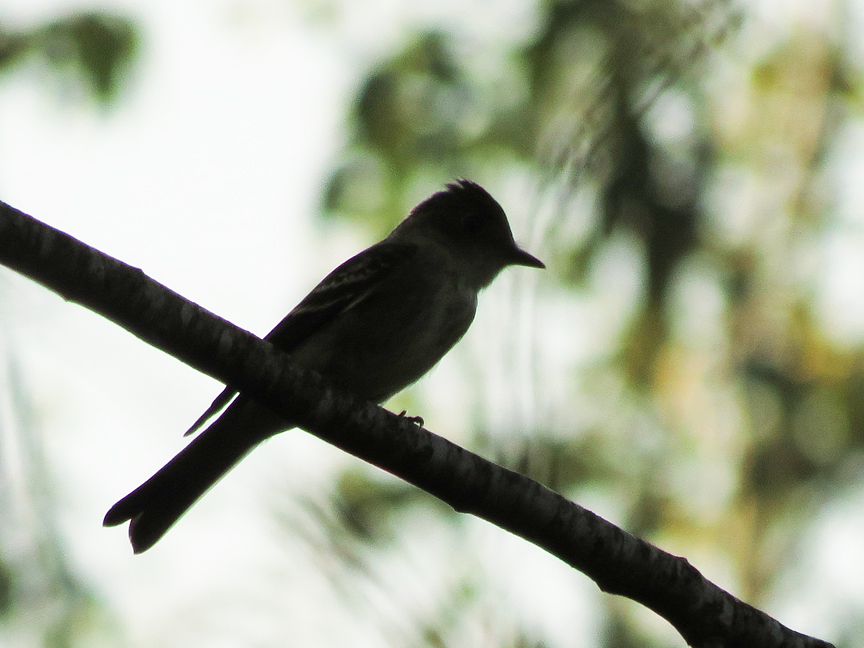
Alder flycatcher.
Another beautiful summer day. Another beautiful summer day without my bike. But that’s all right—I had a cardinal flitting around the place early, and I got a lot of desk work done. And another day in which I didn’t make it out and about until the end of it, when Jack and I took our daily through the woods of Beech Hill.
Another quiet hike—quieter even than yesterday. Now and again, we’d stop so I could look and listen. Nothing flitting through the trees, no peeps in the distant trees. Until, finally, I heard a chickadee. A solitary chickadee. It checked us out for a minute then headed away.
A few minutes later, I heard the faint mew! of a catbird. That was it, just one mew!
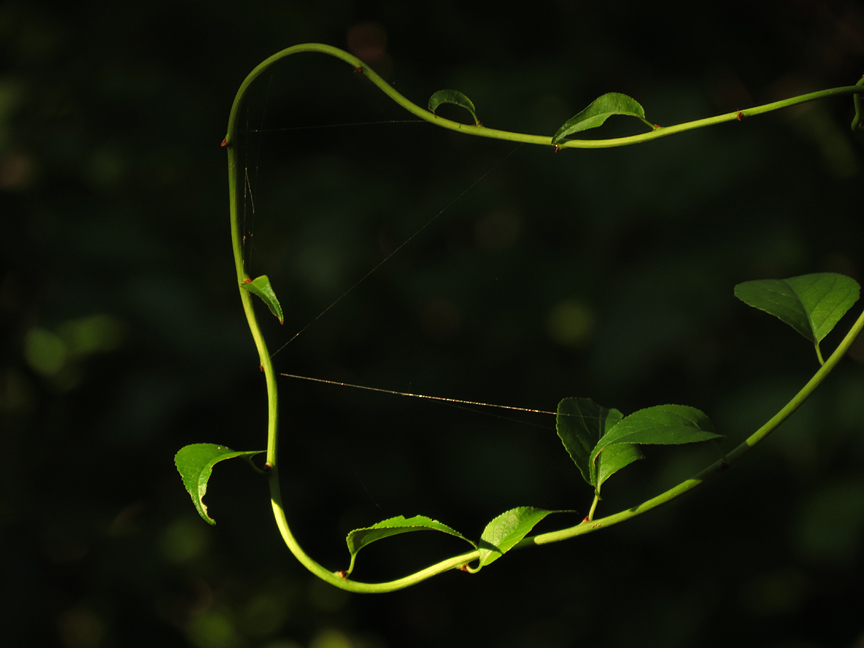
Vine.
And a few minutes after that, I heard the call of a flicker—one of the species’ signature, long staccato calls that seems to last forever and makes you wonder how they can go so long without taking a breath. No towhee, though. No sign of yellowthroats nor other warblers. But then we did hear something that got our attention, something that sounded like it was walking through the brush about thirty feet away. Jack began to growl a little, even. I suspected a turkey, and my suspicion proved correct when I got just a glimpse of its long neck as it disappeared up the trail ahead of us.
Nearing the first fields, I finally did catch sight of a silent passerine: an alder flycatcher. It perched on a back-lit twig looking around for flies.
No humans at the summit, but I did hear the caws of a crow coming from somewhere down the southern slope. Plenty of sails in the bay.
Returning, I heard the high-pitched whistle of a waxwing coming from high in the wooded canopy. First waxwing in a few days—a straggler, I imagine. In fact, what seems to be left up there are stragglers, hangers on. A few quiet families moving about, stocking up on food. Not the chickadees nor turkeys—nor even the flicker, possibly. Those species (along with a few crows) will hang around all year. But the catbirds, the waxwings, the flycatchers, the warblers—these migratory species will soon be moving away.
I did hear a pewee down in the lower woods—four pewees, actually. They’re late to arrive, late to nest, late to leave the nest. Stragglers. Hangers on.
Then back home this evening at about 7:30 I had a nice surprise. I’d been listening to some rapid-fire chattering in the woods out back that sounded to me like the voices of warbler fledglings demanding food. Not a lot of light that time of day, and I didn’t expect to see anything—but I did. A tiny bird flitting high in an oak overhanging the parking lot. I grabbed my binocs and watched for the movement. There it suddenly was, pausing at the end of a leafy branch: an adult male black-throated green warbler.
The warbler, too, will soon be moving away.
Beech Hill List
Beginning at 5 p.m, I hiked the wooded trails.
1. Black-capped chickadee*
2. Gray catbird (v)
3. Northern flicker (v)
4. Alder flycatcher
5. Wild turkey
6. American crow* (v)
7. Cedar waxwing (v)
8. Eastern wood-pewee (v)
Elsewhere
9. Northern cardinal
10. Herring gull
11. Mallard
12. Mourning dove
13. Black-throated green warbler
v = Voice only
*Also elsewhere
Tags: alder flycatcher, American crow, black-capped chickadee, black-throated green warbler, Cedar waxwing, eastern wood-pewee, gray catbird, herring gull, mallard, mourning dove, northern cardinal, northern flicker, wild turkey

