|
|
 |
|
|
Archive for February, 2010
Friday, February 5th, 2010
 Beech Hill at sunset. Another bright one. Another cold one. My outdoor thermometer showed 7 degrees (F) when first I checked, about 7-ish. Out the window above the kitchen sink I watched a crow on the limb of an oak overhanging the parking lot, in the light of the rising sun, preening.
Poured hot coffee. Stepped out onto the back deck. Right away I heard the spring love song of a chickadee—fee bee!
Stuck inside working most of the day, but in afternoon I headed to town. Saw a tight bunch of about a dozen starlings veer over onto the sunlit southern face of a small roadside bank, where they began pecking around in the exposed grass. In Rockland, ring-billed gulls and herring gulls and rock pigeons dipped and swirled, as usual. Not long after, in Rockport Village, I caught sight of another flock of pigeons that apparently frequent the roofs of the Main Street buildings there.
I keep my new snowshoes in my pickup. My return from the village takes me near the Rockville Street trailhead at Beech Hill. These two facts prompted me to take a solitary hike at the end of the day.
Mine was the only vehicle in the parking lot. Moving into the woods, I scanned for the barred owl that hangs out in that area (I’d seen it once myself), but it didn’t appear. As usual, I headed up the less traveled, lower trail—my preferred route at this season for its greater distance and taller trees. Whereas the upper trail showed heavy traffic, after a hundred yards or so I noticed no human footprints in my path. However, I did see canine tracks. The animal had headed in the opposite direction, down the hill, a single dog, or fox, or coyote. Its track never varied; it’d dependably followed the well-used trail.
 Blurry barred owl. About half-way up I decided it must’ve been a coyote. The tracks were larger than a fox’s, the gait was long. I’d have imagined it was a dog, but no stray domestic dog would’ve hurried down the trail the way this animal had. Perhaps it’d passed this way last night. Or in early morning. At one point, near the top, where the trail veers into a wide curve, the coyote had taken a short cut off to the left; I met up with its tracks again at the end of the curve. Also toward the top I noticed other recent canine tracks coming in and moving away—some small like a fox’s, most about the same size as the main tracks. All I could figure is the hill has its share of song dogs.
It makes sense. My own back hillside, a couple miles away, has a family of coyotes that I hear singing late at night at random times of year. And Beech Hill has plenty of rodents—rabbits and squirrels and voles.
At the top of the trail I took my usual picture of the summit, but the sun setting behind the hill moved me also to take a photo from a different angle. And on the way back I headed off the trail for some shots of the bay at gloaming. Things remained quiet on the way down. I took the upper trail—the one I like in spring and summer, for the warblers. Intermittently I’d stop to listen to the sound of the wind in the trees: the faint clatter and squeak of the hardwood branches against each other, the sighs of the conifers.
Approaching the parking lot, I scanned for the owl again but detected no movement. No birds or animals of any kind on the hill this day. But then, in the dimness near the road, I saw a brown gray shape fly silently from a tall tree near the entrance to the limb of another several yards away. The owl. Quietly, I removed my snowshoes (it’s hard to sneak up on anything wearing snowshoes), grabbed my camera, and headed toward the bird. Two steps later, it flew off to the west along the road—so I gave up, started up my truck, headed out.
But passing the stretch where the owl had seemed to go I looked up and saw it perched in a limb overhanging the road. Turned off to the side. Took out my camera. Slipped out the door. Snapped off a couple shots through my long lens—too blurry. Twisted off the lens in hopes of using my flash, but then the owl flew off again.
Maybe my third sighting will be the charm.
Today’s list:
American crow
Black-capped chickadee
European starling
Herring gull
Ring-billed gull
Rock pigeon
Barred owl
 Penobscot Bay at evening.
Tags: American crow, barred owl, black-capped chickadee, European starling, herring gull, ring-billed gull, rock pigeon
Posted in Lists, Observations | No Comments »
Thursday, February 4th, 2010
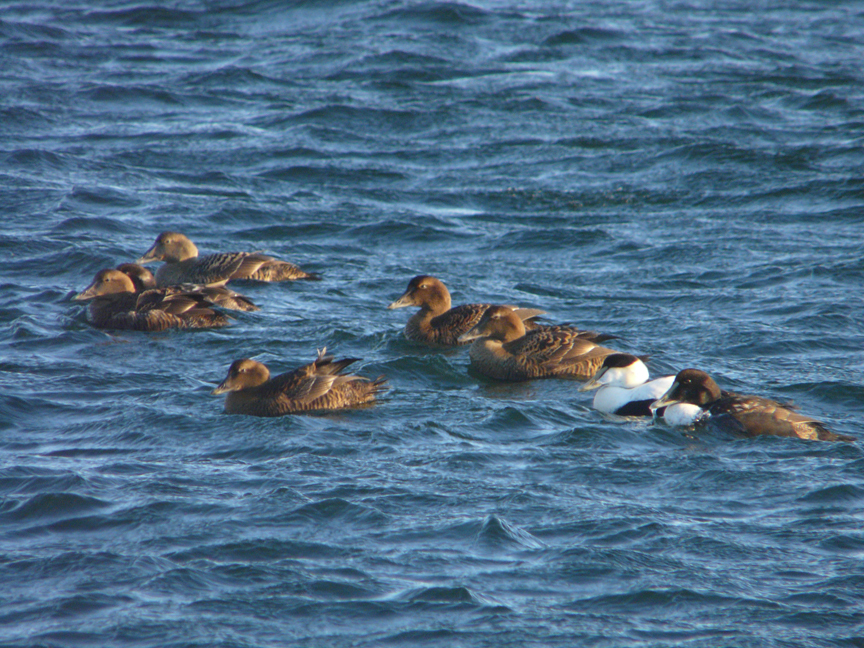 Common eiders. Soon after rising, showering, dressing, making and eating breakfast, and heading downstairs to the office with coffee, I ended up shoveling snow again. The morning beamed with the sort of gloriousness only possible when bright sun meets fresh snow. While on the deck tossing shovelfuls off into the brisk north wind, I heard the clear, unabashed, unmitigated song of a house finch coming from the bare limbs of the big overhanging oak above me. I dropped the shovel and ducked in for my camera. It took me a good three or four minutes of tipping my head to find the bird—which sat in one of the tree’s highest branches, giving forth lusciously cascading warbles of sound. Too obstructed by twigs for a decent photo, though, alas.
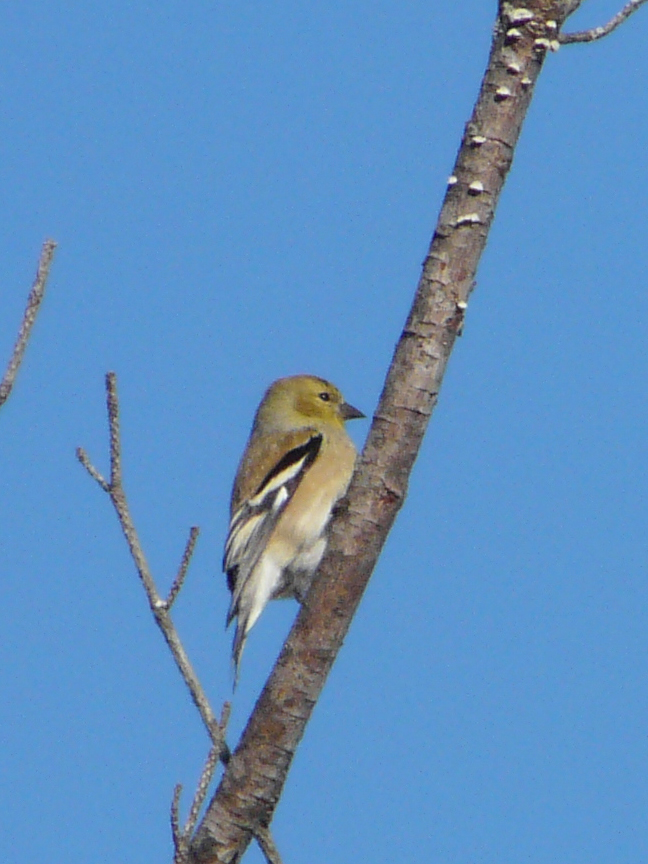 American goldfinch (♀). From somewhere up the hill, meantime, came the chip of a northern cardinal. While scanning for the cardinal, I caught sight of a small bird flitting into the crown of the sickly pine at the property line. A goldfinch. And while all this was going on, I heard the ever-present voices of American crows.
The bright sun crossed the sky slightly higher than it did yesterday, and snow melted, and icicles formed. By mid-afternoon, I had a hankering to move and thought first of the breakwater. It had to be close to high tide. My friend Kristen joined me again, and en route we wondered about the wind. Would it counteract the seeming warmth of the afternoon? I was beginning to think not—until I saw the chop in the harbor. So instead we wondered if the torturous headwind would afflict us outbound or returning. Heading out, we hoped; alas, it was returning.
It seems most of the sensible ocean birds stuck to the protected coves, the shelter of the lee. But a few braved the bare, raw waves: a good-sized raft of eiders, several loons (as usual), a great cormorant, a male long-tailed duck. A couple herring gulls floated alongside the ducks, and one ring-billed flew the length of the breakwater—up and back, up and back—I suppose looking for something edible.
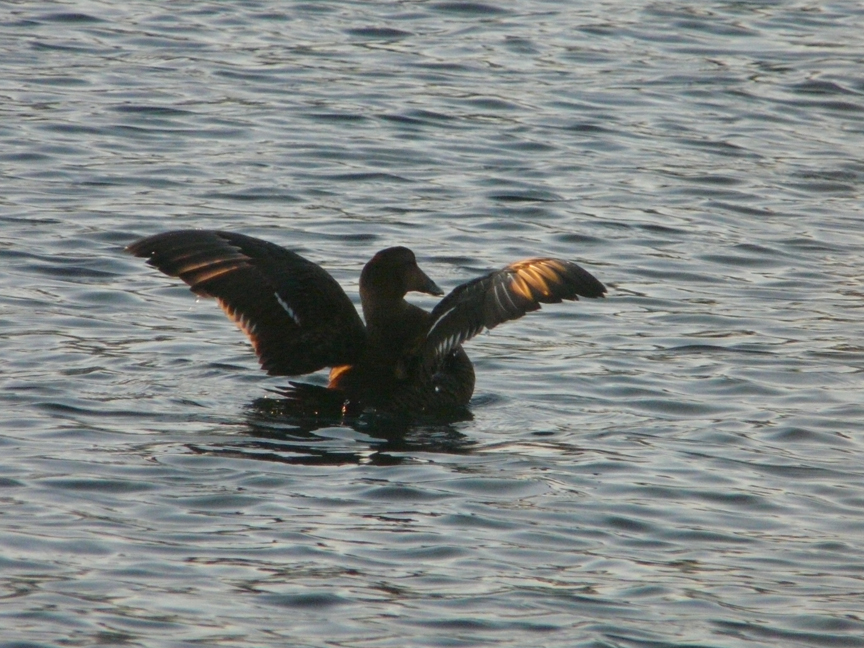 Common eider (♀). The way out was nice: bright, mild enough, and with snow enough that you had to make a point to avoid the hidden cracks between the granite blocks. Heading back, temperatures in the 20s (F) combined with a stout northwest wind to cause an ice-like pain right in the middle of my forehead. Surf splashed over the stones from the shoreside. Out on Vinalhaven, the great turbines, too, turned their faces into the wind. But it let up some about half-way back. A female eider floated calmly to the left of us. To our right, in the little cove, goldeneyes dove and mergansers sailed as the sun headed for the horizon.
When my father was a toddler, his family conspired to have him sit on the lap of one Charles Goodnight, a famous rancher known as “the father of the Texas Panhandle.” Goodnight was by then an elderly cowman—he was born in 1836—and late in his own life I recall my dad marveling at how between the two of them they’d witnessed upwards of 170 years.
I thought of Dad and Mr. Goodnight this week when I read the news of “Herbie,” an American Elm in Yarmouth, Maine, that finally died of Dutch Elm Disease and was cut down on 20 January. After counts and recounts of its rings, arborists finally judged the enormous tree to be 217 years old. When it was but a sapling, George Washington was president. Perhaps another ancient elm in its vicinity back then had lived to a similar age—it would’ve been around before New England was even a glimmer in any European’s eye.
I figure the older you get, the more you consider time. You consider the swiftness of its arc, the brevity of a day, the lifespans of mayflies, the breadth of an ice age. Today, returning against the wind in Rockland Harbor, time seemed long and lazy; tonight already I’m lamenting the loss of this day, 04 February 2010.
Today’s List
House finch
Northern cardinal
American goldfinch
American crow
Herring gull
Common loon
Common eider
Great cormorant
Ring-billed gull
Long-tailed duck
Common goldeneye
Red-breasted merganser
 Rockport Harbor (from the Rockland Breakwater).
Tags: American crow, American goldfinch, common eider, common goldeneye, common loon, great cormorant, herring gull, house finch, long-tailed duck, northern cardinal, red-breasted merganser, ring-billed gull
Posted in Lists, Observations | No Comments »
Wednesday, February 3rd, 2010
 Oak grove, Beech Hill Rumor had it snow might fall—a sixty percent chance is what I’d heard. And my first glance out the window confirmed it: nearly three inches had fallen by dawn. Light, angel snow. After getting dressed, instead of shoveling, I swept it easily away with with a broom. The temperature started at about 20 degrees (F) and rose to near 30 by nightfall. While sweeping snow, I heard the faint cheeps of chickadees, the sudden song of a house finch across the road, and the and chatty, varied voices of crows.
 American crow, Glen Cove. The snow continued, light and steady, all day, and I didn’t see or hear another bird. Much of the day I worked indoors—but I did take a drive to town without noticing even a herring gull in the lowery sky. True, the roads were slippery and traffic was slow and I might’ve been distracted.
When I surveyed Clam Cove at high tide, all I saw was an even watery gray.
It was just about 4 p.m. when I pulled into the Beech Hill parking lot. I had to get out in it, so I pulled on snowshoes and headed into the woods. Close to six inches had fallen by then, and mine were the first tracks on the trail. It was still snowing. Not very cold, little wind. Gentle snow, tiny kisses on my cheeks. I’d forgotten my gloves but didn’t need them.
 Angel snow. Aside from the sound of my snowshoes and the distant fog whistle, the woods were silent. No movement but the settling flakes and an occasional fall of snow from a branch of a tree. Somewhere were chickadees, creepers, woodpeckers, turkeys, owls. Somewhere were deer and foxes, rabbits and squirrels. Maybe bobcats—which have been seen (and photographed) on the hill. But the only evidence my senses could detect were tracks in the snow. They weren’t fresh. Deer had crossed the trail a few times, I could tell, but not since at least morning. All the many varied tracks had inches of fresh snow in them. It made them hard to identify.
A few channels crisscrossing the trail toward the top of the hill I attributed to rabbits. At some point a wild animal had come from uphill and turned into the trail itself, followed it for a good hundred yards, then turned off into the woods again. The tracks were soft, snow-filled, rounded, vague. Judging by their separation and the apparent gait of the critter, I’d guess fox. Or maybe bobcat.
I was sort of hoping for an owl. Maybe a barred owl awakening early. Instead, I saw no birds, I heard no animals at all. They were there, I know—just out of reach of my senses.
Today’s List
Black-capped chickadee
House finch
American crow
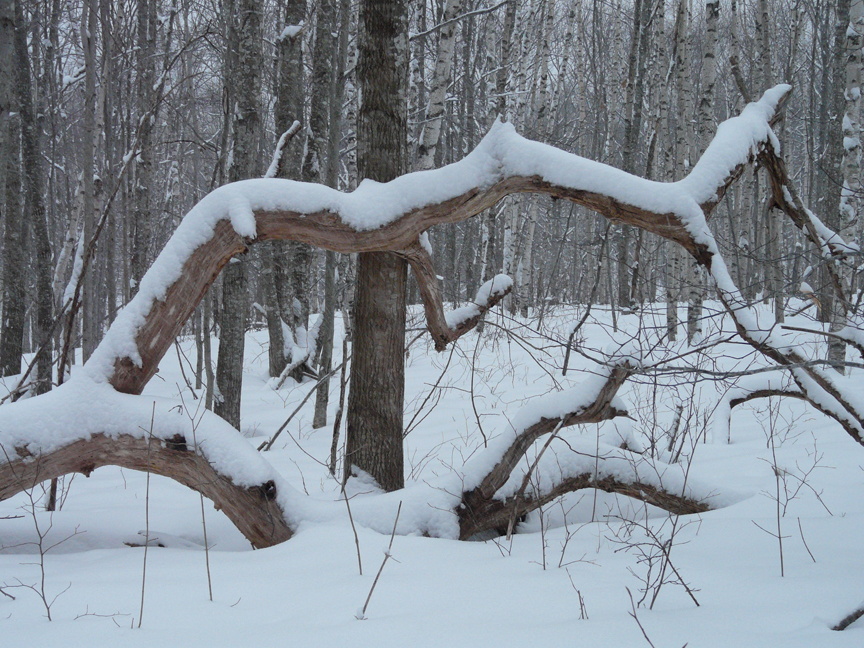 Deadfall where I've seen magnolia warblers in spring.
Tags: American crow, black-capped chickadee, house finch
Posted in Lists, Observations | No Comments »
|
|
| |
| Bird Report is a (sometimes intermittent) record of the birds I encounter while hiking, see while driving, or spy outside my window. —Brian Willson |
|
|


